


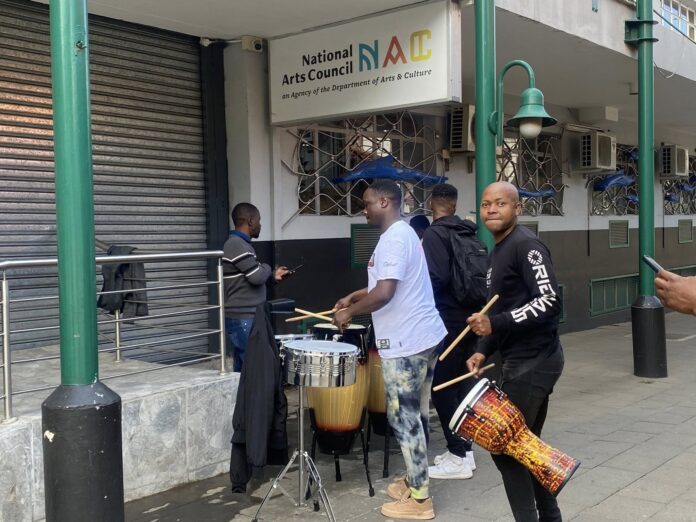
South Africa’s creative sector is facing a major funding crisis, with the National Arts Council (NAC) revealing that it is able to fund only about 4% of the applications it receives.
The staggering funding gap was laid bare by HRH Princess Celenhle Dlamini, Deputy Chairperson of the NAC, at the Creative Cnergy Policy & Investment Symposium.
Dlamini said the NAC receives funding applications worth more than R1 billion per call, while its available budget can range between R150 million and R270 million.
“We are only probably able to fund about 4% of the applications that we actually receive,” she said.
The revelation provides a sobering picture of the financial pressure facing artists and creative organisations trying to turn their work into sustainable careers.
Dlamini explained that the NAC is a government agency operating under the Department of Sport, Arts and Culture and is the largest funding agency for the creative sector under the department.
The council supports about 70% of arts disciplines, including music, dance, literature, visual arts, theatre, craft and multidisciplinary projects. It also provides local and international bursaries for students pursuing arts-related qualifications. But the demand for funding is far greater than the money available.
Dlamini said that while applications received per funding call can exceed R1 billion, the council may have only R150 million to R270 million to distribute. The result is that thousands of applicants can walk away without funding even when their projects may have merit.
Importantly, Dlamini said rejection should not automatically be interpreted as a sign that an application was bad. She explained that applications can be unsuccessful for three broad reasons, compliance, merit and insufficient budget.
This means that some artists are effectively competing for funding in a system where there is simply not enough money to support all qualifying projects.
ALSO READ: NAC under fire: Artists stage sit-in, until all funding results are released
The NAC’s own 2026 funding results illustrate the pressure. For the Craft, Dance, Literature and Visual Arts disciplines alone, 1 389 applications represented funding requests of more than R387 million, while R13.17 million was available for allocation, equivalent to 3.4% of the amount requested.
Talent is not enough
For Dlamini, however, the problem extends beyond getting money into artists’ hands. She said young creatives need to develop the business skills required to survive once they enter the industry.
“We are very much interested in making sure that you actually get some form of mentorship, you know, as a young artist coming into the industry.”
She said many young artists enter the industry with exceptional talent but lack knowledge about contracts, finances and reporting requirements.
“They don’t know how to structure agreements, they don’t know how to do their finances, they don’t know how to report,” she said.
The NAC therefore wants to strengthen capacity building and mentorship, although Dlamini acknowledged that even these interventions are constrained by limited funding.
The council runs capacity-building workshops that cover areas including how to apply for funding and how to report on grants.
One agency cannot do it all
The Deputy Chairperson of the National Youth Development Agency (NYDA), Bonga Makhanya, echoed the need for greater collaboration between institutions supporting young creatives. The solution, according to the discussion, cannot be for artists to approach one government agency and expect it to finance an entire project.
Dlamini encouraged artists to look at co-financing opportunities, including approaching the NYDA after receiving NAC support. She also called for greater engagement with the private sector, including banks, to explore blended finance models.
Using an example of an artist requiring R200 000, Dlamini said an artist could potentially combine support from different institutions rather than depending on one funder. That approach could become increasingly important as public funding remains under pressure.
The NAC itself advises applicants that, because of budgetary constraints, it may not be able to fund an entire project budget and encourages applicants to seek additional funding from other sources.
ALSO READ: ‘Arts body CCIFSA was born to serve political agenda, not artists’ – UKZN Director
Dlamini said government agencies should also recognise their developmental role. While established artists and organisations can benefit from government support, she argued that the NAC’s primary responsibility from a development perspective should include nurturing emerging talent.
The idea is to “de-risk” young creatives by providing early-stage funding that can help them get projects off the ground. But even when the NAC cannot provide the full amount requested, Dlamini said receiving partial funding can give an artist a foundation from which to approach other funders.
“If you come to us and you’re saying, I need, let’s say, R800,000, we more than likely will probably give you R500,000,” she said. “But it’s something. It’s better than nothing.”
That philosophy places greater responsibility on artists to build funding partnerships around their projects. It also puts pressure on other government agencies and the private sector to develop funding products that complement grants rather than operate in isolation.
The broader message from Creative Cnergy was that South Africa cannot build a sustainable creative economy by focusing only on artistic talent. Artists also need business knowledge, financial management skills, access to markets, mentorship and multiple avenues of finance.
For young creatives, particularly those entering the industry without established networks, the gap between having a good idea and being able to finance it can be enormous. Makhanya’s involvement in the discussion reinforced the importance of connecting youth-development support with arts funding.
The potential solution lies in creating a funding ecosystem in which institutions such as the NAC and NYDA work alongside private companies, banks and other investors.
- The National Arts Council (NAC) in South Africa funds only about 4% of the applications it receives due to limited budgets ranging from R150 million to R270 million, despite funding requests exceeding R1 billion.
- The NAC supports around 70% of arts disciplines and provides bursaries for arts-related students but faces a funding demand far greater than available resources.
- Applications are often rejected not just for merit but also due to compliance issues or insufficient budget, meaning many qualified projects do not receive funding.
- The NAC emphasizes the need for young creatives to develop business skills and mentorship to sustain careers and plans to strengthen capacity-building programs despite funding constraints.
- Collaboration between government agencies like the NAC and National Youth Development Agency, private sector partnerships, and co-financing models are encouraged to create a sustainable funding ecosystem for artists.


