


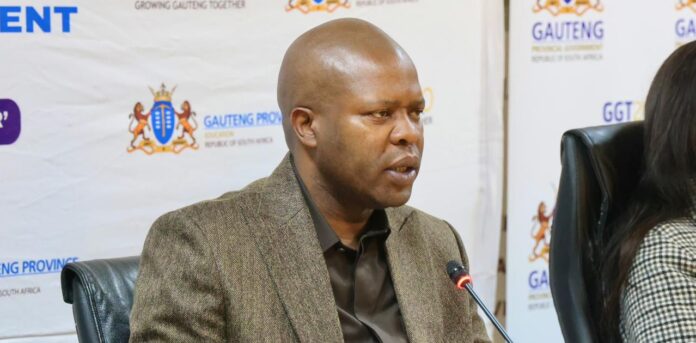
Gauteng education MEC Lebo Maile says his department’s priority would be to drive a seamless education and crack down on corruption that is perpetrated by some teachers and principals, who dip their fingers into school finances.
Maile said this during a press briefing on the tabling of the budget vote at the legislature on Tuesday.
He said his portfolio aimed to offer a preview of key interventions to strengthen public education in the province.
Maile, who is also the MEC of sports, arts and culture in the province, said that the 2026/2027 budget vote aims at outlining priorities, commitments and strategic interventions that would make the education system run smoothly.
‘It takes a village to raise a child’
“This year’s budget vote is tabled under the theme, ‘it takes a village to raise a child’. This is a theme that reflects our firm belief that education is not the responsibility of government alone but a collective societal duty. We continue to hold the view that parents, communities, civil society, labour, business and all sectors of society must play an active role in shaping the future of our children,” said Maile.
He said that his department remains responsible for one of the largest education systems in the country.
“Gauteng currently serves more that 2.86 million learners across 3 320 schools, with over 2.82-million learners enrolled in ordinary schools and 46 421 learners in special schools. Of these, over 2.43-million learners are in public schools.
“These numbers reflect both the scale of our constitutional responsibility and growing pressure on our education system. We continue to face enormous challenges arising from rapid immigration, urbanisation, overcrowding, infrastructure backlogs and growing learner demand, particularly in townships, informal settlements and inner-city schools. These pressures require us to think differently about education delivery, infrastructure planning and long-term sustainability,” said Maile.
Budget increased by R2.9bn
He said that for the department to respond to challenges faced, the budget would be increased from R68-billion in 2025/2026 to R70.9-billion in 2026/2027.
“The increase allows us to strengthen key interventions while keeping our focus on quality, access and equity. Our budget priorities for this financial year are anchored in focused strategic pillars. We continue to strengthen early childhood development as the foundation of education success. The department allocates R994-million towards expanding access to Grade R, improving child readiness and ensuring that no learner enters formal schooling without the necessary foundational support. We recognise that the battle for educational success begins long before Grade 1.
“We intensify interventions aimed at improving learner outcomes across all schooling phases. To this end, we allocate R1.2-billion towards improving performance in critical areas such as mathematics, science, technology, reading development and technical education. The department continues to implement focused interventions to improve literacy, numeracy and subject performance, particularly in gateway subjects,” said Maile.
Modernisation of the education landscape
He said that the department continues with the modernisation of the education landscape to address overcrowding and infrastructure backlogs.
“The department allocates R2.7 billion towards infrastructure investment and a broader school reorganization, district support, principal development and the expansion of schools of specialisattion. These interventions remain critical in changing the physical and structural conditions under which teaching and learning take place. We are fully aware that infrastructure remains one of the biggest constraints facing public education in Gauteng. While these allocations will not resolve all historical backlogs immediately, they represent an important step towards easing overcrowding and improving learning conditions in some of our most affected communities,” said Maile.
The department’s budget vote also focuses on learner wellness, psychosocial support, anti-drug programmes, school health intervention, sports, arts and cultural development, where R3.3 billion will be allocated.
“We understand that learning cannot thrive where violence, bullying, trauma, gangsterism and substance abuse are left unattended. Sa schools remain non-negotiable,” he said.
- Gauteng Education MEC Lebo Maile prioritizes seamless education delivery and combating corruption by teachers and principals in school finances.
- The 2026/2027 budget, increased by R2.9 billion to R70.9 billion, aims to improve quality, access, and equity across the province’s large education system serving over 2.86 million learners.
- Strategic budget allocations include R994 million for early childhood development and R1.2 billion for enhancing learner outcomes in key subjects like math, science, and reading.
- Infrastructure modernization is supported with R2.7 billion to tackle overcrowding, backlogs, and school expansions including special schools and principal development.
- R3.3 billion is dedicated to learner wellness programs addressing violence, bullying, drug abuse, and promoting sports, arts, culture, and psychosocial support.


