


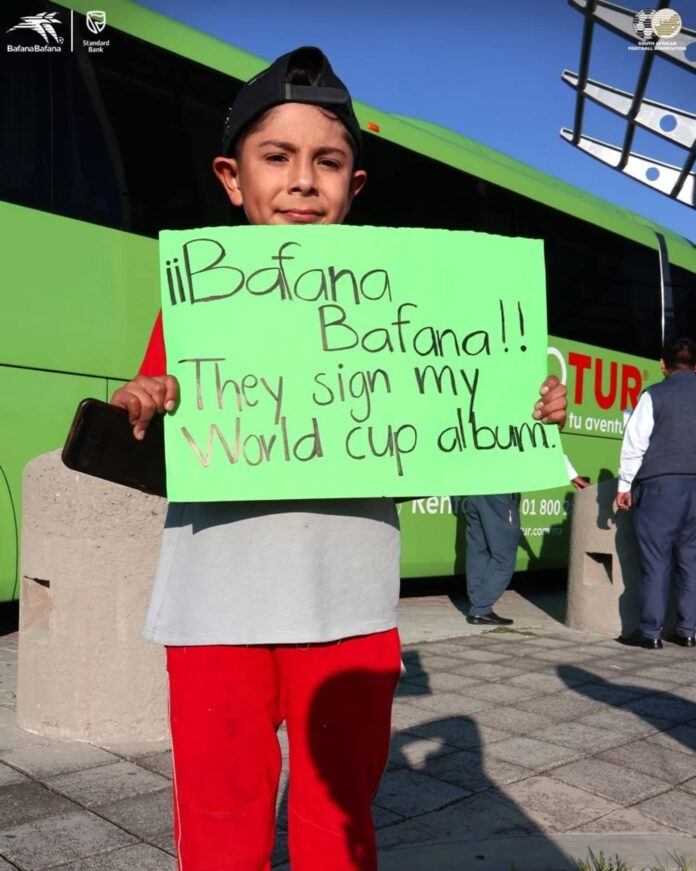
Pachuca, a small city located in the south-central part of Mexico, is the city that coach Hugo Broos chose as the base camp for Bafana Bafana’s final preparations for the 2026 Fifa World Cup which will be co-hosted by the USA, Canada and Mexico. It is located about 90Km north of Mexico City.
Having been a resident of the city for a mere two days, on assignment to cover the SA football national team at the World Cup, one cannot help but notice that Pachuca is one of those towns that seem to be constantly or permanently undergoing construction or repairs.
When you look at the buildings and the general infrastructure, such as roads, electrical energy, and shops, you get the feeling that the work has been going on for decades – and that it is not going to stop anytime soon.
Even if you come back after 10 years, it seems like you are still going to find bits of work there and some form of configuration going on intermittently. While new modern buildings are mushrooming, they are plonked right in the middle of the older structures, whether it be houses, cafés or even decaying hotels. This has formed a rather sharp contrast and a potpourri of first-world and third-world in one mix. Pachuca has surely maintained most of its colonial-era structures.
It is a far cry from Mexico City, the capital, which is associated with a lot of hustle and bustle. Pachuca is a rather sleepy town, more like Polokwane, where there’s lots of hype but nothing much is happening.
Now, we understand clearly why Broos chose a place that is surrounded by mountains over the capital city. Here, disturbances must be few and far in between, and it would take a major effort to confuse and distract the boys from the big task of facing Mexico in the opening match at the seething Azteca Stadium on Thursday.
Like smooth cheese, the favelas, or the barrios, are evenly spread on the foot of the mountains on the edges and outskirts of the town. Those are the red zones, the no-go areas for tourists and meek individuals. According to the locals, the places are so crime-ridden, you have more chance of being mugged than catching a bout of flu.
When it comes to aesthetics, Pachuca’s clutter of electric cables hanging from the lamp posts, as if Spiderman visited the place recently, gives the town a feel of being sloppy and a sense of scanty town planning.
Another glaring mishap is the language barrier; the locals have taken a stance that it does not mean one is not intelligent if they cannot speak English. Unlike in the capital, most locals here are not well-versed with English, and they do not seem to be bothered about it. A small inquiry about something as trivial as a price can turn into something as difficult as a lecture on aerospace engineering.
The nice thing about small towns is that they are orderly and safe. As I took a breathtaking, lung-busting 10km run in the streets of Pachuca, there was an air of safety and security throughout the stretch. None of the big cities’ unsettling and unsafe ambiance and bullshit. And with El Chapo locked up in a US prison, I can categorically confirm that there are no cartels in Pachuca.
But the food is out of this world and scrumptious. The tacos and the barbacoa are to die for, with lip-smacking aroma from the stalls and makeshift kiosks on just about every corner in town. Now it makes sense why a significant number of the natives are a bit significant in the mid-section area and also on the chubby side – I blame the yummy nachos and the burritos.
Now, with Bafana’s first match in a couple of days, we are hoping the team chef kept the boys far away from the nachos and the tacos.
Interesting tidbits about Pachuca:
- It has a population of 300 000 people
- The town is famous for mining green obsidian
- Pachuca de Soto in honor of Congressman Manuel Fernando Soto, who is credited with the founding of the Hidalgo state.
- They have a professional football club, CF Pachuca that competes in the top division of Mexican football and plays its home matches at Hildago Stadium.
- In Pachuca, just like in South Africa, they use the minibus taxi system. They have kombis similar to the Toyota Quantum and Inyathi.
- Bafana Bafana's coach Hugo Broos chose Pachuca, Mexico, as the base camp for 2026 FIFA World Cup preparations due to its quiet, distraction-free environment surrounded by mountains.
- Pachuca is a small, somewhat underdeveloped city with ongoing construction, a mix of colonial-era and modern buildings, and infrastructure issues like cluttered electric cables and poor town planning.
- The city has crime-prone areas called favelas on its outskirts, but the central areas are considered safe and orderly, with no cartel presence.
- Most locals in Pachuca do not speak English and are indifferent to the language barrier, contrasting with Mexico City.
- Pachuca is known for its delicious local food, especially tacos and barbacoa, and has a population of about 300,000, with a local professional football club, CF Pachuca.


