


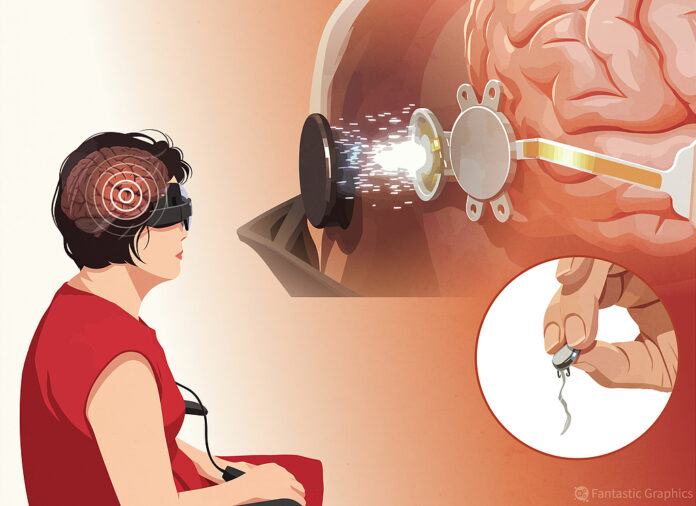
China’s self-developed Intelligent Micro Implant Eye epiretinal prosthesis system has achieved a major milestone in a clinical trial, enabling the country’s first completely blind patient to recognise basic Chinese characters and navigate indoors independently after surgery.
Led by Professor Xu Huizhuo’s team at Xiangya Hospital at Central South University, the trial marks a significant step forward for invasive brain-computer interface (BCI) technology in restoring vision. The patient, who lost her sight due to retinitis pigmentosa, received the implant in April and has since shown notable improvements after rehabilitation training.
The system consists of an active intraocular implant and an external imaging device. A customised pair of glasses equipped with a high-definition camera captures visual information, which is processed and transmitted wirelessly to the implant. A 256-channel flexible electrode array then delivers electrical stimulation to healthy ganglion cells in the macular region, allowing signals to travel through the optic nerve to the visual cortex, where artificial vision is generated.
Researchers noted that artificial vision differs from natural sight and requires extensive training for the brain to adapt to new visual signals. After a period of rehabilitation training, the patient can identify symbols on an eye chart and move around indoors without assistance. Further improvements in object recognition and daily living skills are expected with continued training over the coming months.
The breakthrough fills a gap in China’s domestically developed artificial retina technology and offers new hope for millions of people suffering from vision loss caused by degenerative retinal diseases.
What is BCI?
A BCI is a technology that establishes a direct communication pathway between the brain and external devices. Under normal circumstances, the brain interacts with the world through “biological interfaces” such as the eyes, ears and limbs. A BCI can bypass damaged biological interfaces and create an alternative route for information exchange between the brain and the world.
For patients disabled by stroke, spinal cord injury or amyotrophic lateral sclerosis, BCI can decode neural signals associated with movement intentions and translate them into commands for computers, robotic arms, exoskeletons or other assistive devices. Similarly, BCI may help restore lost sensory functions by converting sound or visual information into electrical signals that the brain can interpret.
Different approaches
BCIs are generally divided into three categories based on how electrodes interact with the brain: non-invasive, invasive and semi-invasive systems.
Non-invasive BCIs use sensors placed on the scalp to record brain activity. They are safe, affordable and easy to deploy but offer relatively low signal quality, limiting their ability to support precise control.
Invasive BCIs involve surgically implanting electrodes directly into the cerebral cortex. The approach provides the highest-resolution neural signals and can support complex tasks such as robotic arm control or neural typing. However, it also carries surgical risks and long-term stability challenges.
Semi-invasive BCIs represent a compromise between the two. Electrodes are implanted inside the skull but do not penetrate brain tissue, reducing surgical risks while providing stronger signals than non-invasive systems.
The three technological approaches are expected to coexist and complement one another, serving different medical needs, according to Yu Shan, a researcher at the Chinese Academy of Sciences.
As a frontier technology in human-machine interaction, BCI has become a strategic emerging industry in China. The technology was included for the first time in this year’s government work report as one of the country’s future industries. Hospitals and research institutions across the country have established dedicated BCI clinics and research programs, while domestically developed BCI products are being used in disease diagnosis, neurological rehabilitation, safety monitoring and the treatment of conditions such as Parkinson’s disease and epilepsy.
- China’s self-developed Intelligent Micro Implant Eye epiretinal prosthesis enabled its first completely blind patient to recognize basic Chinese characters and navigate indoors independently after surgery and rehabilitation.
- The system uses an intraocular implant and external glasses with a high-definition camera to capture and wirelessly transmit visual information to a 256-channel flexible electrode array stimulating healthy retinal cells to generate artificial vision.
- Artificial vision differs from natural sight and requires extensive brain training; after rehab, the patient can identify symbols on an eye charts and move indoors unassisted, with further improvements expected.
- This breakthrough fills a gap in China’s domestic artificial retina technology, offering hope for millions with vision loss from degenerative retinal diseases like retinitis pigmentosa.
- Brain-computer interface (BCI) technology, including invasive, semi-invasive, and non-invasive approaches, is advancing rapidly in China as a strategic industry with applications in vision restoration, neurological rehabilitation, and disease treatment.


