


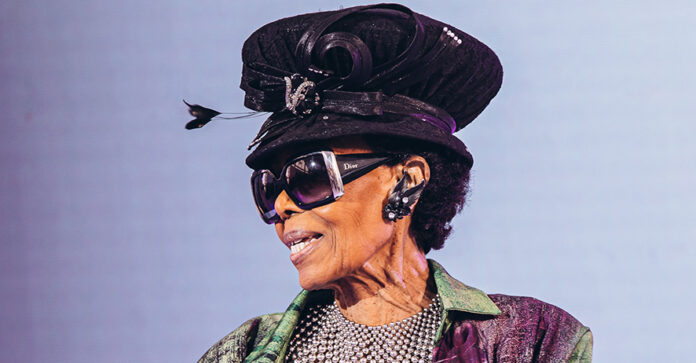
Abigail Kubeka’s singing talent began shining during assemblies at the former Methodist-run Kilnerton boarding school in Pretoria, where some of South Africa’s luminaries received their education.
Her teen years spent in the cultural hotpot that was Sophiatown also influenced her identity as a performer.
Kubeka’s name features among some of the country’s favourite artists from the Sophiatown era. She has shared stages with the likes of Thandi Klaasen, Hugh Masekela, Dorothy Masuka, Jonas Gwangwa, Dolly Rathebe and Mirriam Makeba.
In fact, the story goes that it was Makeba who recognised Kubeka’s talent before inviting her to join the Skylarks Ensemble in 1957.
In 2026, the Orlando East girl with the golden voice is receiving recognition for a life well lived and a colourful career to match. Last weekend, Standard Bank Joy of Jazz honoured Kubeka, a fitting tribute to a woman whose extraordinary career has helped shape the country’s music and performing arts landscape. The accolades are far from over. She will be honoured again at the jazz festival this month.
Sitting across from the veteran singer, actress and performer in her home, one quickly realises that “legend” is not simply a description attached to her name. It is a life lived. At more than eight decades young, she has no plans of slowing down.
Kubheka’s career has unfolded against some of the most difficult chapters in South African history. When she joined the Skylarks, she entered an entertainment industry shaped by apartheid, restrictive laws and a system that often refused to recognise black artists as professionals.
Rather than allowing the circumstances to break her, she believes they revealed the strength of the people who endured them.
“We are an amazing nation – our strength is … I think we are not aware of that,” she says.
“God has just given us everything. He hasn’t given us weapons but usinike iweapon yethu. It is strength, and that’s the greatest weapon you can have because with strength you create magic.”
Kubeka’s career has also spanned theatre, film and television. Her recurring role as Zondiwe in the soapie Generations has endeared her to younger fans. Yet when she reflects on her journey, she acknowledges that she did not walk alone.
For Kubheka, some of the greatest gifts of her career were the artists who mentored her and helped shape the performer she would become, many of whom are no longer alive.
“I learnt a lot from them and I’m so grateful to them. They brought me up, in fact,” she says.
“I can proudly stand on top of the roof and say they brought me up. And I was a very good student because I picked up a lot of things from them.”
As the country marks 70 years after the historic 1956 Women’s March to the Union Buildings, for Kubheka, the women left a lesson that remains relevant today: women must stand together and recognise the power they possess collectively.
Her journey in showbiz mirrored that philosophy almost in a prophetic way. When she first came on the scene, she worked with artists she once admired as a young performer. Later she watched younger generations enter the industry she helped build. The cycle is something she treasures.
For Kubheka, mentorship has never been about holding on to the spotlight. It is about making room for the next person.
Perhaps one of the most striking things about Kubheka, who always makes sure she is immaculately dressed and well put together, is her attitude towards ageing. While society often tells people that reaching a certain age means slowing down or stepping aside, she sees things differently.
Her story is not finished. There are new experiences that need to unfold, people to meet and memories to make. Her attitude is a powerful reminder that ageing does not have to mean becoming invisible.
Kubheka sits comfortably in the knowledge that she has lived a full life while remaining curious about what comes next.
The flowers might have arrived late but she is smelling every bouquet.
“I’m smelling them every time,” she says.
And if her remarkable career is anything to go by, Mam’ Abigail is not done blooming yet.
- Abigail Kubeka’s singing career began during her school assemblies at Kilnerton boarding school and was influenced by her teen years in Sophiatown.
- She was invited by Miriam Makeba to join the Skylarks Ensemble in 1957, marking the start of her professional music career.
- Kubeka has performed with prominent artists such as Thandi Klaasen, Hugh Masekela, Dorothy Masuka, Jonas Gwangwa, Dolly Rathebe, and Miriam Makeba.
- In 2026, she was honoured by Standard Bank Joy of Jazz and is set to be recognised again at the jazz festival later that month.
- Kubeka’s career has spanned music, theatre, film, and television, and she remains actively engaged in mentoring younger artists while embracing ageing with optimism.


