



For years, smokers have been given one seemingly simple instruction – just quit. But for many people trying to break free from cigarettes, the reality is far more complicated.
Stress, anxiety, depression, social environments, routines and nicotine dependence can all play a role in why people start smoking, and why walking away from the habit can be so difficult.
READ: Vaping carries the same health risks as smoking tobacco
Insights from THR Global’s #WeAreTheEvidence campaign highlight just how complicated the journey can be.
According to the organisation, 32.8% of participants who shared their smoking journeys identified stress, anxiety or depression as factors in why they started or continued smoking.
A South African study involving 18,208 adults found that 74.6% of current combustible-cigarette smokers had previously attempted to quit. However, only 42.8% of those who had tried to stop had ever used a smoking-cessation aid.
The findings point to a bigger challenge facing smoking cessation: wanting to quit does not necessarily mean being able to quit successfully. And for THR Global, that gap between intention and success is worth examining.
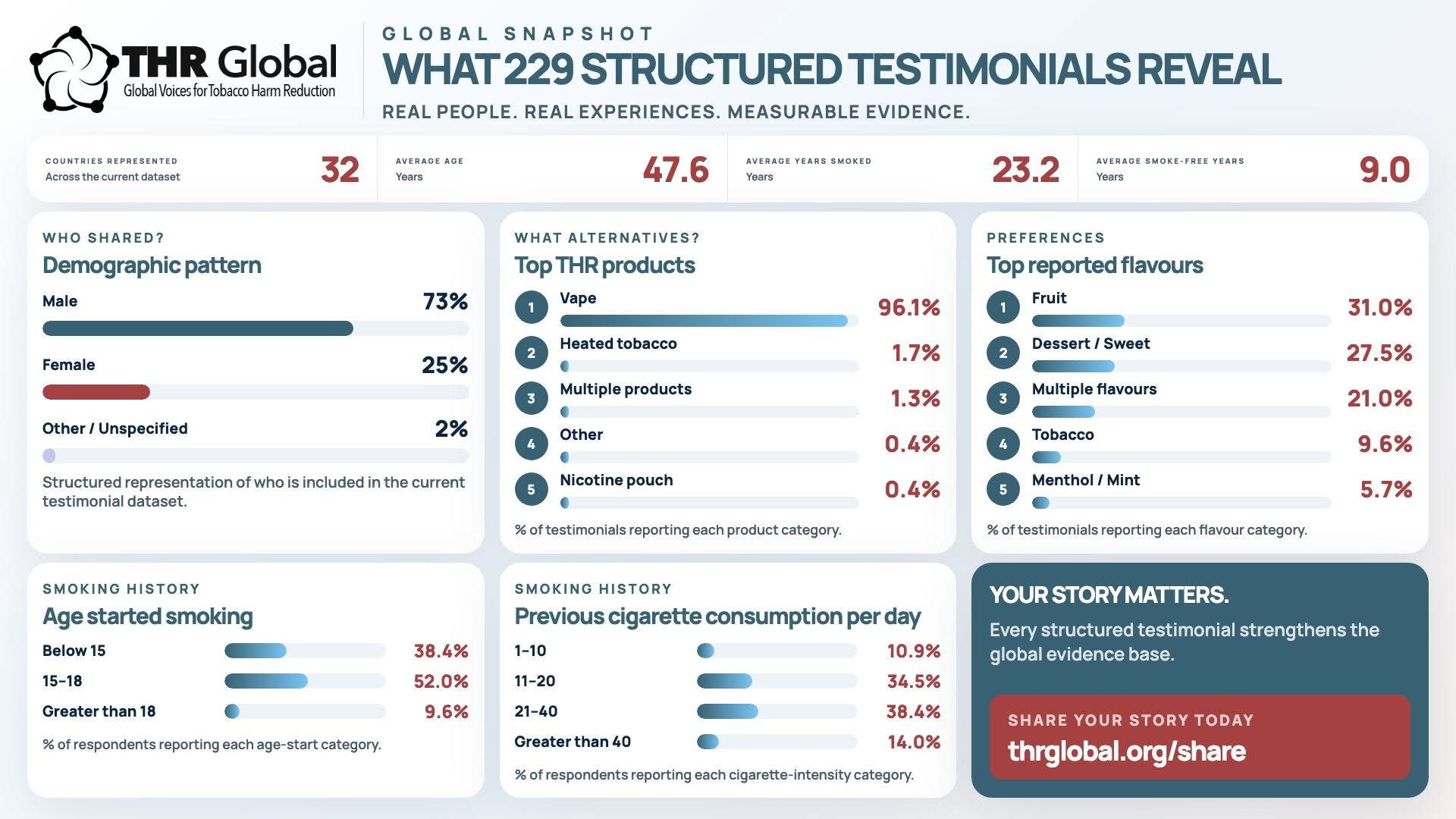
Through its #WeAreTheEvidence campaign, the organisation has collected more than 220 first-hand accounts from smokers and former smokers, documenting why they smoked, what made quitting difficult and the approaches they used when trying to move away from cigarettes.
No universal quitting mechanism
The stories suggest there is no universal quitting experience.
Ndaphi’s smoking journey, for example, began in high school, influenced by his peers.
What started as experimentation eventually became a habit that lasted 16 years. Over time, he says he became increasingly aware of the financial and personal consequences of smoking, including the impact it had on people close to him. His eventual move away from cigarettes involved harm-reduction alternatives.
Laksha’s experience was different. Nicotine pouches did not work for her because they did not replicate the hand-to-mouth behaviour she had associated with smoking. Her story also forced her to confront an unexpected consequence of the habit.
During her interview, she realised that smoking had affected one of her friendships, with time spent together frequently interrupted by the need to step away for smoke breaks.
Their experiences demonstrate how deeply smoking can become embedded in routines, relationships and everyday behaviour.
Not merely a question of willpower
THR Global argues that smoking cessation should not be reduced to a question of willpower. The organisation’s testimonial archive shows people navigating different combinations of dependence, stress, social pressure, habits and personal circumstances.
READ: British American Tobacco expects drop in cigarettes production
Among THR Global’s first 210 formal testimonials, 95.7% reported using vaping as part of their journey away from cigarettes. These are self-reported experiences, and, as THR Global acknowledges, they should not be treated as a replacement for clinical evidence.
But they provide another layer to the conversation – the perspective of people who have actually lived through smoking and attempted to quit. Clinical research is also continuing to examine the potential role of harm-reduction approaches.
A Cochrane review of electronic cigarettes for smoking cessation found high-certainty evidence that nicotine-containing e-cigarettes increased quit rates compared with nicotine-replacement therapy.
A separate review published in Addiction in 2026 similarly found that estimates across multiple systematic reviews consistently favoured nicotine-containing e-cigarettes over a number of interventions, including nicotine-replacement therapy and non-nicotine e-cigarettes.
Psychological wellbeing
The relationship between smoking and mental wellbeing is another important part of the discussion. While some smokers describe cigarettes as a way of coping with stress or difficult emotions, research suggests that stopping smoking may actually be associated with improvements in psychological wellbeing.
A systematic review and meta-analysis published in the British Medical Journal found that smoking cessation was associated with improvements in anxiety, depression, stress, psychological quality of life and positive affect.
That does not mean quitting is easy. Instead, it suggests that smokers may benefit from understanding the relationship between nicotine dependence, mental wellbeing and the coping mechanisms they have developed around smoking.
Listening to smokers
The growing body of research raises an important question: whose voices are included when decisions about tobacco and smoking cessation are made?
For THR Global, smokers and former smokers should have a place in that conversation.
The #WeAreTheEvidence campaign was created to make lived experiences accessible to consumers, researchers, public-health stakeholders, regulators and the media.
As international debate around tobacco harm reduction continues to evolve, its aim is to complement, not replace clinical research by showing what smoking and quitting look like in people’s everyday lives.
And perhaps the most important lesson from the growing collection of personal stories is that there is no one-size-fits-all quitting journey. For some, it may be counselling or medication. For others, nicotine-replacement therapy may help. Some may explore alternative approaches.
- According to THR Global’s #WeAreTheEvidence campaign, 32.8% of participants identified stress, anxiety, or depression as factors in starting or continuing smoking.
- A South African study found 74.6% of current smokers had attempted to quit, but only 42.8% of those had used smoking-cessation aids.
- Among THR Global's first 210 testimonials, 95.7% reported using vaping as part of their journey away from cigarettes.
- Clinical reviews show nicotine-containing e-cigarettes increase quit rates compared to nicotine-replacement therapy.
- A British Medical Journal meta-analysis found smoking cessation is associated with improvements in anxiety, depression, stress, psychological quality of life, and positive affect.


