


Few cars have achieved the legendary status of the Ford Mustang. Since its debut at the 1964 New York World’s Fair, the Mustang has transcended being just another sports car to become a global cultural icon, admired as much for its Hollywood fame as for its unmistakable V8 soundtrack.
Courtesy of Ford Motor Company Africa, I recently spent a week with the seventh-generation Ford Mustang GT to find out whether this 62-year-old American legend still can stir the soul in an era increasingly dominated by electrification.
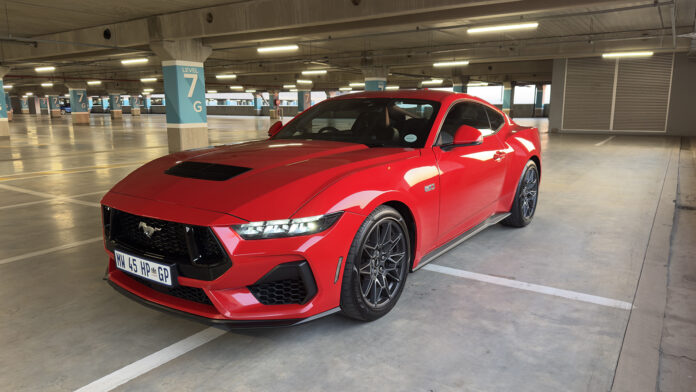
The answer became apparent long before each destination. Finished in striking Race Red metallic paint, my test unit demonstrated how it combines timeless proportions with a sharper, more aggressive design. The long bonnet, muscular rear haunches and signature tri-bar LED lighting ensure there is no mistaking what it is. Despite countless modern performance cars entering the market, the Mustang remains one of those rare vehicles that commands attention before the engine even ignites into life.
The real magic, however, begins with the press of the starter button. Nestled beneath the sculpted bonnet is Ford’s naturally aspirated fourth-generation 5.0-litre Coyote V8, producing 328kW and 540Nm. Mated to a slick-shifting 10-speed automatic transmission, it delivers effortless acceleration while adapting its shift patterns according to the drive mode.
Yet, it isn’t just the performance figures that define the experience. It’s the soundtrack. Every press of the accelerator is rewarded with a deep, thunderous growl that feels increasingly rare in today’s automotive landscape. More than once, enthusiastic revs echoed through city streets loudly enough for startled pedestrians to turn around, while some reactions suggested people momentarily mistook the exhaust crackles for distant gunshots. It is the sort of soundtrack that encourages you to keep driving simply for the joy of hearing it.
The Mustang certainly made an entrance at the Supercar Rhino Run held at Kyalami Grand Prix Circuit in mid-July. Surrounded by exotic machinery worth many millions of rand, the Ford still attracted admiring glances, proving that genuine automotive icons never struggle to hold their own.
Away from organised events, the attention never stopped. Fuel stations became conversation points, traffic lights attracted approving nods and smartphones regularly appeared as passers-by captured photos. During my week with the car, my daughters constantly looked forward to school runs.
Inside, Ford has transformed the Mustang into its most technologically advanced cockpit yet, blending large digital displays with a driver-focused layout that successfully balances modern technology and traditional muscle-car character.
Practicality, though, isn’t really why anyone buys a Mustang. Neither is fuel economy. During enthusiastic driving, consumption climbed as high as 17 litres per 100 kilometres. Anyone concerned about every litre of petrol should probably look elsewhere because ownership of a V8 performance coupé requires accepting that emotional rewards outweigh financial logic.
The Mustang’s appeal stretches far beyond the road. It remains one of cinema’s greatest automotive stars, appearing in classics such as Goldfinger, Bullitt, Grand Prix and Gone in 60 Seconds, where “Eleanor” cemented its place in popular culture.
The seventh-generation Mustang GT continues that legacy with confidence. It was deservedly recognised as a finalist in the 2025 South African Car of the Year competition, while enthusiasts seeking even greater performance can look towards the track-focused Mustang Dark Horse.
Priced from R1.35-million, the Mustang GT competes against the Toyota GR Supra, BMW M2 and the final generation Chevrolet Camaro and Dodge Challenger. It also includes a six-year/90 000km service plan, four-year/120 000km warranty, four-year roadside assistance and a five-year corrosion warranty.
After a week behind the wheel, one thing became abundantly clear: in a rapidly changing automotive world, the Ford Mustang GT remains a car that stirs the soul. Some legends simply never lose their spark.
- The seventh-generation Ford Mustang GT blends timeless design with modern sharpness, featuring a 5.0-litre V8 producing 328kW and 540Nm paired with a 10-speed automatic transmission.
- Its iconic deep V8 exhaust sound remains a rare and thrilling experience in today’s increasingly electrified car market.
- The Mustang commands attention both on the road and at events like the Supercar Rhino Run, proving its status as a global automotive icon.
- Inside, the Mustang offers an advanced digital cockpit with a driver-focused layout, though it prioritizes emotional driving experience over fuel efficiency.
- Priced from R1.35 million, the Mustang GT competes with models like the Toyota GR Supra and BMW M2, continuing its legacy as a soul-stirring performance car in the modern era.


