


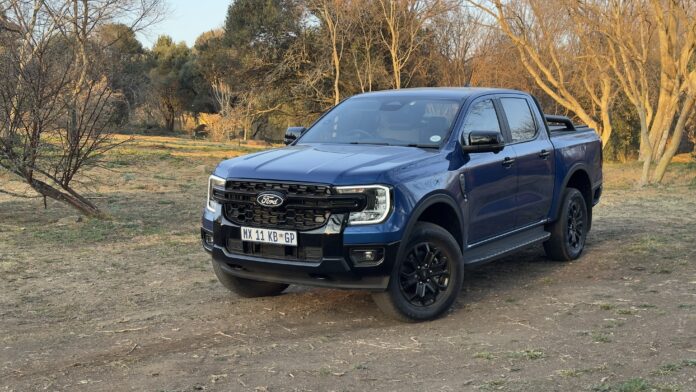
The locally-built Ford Ranger maintained its position as South Africa’s best-selling double-cab bakkie during the first half of 2026, extending a segment-leading run that began in 2023.
According to Lightstone Auto registration data, Ford delivered 10 075 Ranger double-cab models between January and June. Its closest competitors recorded 7 887 and 4 415 registrations respectively during the same period.
Double-cab derivatives accounted for about 80.4% of the 12 522 Rangers registered in the first six months of the year, illustrating the growing importance of lifestyle-oriented models within the traditionally work-focused bakkie market.
The Ranger has led South Africa’s double-cab category every year since 2023. It retained the annual title in 2025 with 20 857 units sold, representing a 3.9% improvement over the previous year.
Comfort, technology and versatility
Ford Motor Company of Southern Africa sales operations director Ryan Searle attributed the sustained demand to the Ranger’s ability to combine traditional bakkie capability with the comfort, technology and versatility expected from modern passenger vehicles.
“The Ford Ranger is equally at home supporting a business, transporting a family or enabling a weekend adventure,” Searle said.
However, the Ranger competes in one of South Africa’s most closely contested vehicle segments, facing established rivals such as the Toyota Hilux, Isuzu D-Max and Volkswagen Amarok, as well as an expanding field of competitively priced challengers like the GWM P-Series and BYD Shark 6.
I tested the Ranger on behalf of Sunday World Motoring at its launch in Oudtshoorn in May and the latest Hilux at its launch in Namibia in June. Over the past two weeks, I also drove the two market leaders back-to-back, together with the closely related Volkswagen Amarok.
Gap narrows between Ranger and Hilux
The comparison demonstrated how narrow the gap between the Ranger and Hilux has become. Both offer impressive capability, comfort and refinement, but one of the clearest differences was in their gearbox operation. The Ranger’s transmission felt smoother and more polished in everyday driving, contributing to a more relaxed experience behind the wheel.
The Amarok, which shares its basic platform with the Ranger, delivered a similarly refined and premium experience but felt heavier on the road than its two market-leading rivals. These impressions may vary depending on various circumstances and specification of each derivative tested.
The updated Isuzu D-Max remains another important contender in the segment, although Sunday World Motoring is still awaiting an opportunity to test it before drawing a broader comparison among the country’s leading double-cab bakkies.
The Ranger is produced at Ford’s Silverton Assembly Plant in Pretoria, which also manufactures the bakkie for several export markets. Ford says the facility was recently ranked as its leading global plant for manufacturing quality.
New Ranger buyers also receive access to the Ford Family Promise, which includes online service booking, mobile servicing as well as vehicle collection and delivery at participating dealerships.
Customers purchasing a new Ranger 4×4 qualify for introductory Ford Adventure Club training, designed to familiarise owners with the vehicle’s four-wheel-drive systems and encourage safer off-road driving.
- The Ford Ranger was South Africa’s best-selling double-cab bakkie in the first half of 2026, with 10,075 units delivered between January and June.
- Double-cab models made up about 80.4% of the 12,522 Rangers registered in the first six months of 2026.
- The Ranger has led the double-cab category annually since 2023, selling 20,857 units in 2025, a 3.9% increase from 2024.
- The Ranger is produced at Ford’s Silverton Assembly Plant in Pretoria, noted as Ford’s leading global plant for manufacturing quality.
- New Ranger 4x4 buyers gain access to the Ford Adventure Club training to improve familiarity with four-wheel-drive systems and promote safer off-road driving.


