


As South Africans grapple with soaring fuel prices, financial services giants WesBank and First National Bank are throwing their weight behind the country’s growing new energy vehicle (EV) ecosystem through support for expanded electric vehicle charging infrastructure.
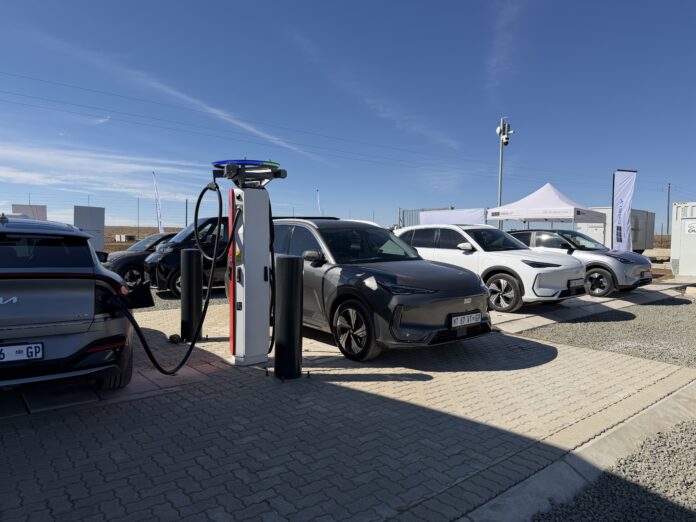
The latest push follows the launch of the second and third off-grid, solar-powered charging stations by Zero Carbon Charge along the busy Johannesburg-to-Durban N3 corridor.
The development comes as motorists face high fuel costs. Petrol prices have climbed sharply in recent months, placing additional pressure on household budgets and fleet operators, while increasing interest in alternative mobility solutions.
Electric mobility convoy
To demonstrate the practicality of electric mobility, WesBank participated in a convoy to the new charging facility near Reitz in the Free State. The convoy included the all-electric Geely E2 and Geely E5 as well as the plug-in hybrid Geely E5 EM-i.
The vehicles completed the 198km journey and arrived with battery capacity to spare, highlighting the growing viability of EV travel on South African roads. According to WesBank, the trip cost approximately R1.31 per kilometre using public charging infrastructure, significantly lower than the running costs of an equivalent petrol-powered vehicle.
The exercise also builds on momentum already gathering in South Africa’s EV market. Industry data shows that March 2026 recorded the highest monthly EV sales in the country’s history, driven by the arrival of more affordable models and growing consumer awareness of lower operating costs.
‘Compelling business case for electric mobility’
Linda Musonda, product head: FNB Commercial Lend Pillar, said the latest charging infrastructure milestone demonstrates that the business case for electric mobility is becoming increasingly compelling.
“The question of whether electric vehicles make financial sense is no longer theoretical. The savings become increasingly meaningful as fuel prices continue to rise,” she said.
FNB head of sustainability and ESG solutions Kival Singh said renewable-energy-powered infrastructure was essential to creating a resilient and sustainable transport ecosystem.
South Africa’s EV landscape has expanded rapidly over the past year with manufacturers such as BYD, Geely, GWM, iCAUR and Volvo Cars introducing a growing number of battery-electric and plug-in hybrid models.
The affordable Geely E2, currently South Africa’s cheapest electric vehicle at R339 900, is being positioned as a key catalyst for broader EV adoption. Industry stakeholders believe that as charging networks expand and more affordable vehicles enter the market, South Africa could emerge as one of Africa’s leading hubs for clean mobility and sustainable transport solutions.
- WesBank and First National Bank are supporting South Africa's new energy vehicle (EV) ecosystem by backing the expansion of electric vehicle charging infrastructure.
- Zero Carbon Charge launched the second and third off-grid, solar-powered EV charging stations along the Johannesburg-to-Durban N3 corridor amid rising fuel prices.
- WesBank demonstrated EV viability through a convoy using electric and plug-in hybrid Geely models, highlighting significantly lower operating costs compared to petrol vehicles.
- March 2026 saw the highest monthly EV sales in South Africa, driven by affordable electric models and growing awareness of cost savings.
- Industry experts emphasize the economic and environmental benefits of EVs, with the affordable Geely E2 positioned as a catalyst for mass adoption and South Africa potentially becoming a leading African hub for sustainable transport.


