


For years, one of the biggest barriers preventing many South Africans from embracing electric vehicles (EVs) has been range anxiety, the fear of running out of battery power far from a charging station, coupled with the country’s limited public charging infrastructure.
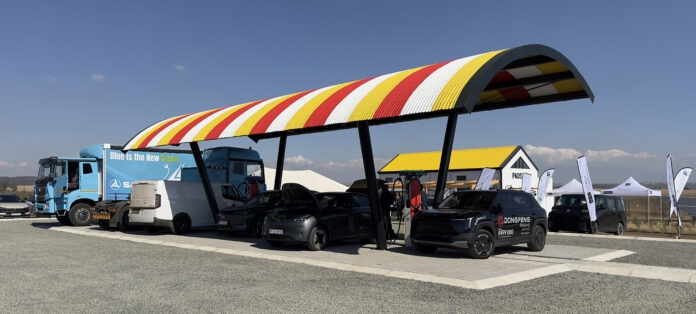
However, there is something in the offing that will help that narrative to shift. South African renewable energy and charging infrastructure company CHARGE has officially launched two new solar-powered electric vehicle charging stations along the strategic N3 corridor between Johannesburg and Durban, marking a major milestone in the country’s evolving electric mobility landscape.
On Wednesday, I attended the launch of the new CHARGE N3 Tugela charging station at the Colenso-Winterton interchange in KwaZulu-Natal. The launch followed Tuesday’s unveiling of the CHARGE N3 roadside station at the Reitz interchange in the Free State.
Positioned along one of Africa’s busiest freight and logistics routes, the charging stations also point toward the future electrification of commercial transportation and logistics fleets in South Africa.
Thousands of trucks move between Gauteng and the Port of Durban daily, making the route a vital artery for the country’s economy. As global transport industries accelerate towards lower-emission mobility solutions, South Africa faces growing pressure to modernise its transport energy infrastructure while remaining competitive.
What makes CHARGE’s model particularly notable is that the charging stations operate entirely off-grid using solar energy. This means the sites do not rely on Eskom’s electricity network – an important consideration in a country that continues to grapple with energy security concerns and infrastructure constraints.
It also comes at a time when South African motorists are increasingly feeling the pressure of rising fuel costs. Diesel prices are hovering around R34 per litre, while petrol prices in some inland regions have climbed above R26 per litre. With global oil market volatility continuing to influence local pump prices, conversations around energy sustainability and transport affordability are becoming more urgent.
Speaking during the launch, CHARGE co-founder and chairperson Joubert Roux said the rollout aims to build long-term confidence in electric mobility.
“By building off-grid EV charging infrastructure along key transport corridors like the N3, we are reducing dependence on volatile fuel prices while creating greater energy and transport cost stability,” said Roux.
“This is about giving consumers and fleet operators the confidence to transition to electric mobility, knowing the infrastructure exists to support them. The future of transport won’t be powered by electric vehicles alone; it will be powered by renewable energy infrastructure.”
The expansion is being supported by a R100-million investment from the Development Bank of Southern Africa (DBSA), which sees the project as part of the country’s broader energy transition strategy.
Gregory Fyfe, DBSA chief investment officer, said renewable energy-powered charging infrastructure could help decarbonise the transport sector while supporting economic growth.
The latest rollout builds on CHARGE’s pilot charging station at Wolmaransstad in the North West, which has reportedly achieved 99% uptime since launching in November 2024.
While South Africa’s EV market remains relatively small compared to Europe and China, momentum is steadily building. More automotive brands are introducing electric and hybrid models locally, while fleet operators are increasingly exploring alternative energy solutions.
The launch attracted representatives from several automotive and mobility brands, including Volvo Cars, Geely, Dongfeng Motor Corporation, JAC Motors, SANY and WesBank, alongside officials from the KwaZulu-Natal and Free State governments.
Speaking to Sunday World Motoring, Roux confirmed that CHARGE’s next major rollout phase will begin in July along the N1 corridor towards Polokwane and Musina. The company ultimately plans to establish 120 charging sites nationally.
Beyond charging vehicles, the N3 launch signals something potentially bigger: the gradual emergence of a national electric mobility ecosystem in South Africa – one increasingly tied to renewable energy, logistics transformation and long-term transport sustainability.
- Range anxiety is a major barrier to electric vehicle (EV) adoption in South Africa.
- This fear stems from running out of battery power away from charging stations.
- Limited public EV charging infrastructure in South Africa exacerbates the issue.
- These factors have hindered widespread acceptance of electric vehicles in the country.
- The article highlights ongoing challenges in improving EV infrastructure and consumer confidence.


