


If there were to be a World Cup for the bakkie market, 2026 would be the year for that global showdown. Over the past few months, as South African motoring journalists, we have sampled some of the impressive line-up of contenders.
Ford showcased its updated Ranger (which I experienced in George), Toyota unveiled the all-new ninth-generation Hilux in Namibia – I also recently drove – Isuzu hosted the updated D-Max in Botswana, Volkswagen refreshed the Amarok in Lesotho, and now Kia has entered the contest with its long-awaited Tasman.
I recently spent a week living with the flagship Kia Tasman 2.2D AT 4WD X-Pro to find out whether the Korean newcomer has what it takes to challenge some of South Africa’s most established bakkie nameplates.
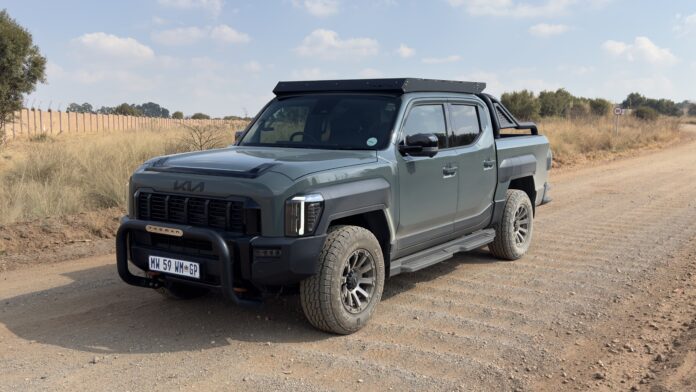
Finished in Cityscape Green metallic and riding on Bridgestone Dueler all-terrain tyres, the Tasman X-Pro arrived looking every bit like a giant determined to make its presence felt. Measuring 5 410mm long, 1 930mm wide and with a substantial 3 270mm wheelbase, it commands attention.
Its styling is perhaps the most divisive aspect of the vehicle. The squared-off proportions and distinctive front-end treatment create a bold identity that is unlikely to leave anyone indifferent. It is very much a love-it-or-hate-it design, but in a segment where standing out is becoming increasingly difficult, Kia deserves credit for avoiding a copy-and-paste approach.
The X-Pro derivative clearly caters to buyers who seek a more rugged alternative to a standard double cab. Features such as pronounced wheel arches, a bridge-style roof rack, all-terrain tyres, 252mm of ground clearance and an impressive 800mm wading depth underline its off-road credentials.
Inside, however, the Tasman adopts a far more restrained and premium approach. The cabin feels modern and thoughtfully executed, almost picking up where the short-lived Mercedes-Benz X-Class left off in combining bakkie practicality with SUV-like comfort.
A fully integrated digital cockpit combines a 12.3-inch instrument cluster, a central infotainment touchscreen and a separate climate-control display. Attention to detail is evident in features such as the mesh-pattern headrests, zippered rear-seat storage pockets, USB-C charging ports and quality leather finishes.
Power comes from Kia’s proven 2.2-litre SmartStream turbodiesel engine, producing 154kW and 440Nm of torque. An eight-speed automatic transmission keeps the engine operating smoothly, while selectable Eco, Normal, Sport and Tow drive modes allow the driver to tailor performance to different situations.
Built on a traditional ladder-frame chassis with double-wishbone front suspension and a rigid rear axle supported by leaf springs, the Tasman retains the toughness expected of a workhorse. Kia claims a payload exceeding one tonne, a 3 500kg braked towing capacity, a gross vehicle mass of 3 250kg and a gross combined mass of 6 200kg, placing it among the stronger performers in the class on paper.
During my test around Johannesburg and the Hartebeespoort area, the Tasman proved to be a refined cruiser, although the aggressive all-terrain tyres were noticeable on tar. One concern during the test was that the vehicle consistently pulled slightly to the left. This behaviour typically points to a wheel alignment issue or, less commonly, wheel damage, and would ideally have been addressed before a media evaluation vehicle was released.
Gravel roads and uneven terrain suited its character far better than daily urban commuting. It felt composed, confident, and comfortable in environments where many owners were likely to use it, making it particularly appealing to farmers, outdoor enthusiasts, and buyers with an adventurous lifestyle.
The biggest hurdle for Kia may not be the product itself but convincing traditional bakkie buyers to embrace a newcomer. South Africans are fiercely loyal to established nameplates such as the Hilux, Ranger, D-Max and Amarok as well as new players from China. Although Kia enjoys a solid reputation for reliability and after-sales support, memories of the Mercedes-Benz X-Class’ brief stay in the market may leave some buyers cautious about new entrant.
Pricing starts at R679 995 for the Tasman 2.2D AT 4×2 LX, rising to R879 995 for the 2.2D AT 4WD SX, while the flagship X-Pro tested here costs R999 995.
The Tasman enters one of South Africa’s toughest automotive segments with bold styling, genuine off-road capability and a premium cabin. Whether it can become a serious challenger to the established order will ultimately depend not only on its abilities, but also on whether buyers are prepared to give the newcomer a chance.
- The article discusses the competitive bakkie (pickup truck) market in 2026, likening it to a World Cup showdown.
- South African motoring journalists have recently tested various leading bakkie models.
- The piece highlights the strength and variety of contenders in the current bakkie market.
- Full details and reviews are available in the e-edition of Sunday World.
- Readers are encouraged to purchase the e-edition to access the complete article.


