


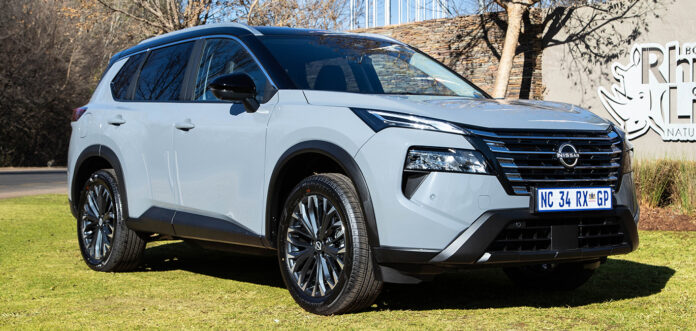
The launch of the new Nissan X-Trail on Tuesday was about far more than introducing an updated family SUV. It represented the beginning of a new chapter for Nissan South Africa following the sale of its Rosslyn manufacturing plant to Chery. As the company’s first local media launch as a vehicle importer, the event also served as a statement of intent that the Japanese brand is preparing an aggressive product offensive to regain momentum in one of South Africa’s most competitive vehicle markets.
“This is the first of a series of exciting launches we have planned for South Africa,” said Nissan South Africa Managing Director Juan Wheeler. “We are going to follow it up with the Tekton that has just been introduced to the world in India, with even more products before the end of this fiscal year.”
Nissan Africa Managing Director Mohamed Samad said the company remains committed to expanding its SUV line-up in Africa, with more model launches like the Nissan Patrol planned through 2027, adding that the X-Trail continues to embody Nissan’s engineering and quality standards.
The numbers certainly support that legacy. Since its debut in 2001, the X-Trail has sold more than eight million units globally, including over 50,000 in South Africa. It now returns to a market transformed by established rivals and an influx of Chinese competitors. Today it must battle established rivals such as the Toyota RAV4, Hyundai Tucson, Kia Sportage, and Mitsubishi Outlander, while also taking on increasingly capable Chinese challengers including the Haval H6, Chery Tiggo 8, Tiggo 8 Pro, and MG HS.
Fortunately, first impressions are encouraging. The updated X-Trail adopts a bolder front grille, redesigned bumper, and stronger stance, complemented by alloy wheels ranging from 17 to 19 inches. Built in Japan, it retains the solid fit and finish expected of the brand.
Our launch route covered approximately 60 kilometres through the Cradle of Humankind before venturing onto gravel roads inside the Bothongo Rhino and Lion Nature Reserve. The route demonstrated exactly what the X-Trail has always done well: comfortable family touring.
The suspension absorbed gravel roads with confidence, while road and wind noise remained well suppressed. The SUV feels planted and reassuring rather than sporty, which is exactly what many family buyers are likely to appreciate.
I also spent part of the drive in the rear seat to evaluate passenger comfort. Rear legroom is generous for average-sized adults, although taller occupants may find knee room limited behind a tall driver. The rear seats are also firmer than expected.
Under the bonnet sits a naturally aspirated 2.5-litre four-cylinder petrol engine producing 135kW and 244Nm, driving the front wheels through a continuously variable transmission (CVT). On paper those figures appear competitive. However, the drivetrain never quite feels as energetic as expected. The CVT blunts much of the engine’s performance, making the 2.5-litre powerplant feel closer to a smaller 1.5-litre engine. Performance is smooth and refined enough for everyday commuting and family duties, but drivers expecting strong acceleration and effortless overtaking from a 2.5-litre engine may leave wanting more.
Every model includes selectable Eco, Normal, and Sport drive modes that adjust throttle response, steering weight, and transmission behaviour. The flagship Acenta Plus further adds Terrain Modes for Mud, Sand, and Snow to improve traction on loose surfaces. While South African buyers are unlikely to encounter snow often, the additional modes proved reassuring on gravel roads during the game drive.
Safety is comprehensive, with six airbags, ISOFIX mounts, parking sensors, and a reverse camera across the range. Nissan also equips the X-Trail with an extensive suite of driver assistance systems, including Blind Spot Warning, Intelligent Cruise Control, Lane Departure Warning, Autonomous Emergency Braking, and Rear Cross Traffic Alert. Higher-specification models add a 360-degree around-view monitor, ProPILOT, and hill descent control.
Pricing is another pleasant surprise. The range starts at R599,900 for the Visia, R688,900 for the Acenta, and R770,900 for the fully equipped Acenta Plus. All models are sold with a three-year/90,000km service plan and a six-year/150,000km mechanical warranty.
The question now is whether the X-Trail can reclaim some of the ground Nissan has lost in South Africa’s booming SUV market.
Its pricing is competitive, its build quality remains excellent, and its 25-year legacy continues to carry weight with many buyers. However, in a segment where turbocharged and hybrid competitors increasingly set the benchmark for performance and efficiency, the naturally aspirated engine and CVT combination feel like the X-Trail’s biggest weakness. Even so, the launch successfully signalled something perhaps more important than the vehicle itself. It demonstrated that Nissan is back on the offensive.
- Nissan South Africa launched the updated X-Trail, marking its first local media launch as an importer after selling its Rosslyn plant to Chery, signaling a new product offensive.
- The X-Trail, built in Japan, features a bolder design, comfortable family-oriented ride, and a naturally aspirated 2.5L petrol engine with a CVT, prioritizing smoothness over sporty performance.
- Comprehensive safety equipment includes six airbags, ISOFIX, parking sensors, and advanced driver assistance systems; higher trims add more tech like ProPILOT and 360-degree cameras.
- Pricing starts at R599,900 for the base model up to R770,900 for the top Acenta Plus, with a three-year service plan and six-year mechanical warranty.
- Despite strong legacy and build quality, the lack of turbocharged or hybrid options may challenge the X-Trail against competitors, yet the launch underscores Nissan’s renewed commitment to the South African market.


