


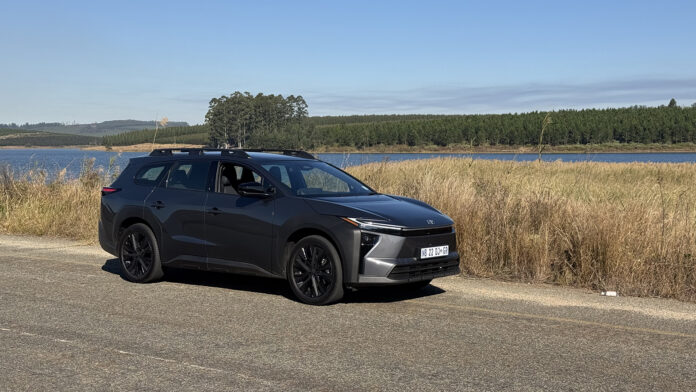
My recent time with the Toyota bZ4X Touring demonstrated how easy an EV can be to live with and how South Africa’s charging ecosystem can complicate the experience.
Toyota South Africa Motors recently handed me the Touring for a week-long test across Gauteng, including trips from Johannesburg to Sasolburg and Pretoria.
The bZ4X is Toyota’s first dedicated battery-electric vehicle and forms part of the Japanese manufacturer’s multi-pathway strategy towards reducing carbon emissions alongside hybrids, plug-in hybrids and other technologies.
The Touring is the more adventurous and practical member of the family. Although it shares its 2 850mm wheelbase with the standard bZ4X, it is 140mm longer and 70mm taller, with the additional rear overhang creating more luggage space. Ground clearance increases from 200mm to 216mm, strengthening its credentials for families looking to venture beyond suburbia.
Its styling combines Toyota’s Hammerhead front end with slim LED headlights and a full-width rear light bar. The result is modern without straying too far into the unconventional.
Underneath sits a 74.69kWh lithium-ion battery, with the Touring supporting AC charging at up to 22kW. Its dual electric motors provide all-wheel drive and a formidable combined 334kW, enabling 0-100km/h in a claimed 4.3 seconds.
That makes this family-orientated Toyota quick, although outright acceleration is arguably less important than how comfortably it goes about its duties.
Comfort is one of its strengths. There is generous space for adults, particularly rear legroom, while the heated and ventilated front seats proved useful during Johannesburg’s recent fluctuating weather. Two wireless charging pads are another thoughtful addition.
The cabin shares some similarities with its more luxurious Lexus RZ relative, including the unusually positioned digital instrument display. However, the steering-wheel adjustment was frustrating because the wheel could obstruct the display. Lowering it solved the problem but the arrangement might not suit every driving position.
The bZ4X Touring proved smooth, quiet and effortlessly powerful on the road. Over my week, it averaged 17.4kWh/100km, while a full charge indicated 443km of available range — enough to reduce the range anxiety often associated with EV ownership.
I also liked Toyota’s X-Mode system, which manages power delivery and braking to maximise traction in low-grip conditions. Dedicated Snow/Dirt and Deep Snow/Mud modes, Grip Control and Downhill Assist Control add capability that might appeal to owners who regularly travel on gravel roads.
Ironically, the greatest challenge had little to do with the vehicle. Arriving at a GridCars DC charger at Fourways Mall with the battery at about 45% and a Pretoria trip planned for the next day, attempts to charge initially failed. My payment card was blocked and the system indicated insufficient funds despite funds being available.
GridCars’ support team eventually resolved the glitches and I was able to charge. However, the episode illustrates why South Africa’s public charging experience needs to become consistently reliable if motorists are to embrace EVs without hesitation.
The bZ4X also repeatedly rejected charging from a domestic wall socket at home. A properly installed home wallbox would appear to be the preferable solution and allow the vehicle to recharge overnight.
Toyota could improve the experience further by providing more intuitive and comprehensive charging information through the vehicle. Some rival EVs do a better job of explaining charging status and energy use.
Ultimately, the bZ4X Touring makes a convincing case as a spacious, comfortable and surprisingly rapid family EV. Possible rivals include the BYD Sealion 7, BMW iX1 and iX2, Mercedes-Benz EQA and EQB and Volvo EC40, depending on whether price, size or practicality carries greater weight.
The Toyota did much to dispel my range anxiety during a week of real-world driving. The bigger concern remains charging anxiety. That is a problem South Africa’s growing EV infrastructure will have to solve.
- The Toyota bZ4X Touring is Toyota South Africa's first dedicated battery-electric vehicle featuring a 74.69kWh lithium-ion battery and dual electric motors with a combined output of 334kW.
- The bZ4X Touring supports AC charging up to 22kW and offers an estimated driving range of 443km on a full charge, averaging 17.4kWh/100km during the test.
- The vehicle has an increased ground clearance of 216mm, more luggage space, and family-friendly features such as rear legroom, heated and ventilated front seats, and wireless charging pads.
- The test revealed issues with South Africa's EV charging infrastructure, including payment glitches at a public DC charger and problems with domestic wall socket charging.
- Potential rivals to the bZ4X Touring include the BYD Sealion 7, BMW iX1 and iX2, Mercedes-Benz EQA and EQB, and Volvo EC40, depending on buyer priorities like price, size, or practicality.


