


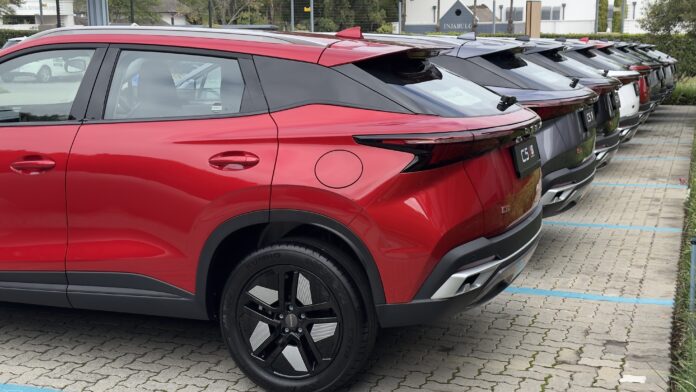
The National Association of Automobile Manufacturers of South Africa (Naamsa) has reported a strong performance for South Africa’s new vehicle market in April 2026, with domestic sales continuing to underpin industry momentum despite growing global and economic uncertainty.
Aggregate domestic sales reached 47 979 units in April, marking the best performance for the month since 2013.
This represents an increase of 5 512 vehicles, or 13%, compared to the 4 467 units sold in April 2025.
The bulk of these sales came from dealer channels, which accounted for 91.1% of total volumes.
The vehicle rental industry contributed 5.1%, while corporate fleets and government purchases made up 2.2% and 1.6%, respectively.
Passenger vehicles remained the key driver of growth, with 34 414 units sold during the month—a 14.3% year-on-year increase.
The light commercial vehicle (LCV) segment, which includes bakkies and minibuses, also delivered a solid performance, rising 9.7% to 10 966 units.
Medium and heavy commercial vehicle segments posted gains as well, with medium trucks increasing by 10.5% to 687 units and heavy trucks and buses climbing 9.9% to 1 912 units.
Top 10 selling brands in April 2026
April’s strong performance stemmed from a competitive brand landscape, with Toyota South Africa Motors leading the way and retaining its dominant position with 10 188 units sold.
It was followed by Suzuki Auto South Africa at 5 363 units and Volkswagen Group South Africa with 4 814 units.
Hyundai Automotive South Africa recorded 2 857 units, while Ford Motor Company of Southern Africa posted 2,702 units locally, supported by 4 183 export units.
Chinese-linked brands continued to gain traction, with GWM South Africa achieving 2 485 units, followed closely by Chery South Africa at 2 462 units.
Newer entrants also showed strong momentum. Jetour South Africa recorded 1 804 units, while Omoda and Jaecoo South Africa reached 1 383 units.
Rounding out the top 10 was BMW Group South Africa with 1,366 units.
However, export performance showed a different trend. Vehicle exports declined by 4% to 30 939 units compared to April 2025.
The drop was largely attributed to a sharp contraction in the LCV segment, down 42.9%, linked to the phased rollout of new model production by a key exporter.
According to Naamsa, the domestic market’s resilience reflects momentum built over recent months, supported by improved financing conditions and stronger consumer sentiment. However, this positive trend is now facing mounting headwinds.
Rising global oil prices, triggered by geopolitical tensions in the Middle East, are expected to push up fuel costs, placing pressure on supply chains and increasing the overall cost of vehicle ownership.
This comes as inflation risks begin to build and as expectations shift towards tighter monetary policy.
In a move welcomed by the industry, finance minister Enoch Godongwana recently extended temporary fuel levy relief measures, offering short-term support to consumers and businesses.
While the April figures highlight a resilient domestic market, Naamsa cautioned that rising costs and global uncertainty could test this momentum in the months ahead.
- South Africa’s new vehicle market saw its strongest April since 2013 with domestic sales up 13% year-on-year to 47,979 units, driven mainly by dealer sales and passenger vehicles.
- Light commercial vehicles and medium/heavy trucks also grew solidly, contributing to the overall market expansion.
- Toyota led the brand rankings, followed by Suzuki and Volkswagen, while Chinese brands like GWM and Chery, plus newcomers Jetour, Omoda, and Jaecoo, showed significant growth.
- Vehicle exports fell 4%, mainly due to a 42.9% drop in light commercial vehicle exports linked to production changes at a key exporter.
- Despite strong domestic demand aided by better financing and fuel levy relief, rising global oil prices, inflation risks, and geopolitical tensions pose challenges to sustained growth.


