


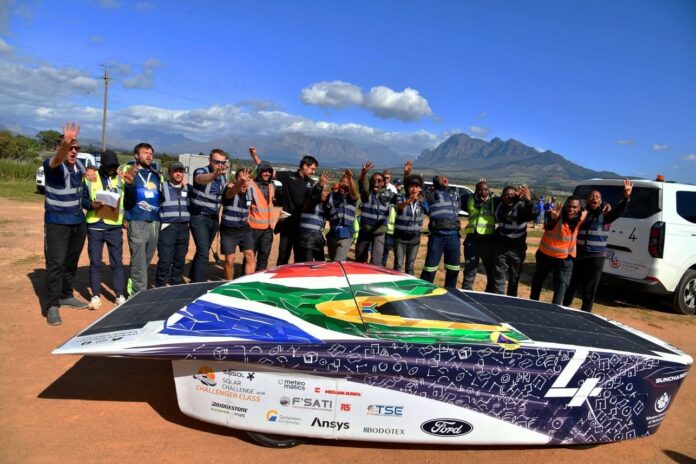
South Africa’s Tshwane University of Technology (TUT) SunChaser team has won the 2026 Sasol Solar Challenge after covering 2,369km, as organisers begin looking beyond solar power towards green hydrogen and other clean-energy technologies for the 2028 competition.
The challenge concluded in Franschhoek in the Western Cape last Thursday, after teams crossed South Africa in experimental solar-powered vehicles, negotiating changing weather, road conditions and the demands of operating prototype technology on public roads. TUT finished ahead of international competitors Solar Energy Racers from Switzerland, which covered 1,518km, and India’s AgniRath team, which completed 1,191km. High-school team Genuine JV also reached the finish after covering 1,001km, demonstrating that the competition is not restricted to university-level engineering teams.
Sunday World Motoring joined the challenge at its start in Boiketlong, Sasolburg, where the teams began a journey designed to test not only solar-powered vehicles but also battery management, aerodynamics, lightweight construction and energy efficiency.
The finish in Franschhoek brought the 2026 competition to a close, but organisers are already considering significant changes for the next edition in 2028. Green hydrogen could form part of a broader energy formula as the organisers seek to evolve the engineering challenge beyond vehicles relying primarily on solar energy and batteries.
The proposal does not mean solar power will disappear. Instead, future teams could be required to determine the most efficient combination of solar energy, battery storage and hydrogen within predetermined energy limits.
READ: Deputy president launches R100m Wits hydrogen facility
Under concepts being considered for the Challenger and Cruiser categories, vehicles could use smaller batteries and solar arrays alongside controlled quantities of hydrogen. Engineers would then have to decide how best to manage the different energy sources over several days and at designated refuelling points.
The Innovation class could provide greater technical freedom, potentially accommodating technologies including hydrogen combustion and other emerging energy systems, subject to safety regulations.
No final technical formula has yet been confirmed. Organisers said the regulations, safety requirements, energy allocations, refuelling arrangements and vehicle architecture will be developed in consultation with universities, engineers, hydrogen specialists and energy companies.
The proposed changes reflect how far solar vehicle technology has developed since the competition began. Advances in photovoltaic cells, batteries, electric motors, power electronics and lightweight materials have made today’s experimental vehicles considerably more sophisticated.
READ: BWM iX5 Hydrogen moves closer to production as road testing intensifies
For the organisers, the challenge for 2028 is therefore shifting from whether vehicles can travel significant distances using the sun to determining how engineers can most efficiently combine multiple clean-energy sources.
After TUT’s 2,369km winning effort this year, the next Sasol Solar Challenge could consequently become as much an experiment in energy integration as it is a solar-powered endurance competition.
- Tshwane University of Technology (TUT) SunChaser team won the 2026 Sasol Solar Challenge by covering 2,369km.
- International teams Solar Energy Racers from Switzerland and India’s AgniRath finished second and third, covering 1,518km and 1,191km respectively.
- The 2026 competition concluded in Franschhoek, Western Cape, after teams crossed South Africa in solar-powered prototype vehicles.
- For the 2028 challenge, organisers are considering integrating green hydrogen with solar energy and batteries under new categories like Challenger, Cruiser, and Innovation.
- The future competition aims to test the efficient combination of multiple clean-energy sources within set energy limits, with rules developed alongside universities and specialists.


