


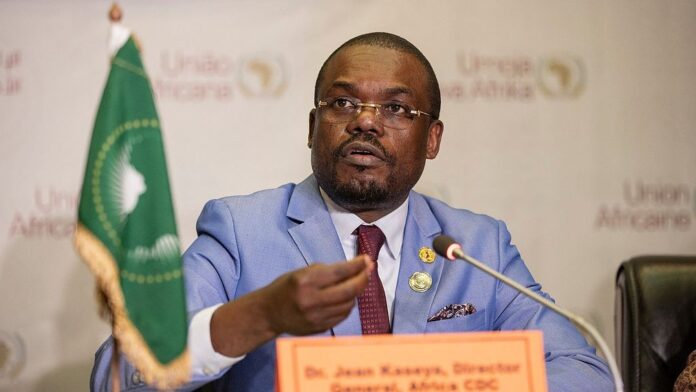
Africa Centers for Disease Control and Prevention (Africa CDC) director-general Dr Jean Kaseya has warned that the current Ebola outbreak centred in the Democratic Republic of Congo could spread to as many as 12 countries, as health officials race to contain what is now being described as the second-largest Ebola outbreak since the West Africa epidemic a decade ago.
Speaking about the outbreak’s origins, Dr Kaseya said the first alert emerged on May 5 in DR Congo’s Ituri province, but initial tests failed to detect the virus because local teams screened for the more common Zaire strain of Ebola.
“When they tested Zaire, it came negative. They were thinking that it was not Ebola,” Kaseya said. “Later, when we had other cases, they sent samples to Kinshasa, and in Kinshasa it was on the 14th that they discovered it was Bundibugyo.”
He said confirmation that neighboring Uganda had also recorded cases prompted the Africa CDC and regional governments to formally declare the outbreak.
Less studied strain
The Bundibugyo strain, first identified nearly two decades ago, is far less studied than the Zaire variant and currently has no approved vaccine or targeted treatment, which is a gap the director criticized sharply.
“I have to say that this strain was discovered 19 years ago. After 19 years, if we still don’t have vaccine medicine, it’s because it was in Africa. I can assure you that if Bundibugyo were in Europe or the US, the vaccine would be available,” he said.
The outbreak has already triggered alarm among international health agencies. The World Health Organization (WHO) has warned about both funding shortages and the growing risk of cross-border transmission.
Between 10 and 12 countries now at risk
Dr Kaseya said the Africa CDC estimates that between 10 and 12 countries are now at risk.
“This current one is the second largest Ebola outbreak after the one in West Africa. We don’t have vaccines, we don’t have medicines. We need to make sure that we are putting in place all public health measures to stop this outbreak,” he said.
Despite the concerns, Kaseya said African health systems now possess far greater experience responding to Ebola than in previous epidemics. He pointed to decades of expertise across the continent, including the work of renowned Congolese virologist Jean-Jacques Muyembe, one of the world’s leading Ebola researchers.
“We have the expertise. People know Ebola, people know what to do,” Kaseya said. “What we are doing now is accelerating work on the vaccine while continuing to implement the public health measures that we learned from previous outbreaks.”
Health officials across East and Central Africa have intensified border surveillance, isolation protocols and community tracing efforts as fears grow that the outbreak could spread further across the region.
- The Ebola outbreak in the Democratic Republic of Congo (DRC), caused by the less studied Bundibugyo strain, could spread to 10-12 countries according to Africa CDC director Dr. Jean Kaseya.
- Initial detection was delayed because local teams tested only for the more common Zaire strain; the Bundibugyo strain has no approved vaccine or targeted treatment.
- The outbreak is now the second-largest Ebola epidemic since the West Africa crisis a decade ago, raising significant concerns about cross-border transmission and funding shortages.
- Despite challenges, African health systems have improved Ebola response expertise, leveraging decades of experience and research from experts like virologist Jean-Jacques Muyembe.
- Regional health officials are intensifying border surveillance, isolation, and contact tracing while accelerating vaccine development and implementing public health measures.


