


Africa’s most interesting systems are often built long before formal markets know what to call them. Mobile money in Kenya changed financial access by addressing the gap left by traditional banking infrastructure, which excluded too many people from the system. Stokvels created disciplined models of collective finance long before fintech discovered community-led savings. Township retail in South Africa has built supply, credit and distribution ecosystems in markets that formal commerce has often underestimated.
These are not just examples of ingenuity. Across the continent, people and businesses have repeatedly built around gaps with a sophistication invisible to outsiders, in markets shaped by infrastructure constraints, multilingual communities, mobile-first behaviour, informal trade, social trust and constant adaptation.
Africa Day honours the continent’s heritage, culture and shared history. It is also a celebration of the creativity, adaptability and community intelligence that continue to define African progress.
For those of us working in technology, it is striking to see those same qualities being translated into digital systems and solutions, beginning to shape the technologies and societies the continent will rely on next. That perspective matters as artificial intelligence (AI) moves from boardroom fascination into practical deployment. Much of the global AI conversation remains framed around scale: bigger models, faster compute, larger capital commitments.
Yet, those metrics say little about whether a technology solves real problems. For African businesses, the more relevant question is how AI improves decisions, expands access and responds to the markets in which people actually live and work.
In South Africa, that story is already taking shape in ways that feel close to everyday reality. Lelapa AI is building African-language tools that respond to the way people actually communicate across languages and contexts, tackling a gap that global AI systems have often struggled to address.
Harambee Youth Employment Accelerator is using AI-powered multichannel support to help young work-seekers navigate opportunities at scale, applying technology to one of South Africa’s most urgent economic challenges.
Professor Vukosi Marivate of the University of Pretoria, one of South Africa’s most respected voices in AI, has consistently pushed for technology that reflects the realities of the societies it serves. His work across machine learning, natural language processing and inclusive digital systems has focused on a critical challenge: technology trained on narrow assumptions about language, behaviour and context will struggle to deliver relevance in markets as layered and diverse as Africa’s.
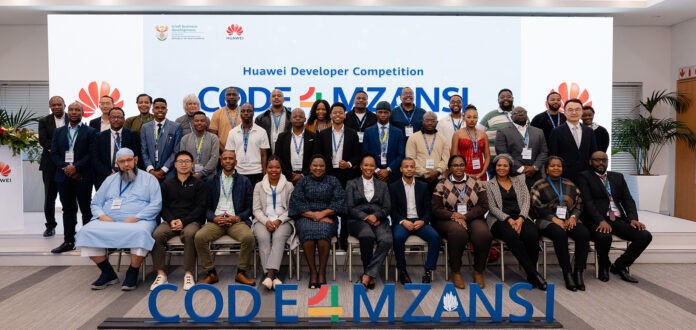
That shift is becoming visible in the next generation of builders. Huawei’s Code4Mzansi initiative, which aims to equip young South Africans with cloud and AI capabilities while creating a platform for practical problem-solving, offers a glimpse of that shift in motion.
The programme has surfaced young developers working on food safety, township retail, household finance, healthcare access, energy resilience, youth employability and creator economy infrastructure.
What stands out is how close these ideas sit to everyday life.
Atlas, one of the solutions to emerge from Code4Mzansi, was developed after the tragic deaths of children in Gauteng and KwaZulu-Natal who consumed contaminated snacks bought from local spaza shops. The team identified a critical gap: recall systems may reach formal retailers, but many exposed communities shop through informal networks outside those channels. Atlas uses AI to create an early-warning trust layer for the informal retail economy.
Africa’s vibrancy has always been expressed in more than its landscapes, colour, music and culture. It lives in the texture of its markets, the fluidity of its languages, the strength of its communities and the ingenuity with which people solve for complexity every day.
In AI, in particular, some of the most compelling African innovations are emerging not from abstraction but from a deep understanding of context, human behaviour and lived reality.
- Govender is senior PR manager: media and communications at Huawei
- Africa has a rich history of innovative, community-driven financial and retail systems that address infrastructure gaps and social needs long before formal markets recognize them.
- African AI development emphasizes practical solutions tailored to local languages, cultures, and market realities, rather than focusing solely on scale and technical metrics.
- South African initiatives like Lelapa AI and Harambee Youth Employment Accelerator showcase AI applications in language processing and youth employment support tailored to local challenges.
- Programs like Huawei’s Code4Mzansi are nurturing young developers to create AI-driven solutions closely connected to everyday issues such as food safety, healthcare, energy, and informal retail systems.
- Africa’s AI innovation is distinguished by its grounded approach, leveraging deep understanding of context, behaviour, and community to solve real-world problems effectively.


