


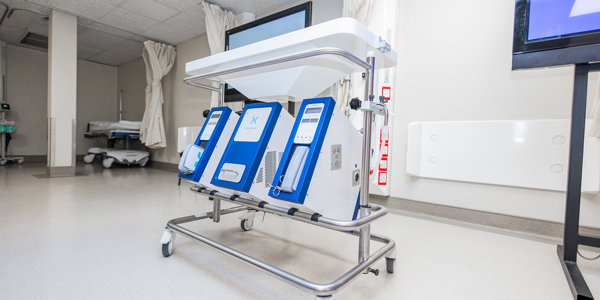
A major breakthrough in organ transplantation has arrived in Africa. South Africa’s Wits Donald Gordon Medical Centre has become the first hospital on the continent to introduce a liver perfusion machine, a cutting-edge technology that preserves and revives donated livers outside the human body.
The introduction of the machine comes years after the world’s first liver perfusion procedures were successfully performed elsewhere.
More time to assess, preserve and prepare organs
The liver perfusion machine keeps donated livers functioning outside the body. This gives surgeons more time to assess, preserve and prepare organs for transplantation. Traditionally, donated organs are flushed with preservation fluid and stored on ice. The new technology, however, enables surgeons to warm and oxygenate donor livers, improving their condition before transplantation.
“We can warm the organ up to about 10 to 13 degrees while oxygenating it, thereby helping to resuscitate the organ outside of the body and get it into a better shape before implanting it into the next recipient,” said Sharan Rambarran.
He is the lead transplant surgeon at the Donald Gordon Medical Centre Liver Transplant Programme.
The technology also offers the possibility of salvaging organs previously considered unsuitable for transplantation, potentially expanding the pool of available donor organs.
Hope for patients facing long transplant waiting lists
According to Rambarran, the liver perfusion machine allows medical teams to assess the metabolic function of donor organs before transplantation. This increases the chances of successful outcomes and reducing complications after surgery.
“We can take more marginal organs, put them onto the machine, resuscitate them and test metabolically whether they are functioning properly before transplanting them into a patient,” he said. “Patients receiving these organs have experienced smoother post-operative recoveries.”
The breakthrough comes at a critical time for South Africa, where donor organs remain scarce and many patients die while awaiting transplants.
One beneficiary of the country’s transplant programme is liver transplant recipient Winston Baatjies, who was diagnosed with liver disease caused by sarcoidosis in 2018.
Although doctors initially expected him to wait several months for a donor organ, he received a transplant after just three days.
Hope to improve transplant outcomes
Baatjies believes the new technology could further improve transplant outcomes by giving doctors more time to evaluate and restore donor organs before surgery.
“If we had the liver perfusion machine then, the liver could have been refreshed, its functions restored and its viability tested more thoroughly,” he said.
Baatjies is among more than 1,000 patients whose lives have been changed by the Donald Gordon Medical Centre’s internationally recognised liver transplant programme.
The transplant not only saved his life but also enabled him to continue working, to take parts in sports and support his family.
“I remained productive and continued contributing to the economy through my work in government,” he said. “Above all, I was able to continue being a father and a husband.”
Increase number of suitable organs
Medical experts believe the introduction of liver perfusion technology could significantly increase the number of organs suitable for transplantation, offering renewed hope to critically ill patients across Africa. However, specialists warn that Africa’s biggest challenge remains the shortage of organ donors.
In South Africa, organ donation rates remain below one donor per million people. This is argely due to cultural barriers, misconceptions and a lack of public awareness.
As Africa embraces this pioneering technology, healthcare professionals say efforts to increase organ donation will be essential to ensuring that more patients can benefit from life-saving transplants.
- A major breakthrough in organ transplantation has arrived in Africa.
- South Africa’s Wits Donald Gordon Medical Centre has become the first hospital on the continent to introduce a liver perfusion machine, a cutting-edge technology that preserves and revives donated livers outside the human body.
- The introduction of the machine comes years after the world’s first liver perfusion procedures were successfully performed elsewhere.
- More time to assess, preserve and prepare organs The liver perfusion machine keeps donated livers functioning outside the body.
- This gives surgeons more time to assess, preserve and prepare organs for transplantation.


