


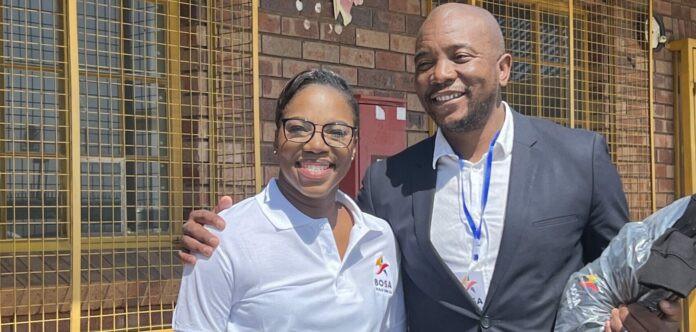
The race for Johannesburg’s mayoral chain is fast turning into one of the most intense political contests in the country, with parties increasingly relying on well-known political figures to take control of South Africa’s economic hub.
What was once framed as a local government election focused on service delivery is now looking more like a national political battleground, where experience, name recognition and political influence are becoming just as important as policy promises.
But while most parties are reaching deep into their political benches, Build One South Africa (BOSA) has taken a different approach.
BOSA fields Hlazo-Webster
On Wednesday, the party announced its deputy leader and Member of Parliament, Nobuntu Hlazo-Webster, as its candidate for mayor of Johannesburg.
Hlazo-Webster brings a background rooted in business, communications and leadership in civil society. Before entering frontline politics, she worked in the private sector in marketing and strategic development, building a profile as an entrepreneur and advocate for women’s economic empowerment. She founded the South African Women’s Commission and has been involved in several initiatives focused on youth development, leadership and business growth. She has also held positions within business networks, including the Businesswomen’s Association of South Africa.
Within BOSA, she quickly rose to prominence after being part of the party’s founding leadership alongside Mmusi Maimane. In the 2024 national election, she was deployed as the party’s Gauteng premier candidate before taking up a seat in Parliament, where she has become one of its key public representatives.
However, her entry into the Johannesburg mayoral race places her in direct competition with some of the most politically experienced figures in the country.
The Democratic Alliance (DA) has placed its Johannesburg strategy in the hands of veteran politician Helen Zille.
Zille, who served as mayor of Cape Town between 2006 and 2009, later became premier of the Western Cape and went on to lead the DA nationally. She remains one of the most recognisable political figures in South Africa, known for her strong campaign style and continued visibility in public political debates.
Mashaba carries hopes for ActionSA
ActionSA, meanwhile, enters the race with party leader Herman Mashaba, who also served as executive mayor of Johannesburg from 2016 to 2019. Mashaba’s name remains closely tied to the city, and his tenure continues to shape his political identity, particularly among voters who associate him with attempts to improve governance and tackle corruption.
The African National Congress (ANC) is also reportedly weighing up candidates with significant national experience as it attempts to regain ground in the metro.
Among the names being discussed are former cabinet minister and African Union Commission chairperson Nkosazana Dlamini-Zuma. Former director-general in the anti-apartheid veteran and ANC integrity committee chair Frank Chikane’s name is also in the mix. Both figures bring long records in government and public service, with experience spanning the democratic transition and state administration.
Rise Mzansi has entered the contest with political analyst Lukhona Mnguni as its candidate. While he has never held executive office, Mnguni is a well-known commentator on politics and governance, with a strong media presence and growing support among younger voters.
Zungula may also throw hat in ring
ATM leader Vuyolwethu Zungula is also expected to be part of the contest should he formally enter the race. His national profile has been shaped by his work in Parliament, particularly his high-profile role in holding President Cyril Ramaphosa accountable during the Phala Phala controversy.
Taken together, the list of candidates shows just how important Johannesburg has become in the political landscape.
This is no longer just a municipal election. It is a fight for control of the country’s most powerful city, where political reputation and public recognition may matter just as much as policy.
What do Joburg voters want?
Yet beneath all the campaigning and candidate announcements lies a bigger question about what Johannesburg voters actually want.
Is the city entering a new political era where fresh faces and first-time contenders can break through on ideas, energy and new approaches to leadership?
Or will voters ultimately lean towards familiar names, leaders whose political careers, public profiles and governing experience already stretch across decades?
Because in the final analysis, the contest may not be decided by who is new, but by who is known.
And that is where the real test begins: can a first-time mayoral contender realistically match the campaign machinery, political experience and public recognition of figures like Nkosazana Dlamini-Zuma and Frank Chikane, or will Johannesburg once again choose leaders it already knows and trusts?
- The race for Johannesburg’s mayoral chain is fast turning into one of the most intense political contests in the country, with parties increasingly relying on well-known political figures to take control of South Africa’s economic hub.
- What was once framed as a local government election focused on service delivery is now looking more like a national political battleground, where experience, name recognition and political influence are becoming just as important as policy promises.
- But while most parties are reaching deep into their political benches, Build One South Africa (BOSA) has taken a different approach.
- BOSA fields Hlazo-Webster On Wednesday, the party announced its deputy leader and Member of Parliament, Nobuntu Hlazo-Webster, as its candidate for mayor of Johannesburg.
- Hlazo-Webster brings a background rooted in business, communications and leadership in civil society.


