


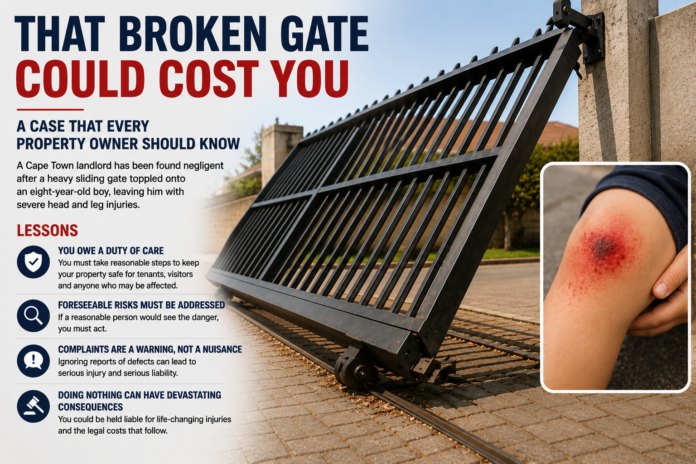
Property owners who ignore broken gates, unsafe walls, loose balustrades or other hazards could find themselves paying damages when somebody gets hurt.
That is the warning from lawyers following a Western Cape High Court judgment that found a Cape Town landlord liable after a heavy sliding gate toppled onto an eight-year-old boy.
The August 25 ruling provides an important lesson for homeowners and landlords: you do not have to know that an accident will happen before becoming responsible for preventing it.
Reasonable precaution for foreseeable dangers
The question is whether a reasonable person could have foreseen the danger and taken reasonable precautions.
Acting Judge Rehana Parker found property owner Moegamat Shadley Chilwan negligent for failing to make a sliding gate at his Ruyterwacht property reasonably safe.
DSC Attorneys partner Kirstie Haslam, whose firm represented the plaintiff, said the principle extends beyond gates.
“You do not have to eliminate every conceivable risk, but you do have to take reasonable steps to protect people from dangers that are foreseeable,” Haslam said.
That could include something as ordinary as a staircase, wall, gate or balustrade that has become dangerous through poor maintenance or inadequate safety measures.
The case illustrates how an apparently mundane household defect can become a serious legal liability.
2017 incident
On September 19 2017, the boy and his mother returned to the property, where they were tenants.
His mother opened the sliding gate and asked him to close it while she hurried towards their residence. About 10 seconds later, she heard him screaming. The gate had toppled onto him.
The boy suffered a severe head injury, including a fracture, frontal haematoma and scalp laceration. He also fractured his right femur.
Chilwan maintained the gate was safe and alleged the boy pushed it wide open before closing it so forcefully that a stopper broke.
But Judge Parker found he produced no evidence supporting that version.
His own evidence ultimately undermined his defence when he conceded under cross-examination that a stopper was not installed. “Evidently, there was no stopper in place but rather, a bracket. A bracket is not a stop,” Parker said.
Warning signs
The court heard allegations that warning signs had existed before the accident.
One tenant testified that the gate had previously fallen and claimed she complained “hundreds of times” about problems with the gate and its lock.
Another witness said it had fallen on numerous occasions.
Engineering expert Anton Krause testified that additional stabilising mechanisms could have prevented the gate from toppling.
Parker found the gate’s sheer size and weight created a hazard and that its derailment was foreseeable without sufficient safety mechanisms such as stops, guide rollers or a stabilising pole.
“In my view, the defendant could and should have done more than he did to ensure that the gate was rendered reasonably safe,” Parker said.
The judgment also demonstrates that blaming the person injured, or someone supervising them will not necessarily protect an owner from liability.
Chilwan attempted to hold the boy’s mother partly responsible, arguing she had failed to supervise him properly. The court rejected this because Chilwan failed to substantiate his version of how the accident occurred. Parker concluded that “no blame can be laid at the feet of the plaintiff”.
Haslam said property owners should identify hazards and address defects capable of causing injury. “Once a risk is foreseeable, doing nothing can have very serious consequences; for the person who is injured and ultimately for the owner who failed to act.”
Chilwan must compensate the boy in an amount still to be agreed or determined and pay specified legal costs.
- A Western Cape High Court ruled a Cape Town landlord liable after a heavy sliding gate toppled onto an eight-year-old boy, causing severe injuries.
- The judgment states that property owners must take reasonable precautions to prevent foreseeable dangers, extending to hazards like unsafe gates, walls, or balustrades.
- The landlord, Moegamat Shadley Chilwan, was found negligent for not installing a proper stopper on the sliding gate, which lacked adequate safety mechanisms.
- Witnesses testified that the gate had previously fallen and that complaints about its safety had been ignored, reinforcing the landlord's liability.
- Chilwan must compensate the injured boy and pay legal costs, with the compensation amount yet to be agreed or determined.


