


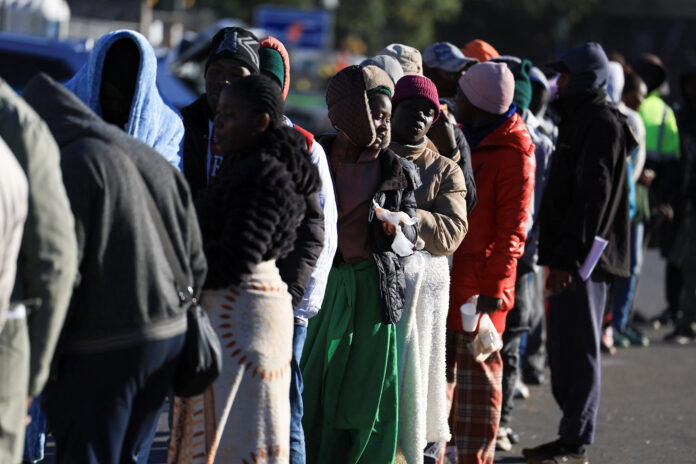
There is no government deadline. In fact, nothing exists outside of a fake flyer circulating on social media warning foreigners they will be arrested, detained or deported unless they leave the country.
This kind of nothing has blocked clinic doors for months, demanding papers from suspected non-nationals without any legal right.
This anti-immigrant sentiment on the streets has the very real potential for the kind of violence that took 62 lives in 2008, including 27 South Africans, and has hardened since the Covid-19 pandemic.
It’s already started. Five Mozambicans were killed in Mossel Bay after an outbreak of violence there; migrant shops have been looted; and thousands of migrants have been displaced while others, fearing for their lives, are fleeing the country.
Immigration control plan
President Cyril Ramaphosa addressed the issue directly on June 7, announcing a plan that included increased immigration enforcement, border security, ending the green ID book, capping foreign worker quotas, and regional diplomacy.
The Human Sciences Research Council has already noted a hostile upswing since Covid-19. In 2021, 30% of South Africans said they would “welcome no immigrants”. By 2025, that had climbed to 42%, mostly driven by the poor and lowest socioeconomic classes. In KwaZulu-Natal, that number blistered furiously from 25% in 2021 to 60% last year.
While foreign nationals make up a small fraction of South Africa’s population – just 5.1%, according to South Africa’s own census figures, or 3.1-million people – those numbers have been distorted, with immigrants blamed for everything from failing clinics to overcrowded schools, soaring crime and high unemployment rates.
Anti-immigration politics, researchers say, give leaders a way to address what people are angry about – immigrants – but not what’s actually broken.
In the health sector, you don’t have to look far for examples of what’s broken: take the 2021 Tembisa Hospital “skinny jeans” scandal, where R2-billion was stolen, and the corruption linked to communications company Digital Vibes, uncovered in the same year, during Zweli Mkhize’s term as health minister.
Endemic corruption and maladministration
But fixing endemic corruption and maladministration is more difficult than shouting down presumed non-nationals and blocking their access to clinics and hospitals, even when the Constitution says that no one may be refused emergency medical treatment. The National Health Act is explicit: anyone not on medical aid, regardless of citizenship or immigration
status, is entitled to free primary healthcare services.
That didn’t stop Health Minister Aaron Motsoaledi in 2018 from saying migrants were overloading the healthcare system, even while admitting it was more anecdotal than factual.
In interviews since 2024, he told Bhekisisa’s TV programme, Health Beat, that he knows very well that foreigners are coming to South African clinics to get HIV treatment. And he’s doing nothing to stop it because “we believe it will work in reverse for us to fight the disease if you deny people treatment”.
NHI Act promotes anti-immigrant sentiments
But the National Health Insurance (NHI) Act, as it is written, also promotes anti-immigrant sentiments.
The NHI roll-out is “on pause” while the Constitutional Court considers if fair processes were followed to enact it; a judgment that is not expected until December or early 2027.
The current version of the act says refugees and undocumented migrants will only qualify for free health treatment for emergencies and “notifiable diseases” such as tuberculosis or cholera. But that list doesn’t include HIV.
Bhekisisa’s Mia Malan asked Motsoaledi why HIV didn’t make the list and if he would consider starting a process to change the act. The health minister’s answer was yes, as he believes everyone in South Africa should have access to ARVs, regardless of where they’re from or if they can pay for it. – The Bhekisisa Centre for Health Journalism
- A fake flyer warning foreigners of arrest and deportation has fueled months of anti-immigrant actions, including blocking clinic doors and violent attacks, resulting in deaths and displacement of migrants in South Africa.
- President Cyril Ramaphosa announced a plan on June 7 to address immigration control through increased enforcement, border security, ending the green ID book, capping foreign worker quotas, and regional diplomacy.
- Anti-immigrant sentiment has surged, with a significant portion of South Africans, especially in poorer communities and KwaZulu-Natal, expressing opposition to immigration, despite foreigners representing only about 5.1% of the population.
- Corruption and maladministration in public services, including the health sector, are key issues driving public anger that is wrongly directed at immigrants, while constitutional and legal protections ensure migrants access to emergency healthcare.
- The National Health Insurance (NHI) Act restricts free healthcare for refugees and undocumented migrants to emergencies and certain diseases, excluding HIV, though Health Minister Aaron Motsoaledi supports access to HIV treatment for all and is open to changing the law.


