


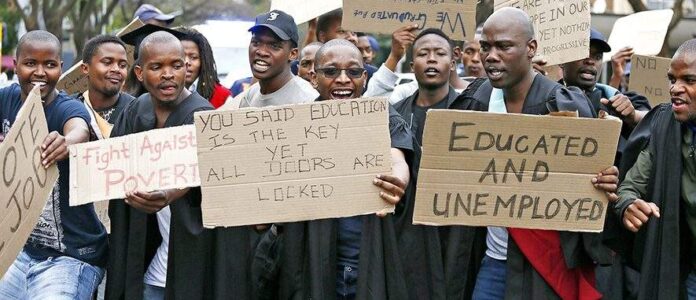
The increased struggle for young people graduating at tertiary to find employment has raised concern about whether formal qualifications still carry enough weight to change the labour market.
Michael Hanly, the managing director at New Leaf Technologies, highlighted that the unemployment rate has increased to 32.7% in the first quarter, reflecting 345 000 job cuts in three months.
The data showed that 12.2% of graduates remain jobless, but more students are sitting for their matric, with 37.6% recorded last year.
‘World of work changing fast’
“The world of work is changing faster than most education systems can keep up with. A qualification has fast become the entry point of a career, not the finish line. Micro-credentials are surfacing with a lot more value.
“Most people study one thing and end up building a career in something else entirely. Careers are rarely linear, and they increasingly depend on people who keep learning, reskilling and adapting,” said Hanly.
He warned that education is continuous and should not stop when the formal study ends. Hanly said technology has accelerated change, meaning what a student had decided on in their 20s might be different in their later years.
Impact of AI
He said artificial intelligence (AI) has also changed how people work but emphasised that even its usage needed someone who understands the context of what is being shared.
“Too much learning still gets measured by who showed up and who finished the course. That tells you nothing about whether anyone got better at their job, we can’t keep peering in the rear-view mirror.
“The organisations getting this right measure learning against real performance outcomes, and they build it into how the business runs rather than treating it as a once-a-year event,” said Hanly.
He said that across industries such as financial services, hospitality, retail, manufacturing and healthcare, New Leaf Technologies has seen this shift in thinking take hold, with more organisations moving away from treating learning as a once-off event and instead focusing on mapping skills and creating clear career paths.
Hanly said that over the next decade, skills such as adaptability, critical thinking, creative problem-solving and emotional intelligence will become increasingly important, along with the ability to use new technology.
He added that both individuals and companies that succeed will be those that see learning as an ongoing process rather than something that is ever fully completed.
- Youth unemployment has surged, with a 32.7% unemployment rate and 345,000 job cuts in three months; 12.2% of graduates remain jobless despite more students completing matric (37.6% last year).
- Michael Hanly emphasizes that formal qualifications are now just the career entry point, as the evolving job market demands continuous learning, reskilling, and adaptability.
- The rise of micro-credentials offers more relevant value, reflecting the need for skills beyond traditional degrees due to rapid changes fueled by technology and AI.
- Organizations are shifting to measure learning by real performance outcomes and integrating continuous skills development into business operations rather than annual training events.
- Future essential skills include adaptability, critical thinking, creative problem-solving, emotional intelligence, and technology use; lifelong learning is crucial for ongoing career success.


