


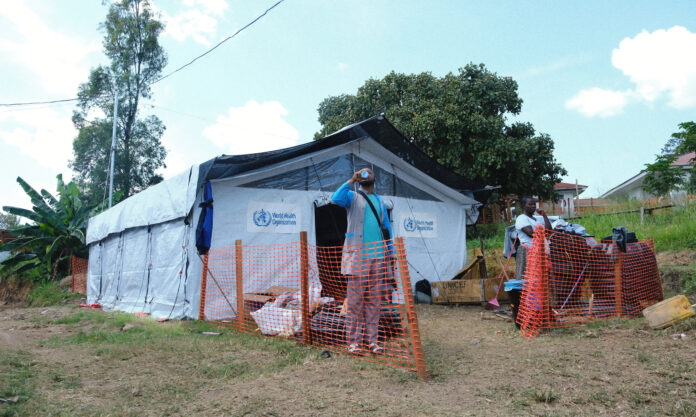
The European Commission said on Wednesday it will fund the response to the Ebola outbreak in Central Africa with a €493-million (about R9.2-billion) financial aid package.
The amount comprises frontline medical support for the immediate outbreak response, humanitarian assistance in the Great Lakes region and Uganda, vaccine and treatment research for filoviruses as well as longer-term work to improve preparedness and health systems.
This comes amid concerns that health workers battling the outbreak in eastern Democratic Republic of Congo lack the personnel to identify suspected cases, the ambulances to transport them and even the construction materials to build isolation wards.
More than 800 confirmed cases
A month after the World Health Organization declared an international emergency, the outbreak of the rare Bundibugyo strain has grown to more than 800 confirmed cases, with warnings mounting that it could become the worst on record – surpassing the 2014-16 West Africa epidemic that killed more than 11 000 people.
Health teams are so stretched that tens of thousands of contacts of those cases remain untraced, Jean Kaseya, director general of the Africa Centres for Disease Control and Prevention, told Reuters, pointing to insecurity and the urban, mining-heavy setting of the outbreak as central obstacles.
“After four weeks we have an outbreak in an urban area where there is insecurity, where there is this mining and trade activity, and also where we are not reaching all the people who must be in the contact list,” he said late on Tuesday.
“If we don’t reach these people, we cannot say that we can win with this outbreak.”
The commission’s response to the outbreak has been coordinated from day one with member states, international bodies and partners.
“Ebola is a test of our global solidarity. As some turn inward, the EU remains present, engaged, and a reliable partner,” Commissioner for Crisis Management Hadja Lahbib said in a statement.
The Commission continues to monitor the outbreak closely in cooperation with its partners though the European Centre for Disease Prevention and Control currently assesses the risk to people in Europe as very low.
- The European Commission said on Wednesday it will fund the response to the Ebola outbreak in Central Africa with a €493-million (about R9.2-billion) financial aid package.
- The amount comprises frontline medical support for the immediate outbreak response, humanitarian assistance in the Great Lakes region and Uganda, vaccine and treatment research for filoviruses as well as longer-term work to improve preparedness and health systems.
- This comes amid concerns that health workers battling the outbreak in eastern Democratic Republic of Congo lack the personnel to identify suspected cases, the ambulances to transport them and even the construction materials to build isolation wards.
- More than 800 confirmed cases A month after the World Health Organization declared an international emergency, the outbreak of the rare Bundibugyo strain has grown to more than 800 confirmed cases, with warnings mounting that it could become the worst on record – surpassing the 2014-16 West Africa epidemic that killed more than 11 000 people.
- Health teams are so stretched that tens of thousands of contacts of those cases remain untraced, Jean Kaseya, director general of the Africa Centres for Disease Control and Prevention, told Reuters, pointing to insecurity and the urban, mining-heavy setting of the outbreak as central obstacles.


