


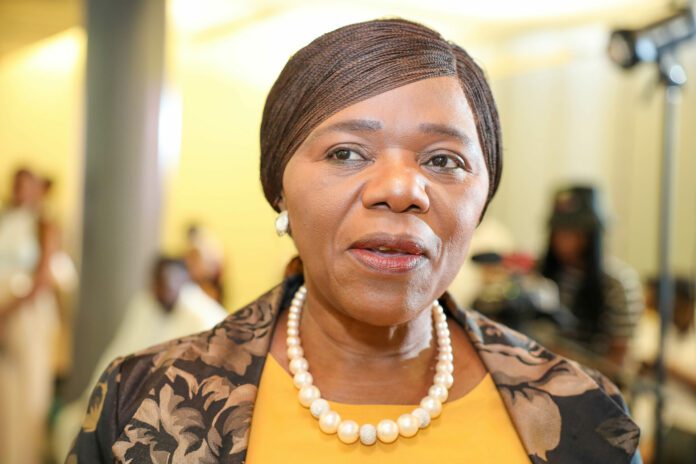
Former Public Protector Professor Thuli Madonsela has waded into a generational feminist debate over whether describing women as “imbokodo” celebrates their power or dangerously normalises their suffering.
Madonsela defended the liberation slogan “Wathint’ Abafazi, Wathint’ Imbokodo” during a Women’s Month address at the University of Mpumalanga this week, while acknowledging that younger feminists increasingly reject its symbolism.
She said the criticism rested on an interpretation that portraying women as rocks creates an expectation that they must withstand abuse, hardship and gender-based violence.
“Some of our young feminists, I suspect some of them are in this room, reject that slogan,” Madonsela said.
“They believe it suggests that women are too strong to be destroyed, and it renders them vulnerable to gender-based violence.”
But Madonsela pushed back against that interpretation.
“I’m going to say what I’ve said to young women in events we’ve organised at Stellenbosch University, that that’s not what it means,” she said.
“It means, when you attack women, you poison society at its source.”
The burden of being ‘strong’
Madonsela delivered the address, titled Wathint’ Abafazi Wathint’ Imbokodo: From Past Laws to Possibility, as South Africa wrapped up Women’s Month.
READ: Access for women does not always lead to opportunity
Her intervention enters an increasingly uncomfortable conversation about “imbokodism” — the romanticisation of women’s resilience even where that resilience is demanded by inequality, violence and economic hardship.
Madonsela argued that the original political meaning of imbokodo should not be reduced to women possessing some superhuman ability to absorb suffering.
Instead, she located it within Ubuntu and the interconnectedness of society.
Women, she argued, should thrive not because they can endure more pain than men, but because suppressing half of society ultimately weakens everyone.
Yet Madonsela also acknowledged the enormous burden women continue carrying.
“Mao Zedong said ‘women hold half the sky’. I say they hold three quarters of the sky at the moment,” she said.
She pointed to unpaid care work and what she described as a “gender tax”, saying women disproportionately supported parents, siblings and other relatives while simultaneously trying to advance themselves.
“You can’t rise when you are carrying the world,” she said.
Progress mixed with regression
Madonsela described South Africa’s progress on women’s emancipation as a “mixed bag”, characterised by progress, stagnation and regression.
Women had made major advances in Parliament, Cabinet, the judiciary and public service leadership.
But she drew a distinction between women occupying powerful offices and actually exercising power.
“Our goal, when we held that conference under the National Women’s Coalition in the ’90s, was not putting women in positions of power. It was putting women in power,” she said.
“You can be in a position of power, but still be a metaphorical tea maker.”
She recalled interviewing anti-apartheid activist Helen Joseph in 1989 about women refusing to remain relegated to making tea while men conducted political meetings.
Madonsela said women’s representation had improved dramatically since democracy, including in the judiciary, where women now account for close to half of judges.
However, economic ownership, land and corporate leadership remained stubborn barriers.
She was particularly concerned about gender-based violence.
Madonsela rejected earlier explanations that rising GBV statistics could simply reflect improved reporting, saying killings could not be explained away in the same manner.
“It’s very clear that the number of women who are being killed is increasing, and a lot of it is femicide,” she said.
Women busted leadership myths
Madonsela traced the imbokodo slogan back to the historic 1956 Women’s March, arguing that the women who marched on the Union Buildings demolished stereotypes that women could not lead, strategise, collaborate, organise or remain disciplined.
About 20,000 women participated despite racial, political, cultural and class divisions.
“How do you mobilise 20,000 women if you can’t lead?” Madonsela asked.
READ: Fiery political activist Mandisa Mashego a woman for all seasons
“How do you get 20,000 women, not only to follow you, but for them to collect 100,000 petitions?”
She argued that colonialism and apartheid had distorted African womanhood by portraying black women as perpetual legal minors.
The Black Administration Act, she said, imposed patriarchal concepts that were subsequently presented as authentic African customary law.
Madonsela invoked African women rulers including Queen Njinga of Angola, Amanirenas of Kush and Yaa Asantewaa of the Ashanti as historical evidence that female leadership was not foreign to African societies.
She said universities now had an important role in dismantling inherited stereotypes and decolonising knowledge.
Madonsela ultimately landed between the two sides of the imbokodo debate: defending the liberation metaphor while warning against a society that depends on women endlessly proving their strength.
“If a society wants to thrive, if it wants to achieve its development goals, if men are to be free, then women have to be free,” she said.
“And women have to thrive.”
- Former Public Protector Professor Thuli Madonsela defended the liberation slogan "Wathint’ Abafazi, Wathint’ Imbokodo," stating it means attacking women harms society at its source.
- Madonsela acknowledged younger feminists reject the slogan because it may imply women must endure abuse and gender-based violence.
- She highlighted women's disproportionate burden, noting women "hold three quarters of the sky" through unpaid care work and supporting relatives.
- Madonsela said South Africa has seen mixed progress on women's emancipation, with advances in representation but persistent barriers in economic ownership and leadership.
- She condemned rising gender-based violence rates as femicide, rejecting claims that higher statistics are merely due to better reporting.


