


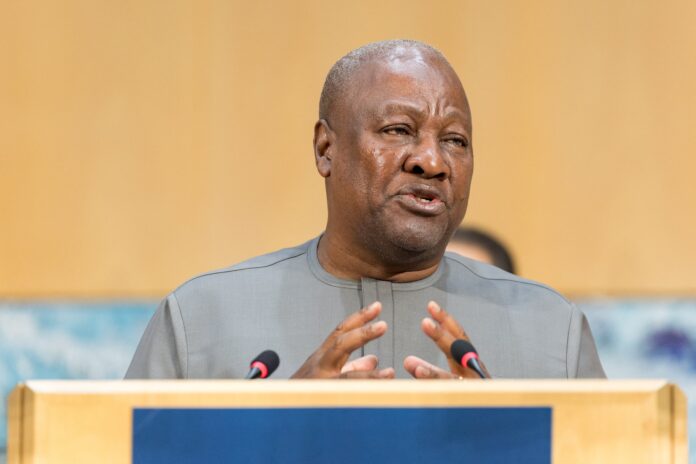
Ghana’s president and finance minister said on Wednesday that African debt was “mispriced” and there needed to be faster and fairer restructuring tools, adding that their country was targeting an investment-grade credit rating within three years.
President John Dramani Mahama and Finance Minister Cassiel Ato Forson made the comments at an investor conference in London.
The West African gold, oil, and cocoa-producing country’s economy is on the mend after a 2022 debt default that required restructuring of the government’s external and domestic debt.
Call for debt reform
“Debt restructuring mechanisms must become faster, fairer and more inclusive,” Mahama said.
Ghana had restructured its debt under the G20’s Common Framework debt-restructuring mechanism, which some have said is too slow.
Mahama called for debt reform that supports development and said the continent needs climate finance as well.
He called for the relationship with Britain to “evolve from one that is primarily shaped by aid, to one that is anchored in enterprise innovation and investment”.
“Africa is not a risk to be managed. Africa is an opportunity to be seized,” Mahama said.
Investment-grade target
Forson said Ghana should be in investment-grade territory within three years. The major international agencies currently have its sovereign rating several notches lower, in sub-investment or “junk” status.
He added that there had been a surge in state-owned enterprises that was not ideal for the economy. While investors often want to place money with the sovereign, he said that risked ballooning debt and that “government alone cannot do it”.
Ghana’s economic growth picked up pace late last year. Growth data for the first quarter of 2026, which could reflect the impact of the Iran war, is not out yet.
- Ghana's President John Mahama and Finance Minister Cassiel Ato Forson highlighted the need for faster, fairer debt restructuring tools for Africa, criticizing current mechanisms as too slow.
- Ghana is recovering from a 2022 debt default and aims to achieve an investment-grade credit rating within three years.
- Mahama called for reform in debt management that supports development and increased climate finance, urging a shift in UK-Africa relations from aid to innovation and investment.
- Forson warned against over-reliance on state-owned enterprises and government-led borrowing, emphasizing the need for broader investment to avoid ballooning debt.
- Ghana’s economic growth improved late last year, with upcoming growth data for early 2026 awaited amid global uncertainties such as the Iran conflict.


