


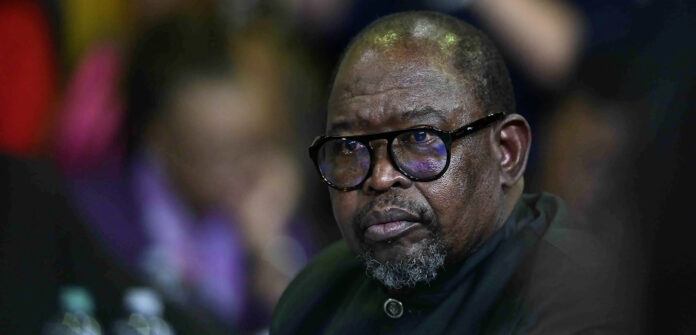
Finance Minister Enoch Godongwana has been accused of using his proxies to trigger a crisis inside the board of state-owned asset manager, the Public Investment Corporation (PIC), in a bid to collapse it and install his own allies.
This comes after this week’s dramatic implosion of the board of Africa’s largest asset manager, which manages R3.6-trillion in assets, as members resigned in succession.
The collapse of the board is the culmination of a high-stakes political power game that has pitted Godongwana against his deputy, David Masondo, who chaired the PIC until his own resignation from the board this week.
Several members of the now-collapsed board, who asked not to be named, said Godongwana was hostile from the moment they took office in September, allegedly because he opposed Masondo being appointed chair instead of his preferred candidate.
However, the minister has dismissed the claims as “lies”.
The board members alleged that Godongwana instigated instability through two members who were apparently sympathetic to him, ultimately leading to the board’s collapse.
“The minister brought his proxies to make life difficult and oppose everything the board was doing. Then they would complain to the minister, who would call us for a meeting at short notice. He brought these people in to cause chaos,” another insider said.
The board members further alleged that Godongwana told directors on three occasions that he would look for a legal basis to dissolve the board.
Sunday World has not independently verified this account.
The source said board members regarded the remarks as a threat to their tenure and believed they made it more difficult to challenge the minister on disputed decisions.
The insider said it had been clear from the outset that the minister opposed his deputy, Masondo, chairing the board.
Sunday World understands that Godongwana is considering either Deputy Minister in the Presidency responsible for Planning, Monitoring and Evaluation Seiso Mohai or Deputy Minister of Trade, Industry and Competition Zuko Godlimpi as potential chairperson of the new PIC board he will constitute.
Godlimpi is also the chairperson of the ANC NEC’s Economic Transformation Subcommittee and a co-spokesperson for the party.
Mohai was ANC chief whip in the Free State legislature before becoming MEC for Public Works, Roads and Transport in 2004 and later MEC for Finance in 2009. He returned to the National Assembly in 2013 and was appointed deputy minister in 2024.
It is also understood that labour, which has a significant stake in how government pension funds are managed, is preparing to oppose any move to sideline its representatives from the PIC.
A labour leader said such a move would trigger a major mobilisation for legislative and regulatory changes that would allow the Government Employees Pension Fund (GEPF) to invest through another asset manager.
“We know he will appoint a new board of his lackeys to capture the PIC. But workers will not allow that to happen. The GEPF belongs to workers and there is nothing stopping them from asking that their pension money be managed elsewhere,” the source said.
The source added that unions could pursue the matter through the Public Service Coordinating Bargaining Council, where worker representatives hold significant influence over the GEPF.
Speaking to Sunday World on Saturday, Godongwana denied that he had been orchestrating the crisis for months, saying he had met the PIC board only a few times over the past five years.
He also rejected claims that he had installed proxies to destabilise the board.
Godongwana further dismissed suggestions that labour could lobby for the GEPF to move its investments away from the PIC.
He said there was no intention to sideline labour from the board, adding that he had written to labour organisations requesting nominations for the new board.
He said the law was clear on how government pension funds should be invested.
“It’s not a matter of lobbying; the law is clear on this.”
Section 6(2) of the Government Employees Pension Law states that “the fund shall be controlled by a board of trustees but the investment of moneys shall be effected through the Public Investment Corporation SOC Limited”.
The PIC is also without a chief executive officer after Patrick Dlamini was suspended, a move that reportedly angered Godongwana and ultimately contributed to the collapse of the board.
The suspended CEO was accused in a whistleblower report of centralising power, attempting to fill critical positions with personal associates, bypassing both the board and the GEPF on material decisions, invoking political protection through external patrons and intervening in investment decisions that should have followed established governance processes.
A source familiar with the relationship between Godongwana and Dlamini said the two have enjoyed a close professional working relationship dating back to their time at the Development Bank of Southern Africa.
Dlamini’s rift with the board was triggered by a 2013 transaction involving the acquisition of Lanseria Airport by Acapulco, Harith General Partners and the GEPF.
Acapulco was loaned R300-million by the PIC to acquire a 16% stake in the airport.
The loan was never repaid, and compound interest increased the amount owed to R600-million.
When the PIC enforced its security by reclaiming the shares, a valuation conducted by an accounting firm appointed by both Acapulco and the PIC resulted in the asset manager paying Acapulco R411-million to cede its shares.
The payment was challenged internally, and a report compiled by auditing firm PwC questioned both the valuation and the payment.
Masondo has asked the Special Investigating Unit (SIU) to investigate the matter.
Godongwana said the outcomes of all investigations into the PIC, including the SIU probe, would reveal the true extent of any wrongdoing and identify those responsible.
A source close to the minister claimed that Dlamini was, in fact, Masondo’s preferred candidate for the position of CEO.
- Finance Minister Enoch Godongwana is accused of using proxies to destabilize the Public Investment Corporation (PIC) board, aiming to replace it with his allies, following a series of board resignations.
- The crisis reflects a political power struggle between Godongwana and his deputy David Masondo, who recently resigned as PIC chair amid tensions over board appointments.
- Godongwana denies orchestrating the collapse or installing proxies, and states he has invited labour organizations to nominate new board members, rejecting claims that labour will be sidelined.
- The PIC currently lacks a CEO after Patrick Dlamini’s suspension amid allegations of governance breaches and conflicts with the board; Dlamini is said to be Masondo’s preferred candidate.
- Labour unions threaten significant opposition if sidelined, including pushing for legislative changes to allow the Government Employees Pension Fund to invest outside the PIC.


