


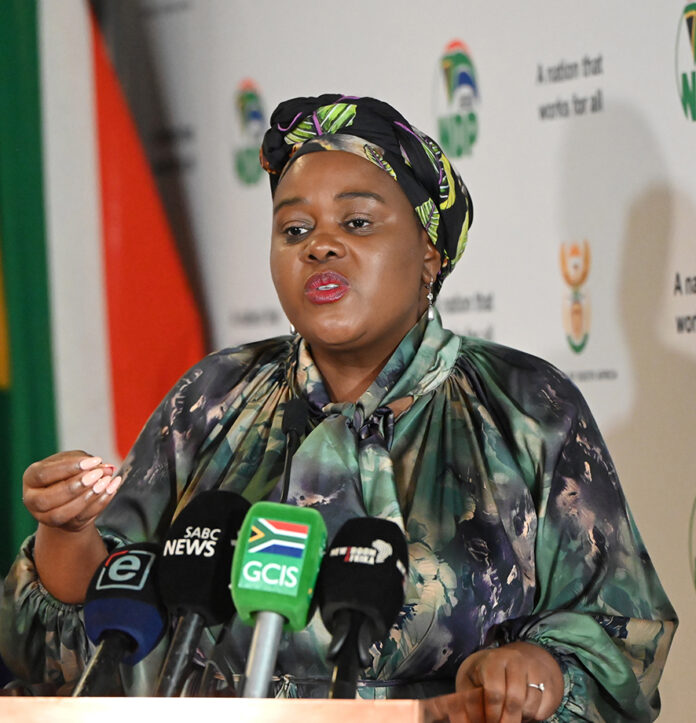
Justice and Constitutional Development Minister Mmamoloko Kubayi has told the Truth and Reconciliation Commission (TRC) Inquiry that government is accelerating efforts to provide long-awaited reparations and support to families affected by apartheid-era atrocities, saying the goal is to help victims and their relatives finally find closure.
Appearing before the commission on Friday, Kubayi outlined measures her department has undertaken since she assumed office, including settling outstanding reparations, providing educational assistance, rebuilding homes destroyed during apartheid violence and ensuring the dignified reburial of victims whose remains were recovered.
Kubayi said one of the first issues she addressed after taking office was identifying families who had still not received their reparations.
“When I arrived in the portfolio, I found that there were about 4 000 people who had not received their reparations. We published their names and called on them to come forward so they could receive the benefits that are due to them,” she said.
Funding education for qualifying beneficiaries
She said government continues to fund education for qualifying beneficiaries and expects the programme to continue until around 2037.
“Our commitment to families has not ended. We continue to support them through basic and higher education assistance, ensuring that children and dependants receive the opportunities they deserve,” Kubayi said.
The minister said significant progress had also been made in housing reparations, particularly for families whose homes were destroyed during apartheid or political violence.
“We have launched projects to rebuild homes for families whose houses were bombed or burnt during apartheid and violent conflict. This is about restoring dignity to people who lost everything,” she said.
Kubayi highlighted the completion of the Gallows Project, which focused on recovering and returning the remains of anti-apartheid activists executed by the apartheid government.
“In many African cultures, families cannot truly heal until their loved ones are laid to rest. We fast-tracked this project to ensure that the remains were returned and families could finally bury them with dignity,” she said.
Investing in memorial sites
She added that government is also investing in memorial sites to preserve the history of apartheid atrocities for future generations.
“We want future generations to understand what happened during apartheid so that these atrocities are never repeated. These memorial sites are part of ensuring that our history is remembered,” Kubayi said.
Kubayi said while some programmes remain incomplete, including aspects of medical benefits and community rehabilitation, government remains committed to seeing them through.
“This has never been a one-day exercise. It is an ongoing process involving victims, families and communities. We are proud that in many areas we have delivered reparations and helped families move towards closure,” she said.
The minister also announced changes aimed at easing the burden on families participating in ongoing inquests into apartheid-era crimes.
She said government has expanded financial assistance to transport relatives to court proceedings and amended Legal Aid South Africa’s policy to provide legal representation where necessary.
“We recognised that families should not be prevented from attending proceedings because they cannot afford to travel. We have changed our approach to ensure they can participate fully in the process,” Kubayi said.
‘Victims need support beyond financial compensation’
Kubayi said these interventions reflect government’s continued commitment to implementing the recommendations of the TRC and supporting victims beyond financial compensation.
The commission is investigating whether attempts were made to interfere with or halt investigations and prosecutions arising from cases referred by the TRC. It is also examining delays in pursuing accountability for apartheid-era crimes.
The TRC, established in 1995 under Archbishop Desmond Tutu, was tasked with uncovering gross human rights violations committed during apartheid, granting amnesty under certain conditions and recommending reparations for victims. While many victims testified before the TRC, numerous cases were referred for further criminal investigation and prosecution, many of which remain unresolved.
Kubayi is among several senior ANC leaders who have appeared before the commission. Earlier witnesses have included ANC secretary-general Fikile Mbalula and former Police Minister Bheki Cele.
- Justice and Constitutional Development Minister Mmamoloko Kubayi stated that the government is accelerating efforts to provide reparations and support to families affected by apartheid-era atrocities.
- Since taking office, Kubayi's department has settled outstanding reparations, provided educational assistance, rebuilt homes destroyed during apartheid violence, and ensured dignified reburials of recovered victims' remains.
- Government continues to fund education for qualifying beneficiaries, with the programme expected to continue until around 2037.
- The Gallows Project, focused on recovering and returning the remains of anti-apartheid activists executed by the apartheid government, has been completed.
- Financial assistance for transport and legal representation has been expanded to ease the burden on families participating in ongoing inquests into apartheid-era crimes.


