


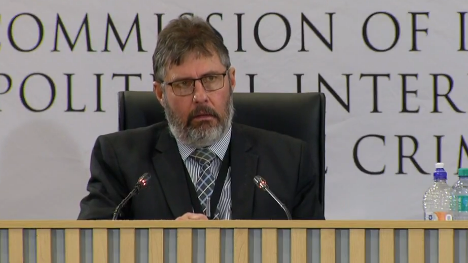
Retired Lieutenant Colonel Jakobus Prinsloo, a former member of the SAPS Directorate for Priority Crime Investigation (Hawks), has told the Madlanga commission of inquiry that his superiors ignored repeated pleas to beef up security at Port Shepstone offices, where cocaine worth an estimated R200-million was stored.
Prinsloo, who retired in May 2025, testified before the commission on Thursday, detailing the conditions at the Hawks offices where the drugs had allegedly been kept before going missing.
Severe security shortcomings
He linked the theft to severe security shortcomings, including the absence of CCTV cameras, alarms and proper access control.
He said the building had an electric fence but it became ineffective during periods of load-shedding.
“There was a code, universal code that we all used to gain access to the offices but it would be changed whenever there was a break-in.
“There was no alarm or CCTV footage, and we also did not have a receptionist because of staff shortages,” he said.
According to his testimony, another break-in occurred at the offices in January 2021, after which officials again appealed for enhanced security measures. However, no action was taken.
Just months later, in June 2021, a large consignment of cocaine was delivered to the Port Shepstone offices for storage.
Security concerns not escalated
During proceedings, commissioner Sesi Baloyi questioned why concerns about the inadequate security arrangements were not escalated through higher SAPS channels.
“Is there anything in the broader SAPS that regulates and enables a person to escalate matters? For instance, you have this huge amount of drugs that needs more security. Can you not, through this channel, express your concern about not having security considering the amount of drugs?” Baloyi asked.
“I would have faced serious consequences if I’d done that. I would have lost my job because I am only expected to report whatever issue to my direct manager, not through other channels,” Prinsloo responded.
Drug exhibits not formally recorded
He also testified that when the drug exhibits arrived in Port Shepstone, they were not sealed or formally recorded.
“Myself and the officers who were there formed a chain to pass the bricks of cocaine, and we had gloves on. We put them in storage. General Senona was present, but he was drinking coffee next to the vehicle.
“My role was to follow instructions given, but the strange thing is there was no SAP13, and the exhibits were not recorded in any register, and this was a big risk, as the exhibits could have been stolen by anyone. They were also not counted,” he said.
He stated that he did not want anything to do with the drugs because they were not kept in his office.
“I did not have the keys to that safe, and the way they came in, they were not in evidence bags, that is why I did not want anything to do with it,” he said.
He added that he had been informed there were 541 bags of cocaine but could not verify the figure because the drugs were never counted. According to evidence presented before the commission, the drugs were worth R200-million.
The testimony continues.
ALSO READ: Senona’s office ejection claim a fabrication- KZN police
- Retired Lt Col Jakobus Prinsloo testified that repeated requests to improve security at the Port Shepstone Hawks offices, where R200-million worth of cocaine was stored, were ignored by superiors.
- Major security issues included no CCTV, alarms, proper access control, a non-functional electric fence during load-shedding, and no receptionist due to staff shortages.
- Prinsloo revealed drug exhibits were not sealed, formally recorded, or counted upon arrival; no evidence registers were completed, posing a high risk of theft.
- He said he feared job loss if he escalated security concerns beyond his direct manager, highlighting a restrictive reporting culture within SAPS.
- Large cocaine consignments were stored in insecure conditions with little oversight, and Prinsloo distanced himself from handling the drugs as he lacked access to the safe and evidence bags.


