


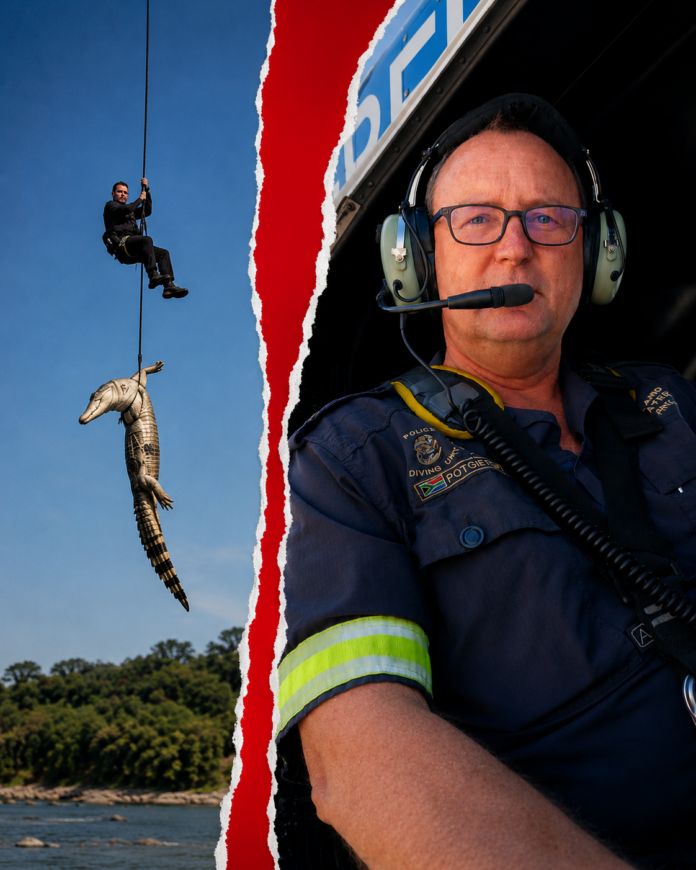
The police diver who stunned South Africans after being lowered from a helicopter into the crocodile-infested Komati River to retrieve a 500kg reptile believed to have ingested missing businessman Gabriel Batista has revealed the terrifying thoughts racing through his mind while hanging above the notorious waters.
“You start to realise the harness could break. There could be an engine problem. The helicopter could make an emergency landing. There were still crocodiles in that river.”
These are the chilling words of veteran SAPS captain Johan “Pottie” Potgieter, whose dramatic retrieval operation near Komatipoort, in Mpumalanga, turned him into a national talking point after footage of the daring mission spread across social media and international news platforms.
‘Reality struck in mid-air’
Speaking to the Sunday World, Potgieter said adrenaline initially masked the danger before reality struck in mid-air.
“When we started, adrenaline was flowing, so you don’t think too much about things that could go wrong,” he said. “But as I was hanging there, then all those things started running through my mind.”
Potgieter, the provincial diving coordinator for SAPS Mpumalanga, has spent 37 years in uniform and says policing has been his dream since childhood.
“It’s something I always wanted to do since I was a small boy,” he said.
His unit handles drowning recoveries, underwater searches for exhibits, rescues and water policing operations across the province.
Komati River is dangerous
But even among dangerous assignments, the Komati River remains one of the most feared.
“A lot of people get taken there by crocodiles. A lot of people get washed off by that low-water bridge,” Potgieter said.
Batista, a Portuguese businessman and owner of the Border Country Inn restaurant, pub and lodge in Komatipoort, disappeared after attempting to drive across the low-water bridge.
“His vehicle got washed off,” Potgieter explained. “Unfortunately, he got out of the vehicle and was washed down through rapids before ending up in a low pool.”
Crocodile ‘did not move’
Potgieter said investigators identified the crocodile through unusual behaviour.
“Usually when you fly over them with a helicopter or drone, they get scared and run back into the river,” he said. “This one didn’t move.”
The crocodile was spotted roughly 150 metres from where Batista entered the water. Its stomach was heavily bloated.
“We knew it had ingested a big meal,” Potgieter said.
The crocodile was later euthanised and investigators recovered human remains believed to belong to Batista.
But the operation uncovered an even more haunting discovery.
Potgieter confirmed that six different shoes of varying sizes, including flip-flops and Crocs, were found inside the reptile.
He said there was no way of knowing if it killed the six people or simply found their remains in the river.
“It’s open for speculation,” he said. “Maybe it just ate the shoes. Maybe it ate the feet with the shoes on.”
‘Giving grieving families closure’
Despite the grim nature of the mission, Potgieter said the operation was driven by one thing: giving grieving families closure.
“People come first. These families need closure,” he said. “So if I know for a fact, or if I strongly suspect, as in this case, that the remains are inside the crocodile, then unfortunately the animal must be put down. Families need to know what happened to their loved one so that they can bury them and try to move forward.
He explained that closure also included legal implications where estates of the deceased must be discussed with physical evidence backing their deceased status.
However, for Potgieter, the recovery missions vary dramatically, depending on terrain and conditions.
“I’ve been to operations where we were busy for only 10 minutes,” he said. “Then I’ve been on operations that lasted three months.”
The rivers of Mpumalanga, he warned, remain deadly.
In December, two soldiers were swept away and died at the same crossing. In another incident this year, nine people survived after their vehicle was washed off the bridge.
“That place is notorious,” Potgieter said. “Unfortunately, people keep on doing it.”
For South Africans watching from their phones and television screens, Potgieter’s descent into the river looked like something from an action film.
For the veteran diver, however, it was another day carrying the weight of families, fear and fate above waters where one mistake can become the last.
- SAPS captain Johan “Pottie” Potgieter performed a daring helicopter dive into the crocodile-infested Komati River to retrieve a 500kg crocodile suspected of ingesting missing businessman Gabriel Batista.
- The crocodile's unusual behavior—a bloated stomach and lack of fear towards helicopters—led investigators to believe it had consumed Batista, whose vehicle was washed off a low-water bridge in Komatipoort.
- Human remains believed to be Batista's were recovered from the euthanized crocodile, along with six different shoes, raising questions about other possible victims.
- Potgieter emphasized the mission's goal was to provide grieving families with closure and legal certainty by confirming the fate of loved ones.
- The Komati River is notoriously dangerous, with recent fatal incidents, yet people continue to risk crossing the hazardous low-water bridge.


