


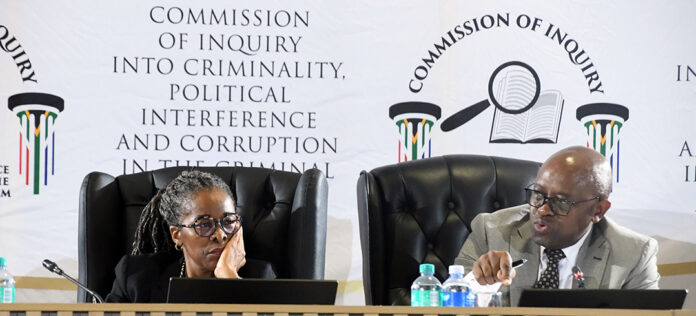
The Madlanga Commission of Inquiry on Tuesday heard that the Independent Police Investigative Directorate (IPID) did not consider it necessary to take a statement from a key witness in the case involving a 751kg drug bust because the information the witness had supplied was already corroborated through other evidence obtained during the investigation.
IPID assistant director of investigations Takalani Maphosho said this as the commission continued to hear her testimony.
Led by evidence leader Advocate Tebogo Mosikili, Maphosho was questioned about businessman Tumelo Nku’s role in the Scania drug bust in 2021, and why investigators had not interviewed him despite information suggesting he knew about the operation.
Maphosho explained that IPID’s investigation was primarily focused on the conduct of police officials involved in the operation rather than the underlying criminal case relating to drug trafficking.
Nku’s sources provided drug information
The commission heard that information received by IPID indicated that Nku had obtained intelligence from his sources about drugs and firearms allegedly destined for South Africa from Brazil.
“The informer received information through his sources about drugs and firearms that were to be delivered in South Africa. The goods were allegedly being transported from Brazil to a company called Scania,” Maphosho testified.
Nku had previously supplied information relating to criminal activities to the police but had grown frustrated by the lack of feedback from authorities, she said.
“The informer indicated that he had been giving information relating to criminal activities to the police. However, he was never kept abreast of the progress of the information he provided. As a result, he decided to provide information to another law enforcement agency and was in the vicinity on the day of the drug bust merely to observe,” she said.
Maphosho testified that intelligence received ahead of the operation suggested that Scania was expecting 11 containers from Brazil, three of which allegedly contained drugs and firearms.
“The information received was that Scania was expecting eleven containers from Brazil and amongst those containers there were three containers that were alleged to have drugs and firearms,” she said.
She added that the information was confirmed by Roseland Ngobeni, a Sea Import Controller employed by Freitan Logistics, whose responsibilities included clearing shipments between Scania South Africa and Scania Brazil.
According to Maphosho, the three containers identified through intelligence were given priority handling at the Durban Harbour before arriving at Scania.
The commission heard that investigators linked to the Booysens case acted on the intelligence and found it to be substantially accurate.
“The information was followed by the complainants in the Booysens case and indeed the information was positive. There was a drug bust at Scania,” Maphosho testified.
Firearms intelligence not pursued, dog unit not utilised
However, Maphosho said the aspect of the intelligence relating to firearms was never pursued.
“The information with regard to firearms was never followed due to the general who refused them to work at the crime scene,” she told the commission.
Maphosho further testified that although a dog unit was called to assist investigators, the dog was ultimately not used.
“The dog unit was called however, the dog was not utilised at the crime scene,” she said.
Concerns about officers’ conduct
She also raised concerns about the conduct of members of the Hawks and Crime Intelligence who attended the scene.
“If the DPCI/Hawks and Crime Intelligence members who attended the crime scene had the appetite to prevent the influx of drugs and illegal firearms into the Republic, they were supposed to get proper information from the members who were involved in the drug bust instead of arresting them,” Maphosho testified.
“The conduct of the DPCI/Hawks and Crime Intelligence members at the crime scene appears that they were protecting the owner of the drugs,” she added.
Maphosho said IPID had intended to investigate inconsistencies involving references to 700 and 715 bricks of drugs, as well as an additional brick later submitted to the Forensic Science Laboratory (FSL).
“There is no clear explanation for the inconsistencies in the number of drugs submitted at FSL,” she testified.
She said the matter had been discussed with IPID Executive Director Jennifer Ntlatseng, who requested legal advice on whether further investigations should be pursued.
“The aim was to investigate if the drugs, especially those in the changed bags, were ever submitted to FSL and, if submitted, request the laboratory to re-test the changed bag and compare it with the other bags for the purpose of confirming the contents thereof,” Maphosho said.
- The Independent Police Investigative Directorate (IPID) did not interview key witness Tumelo Nku in the 751kg Scania drug bust case as his information was corroborated by other evidence; IPID's focus was on police conduct, not the criminal drug case itself.
- Nku obtained intelligence from sources about drugs and firearms being shipped from Brazil to South Africa via Scania, and he provided info to police but later shared it with another agency due to lack of feedback.
- Intelligence indicated 11 containers were expected from Brazil, with three allegedly holding drugs and firearms; this was confirmed by a Sea Import Controller, and these containers received priority handling at Durban Harbour.
- Despite this, firearms intelligence was ignored due to refusal by a general to allow investigation at the crime scene, and a dog unit brought to assist was not used; concerns were raised about Hawks and Crime Intelligence officers' conduct, suggesting possible protection of the drug owner.
- IPID noted inconsistencies in the quantity of drugs submitted to the Forensic Science Laboratory and considered further investigation, including lab retesting, pending legal advice.


