


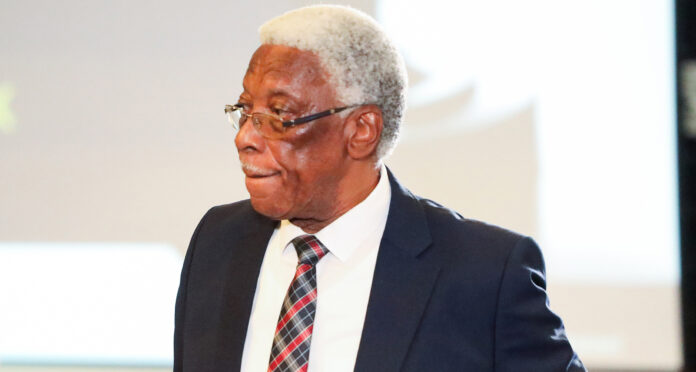
The Judicial Service Commission (JSC) has found Eastern Cape Judge President Selby Mbenenge guilty of gross misconduct—a finding that carries the consequence of possible removal from office—and is now considering whether to advise President Cyril Ramaphosa to suspend him, according to a letter sent to his attorneys.
The decision places Mbenenge on a constitutional path that could end with his impeachment, after the JSC concluded that the admitted facts are serious enough to justify his removal.
In the letter dated April 16, the Judicial Conduct Committee confirms that a complaint lodged by Andiswa Mengo, secretary at the Eastern Cape high court in Makhanda (formerly Grahamstown), triggered a formal process that culminated in a Judicial Conduct Tribunal report.
“I refer to the complaint that was lodged by Ms A Mengo against Judge President S Mbenenge of the Eastern Cape Division of the High Court,” the letter reads, adding that a tribunal “appointed in terms of section 21(1) of the Judicial Service Commission Act, 1994 (JSC Act) has submitted its report.”
Significant escalation
The provision allows a Judicial Conduct Tribunal to be formally set up, giving the JSC the legal power to escalate a complaint against a judge into a full, formal hearing that constitutes the highest level of investigation into judicial conduct.
The letter, addressed to KMNS Attorneys, who represent Mbenenge, sets out the decisive turn in the matter following the tribunal’s findings.
It states that the report was placed before the JSC, which deliberated on the issue in early March.
“As required by section 33 of the JSC Act, the Tribunal’s report and all the relevant documents were submitted to the Judicial Service Commission for consideration,” the committee writes.
At a meeting held on March 5, 2026, the JSC—sitting without members of parliament—considered both the tribunal’s report and submissions from the parties.
The outcome marks a significant escalation in the case against the senior judge.
“By a majority decision,” the letter states, the commission “made a finding that the admitted facts during the tribunal established gross misconduct rather than misconduct simpliciter.”
The committee goes further, recording the constitutional implication of that finding.
“Accordingly, in the JSC’s view, JP Mbenenge is guilty of gross misconduct under section 177(1) of the constitution,” the letter says.
This section sets the legal test for removing a judge, providing that a judge can only be removed if the JSC finds they committed gross misconduct and parliament agrees.
Written submissions
The JSC is now moving to the next phase, inviting Mbenenge’s legal team to respond as to whether he should remain in office while that process unfolds.
“You are invited to make written submissions on whether, pending the process in terms of section 177(1) of the constitution, the commission should advise the President in terms of section 177(3) to suspend Judge President Mbenenge,” the letter states.
The latter constitutional clause allows Ramaphosa to suspend a judge while the removal process is ongoing. It is not a removal yet—just taking the judge off duty temporarily.
The JSC itself cannot suspend the judge. It can only recommend it. The president makes the final call.
The commission has set a deadline for these representations, signalling that a decision on possible suspension may follow shortly after.
“If you intend to submit representations, it would be appreciated if the same could reach the Secretariat by no later than 22 May 2026,” the letter reads.
The correspondence, signed by acting JSC secretary Advocate Nelson Phakola, confirms that Mbenenge himself has been copied, formally placing him on notice as the process moves toward a potential recommendation to the president.
- The Judicial Service Commission (JSC) found Eastern Cape Judge President Selby Mbenenge guilty of gross misconduct, potentially leading to his removal from office.
- The complaint was initiated by Andiswa Mengo, a court secretary, triggering a Judicial Conduct Tribunal that investigated and reported on the allegations.
- The JSC, in a majority decision, agreed with the tribunal’s finding of gross misconduct under section 177(1) of the Constitution, which allows for a judge’s removal if parliament concurs.
- The JSC is now considering whether to advise President Cyril Ramaphosa to suspend Mbenenge temporarily during the ongoing removal process, inviting written submissions from Mbenenge’s legal team by May 22, 2026.
- President Ramaphosa holds the power to suspend Judge Mbenenge based on the JSC’s recommendation, but the final decision on removal requires parliamentary approval.


