


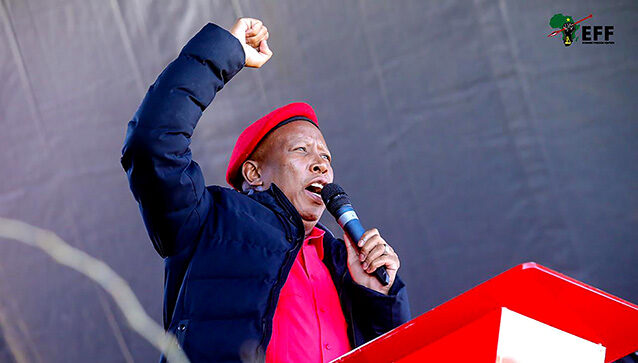
Economic Freedom Fighters (EFF) leader Julius Malema used his Youth Day address at the Union Buildings on Monday to call for peace across Africa, an end to xenophobia, free education and radical economic transformation.
Addressing a crowd of more than 80 000 supporters, Malema said South Africans must reject divisions among Africans and embrace unity across the continent.
“We are all suffering, even the Zimbabweans are suffering. How are they having a problem when they are selling bananas? I am saying not in my name. I join the struggle of people who love each other. Let there be peace in Africa. We cannot say we love South Africa and hate Africans, we are one thing.”
He added that despite constant criticism and threats against him, he would continue speaking out on issues affecting ordinary people.
“I will never beg them; I will always tell them the truth. We need peace in Africa and that peace starts here in South Africa.”
The Youth Day commemoration marked 50 years since the 1976 Soweto uprising, when black students protested against being taught in Afrikaans under apartheid education policies.
Paying tribute to the youth of 1976, Malema said their courage had paved the way for future generations.
“We say to them thank you, for not being cowards because if you were cowards, we would not be here. Be inspired by the youth of 1976 because there is nothing black and inferior. Black means confidence, intelligence and working hard to turn this country a better country,” he said.
‘Apartheid symbols must go’
Malema also outlined how an EFF government would seek to transform symbols associated with South Africa’s colonial and apartheid past.
He said the Union Buildings would be renamed because the current name reflected the union between English-speaking and Afrikaner whites.
“It is their union building. Under this place will be declared a freedom square, that big statue of Luis Botha will be demolished but the Nelson Mandela statue will remain standing. We do not want to be associated with a murderer called Luis Botha,” he added.
GNU ‘failing the youth’
Turning to the economy, Malema criticised the government of national unity, accusing it of failing to address the country’s youth unemployment crisis.
“The youth of South Africa is unemployment and many of those have given up looking for jobs. 10.6-million young people wake up to do nothing. Only the EFF can stop that unemployment by nationalizing the mines, beneficiation must happen here in South Africa,” said Malema.
Education was another key focus of his speech, with the EFF leader reiterating his party’s commitment to free education.
“Education is not like cheese or polony; it is a right. Everything must be free, from food, uniforms and books, so that our children go to school. We want to produce a generation of educated people,” he said.
Malema argued that government resources should be directed towards ensuring every child has access to education without financial barriers.
He also addressed social issues, including alcohol abuse, saying excessive drinking was damaging families and communities.
“We are in parliament saying stop the advertising of alcohol. We are not saying stop drinking, but if alcohol makes you make you beat up children, stop it. It is destroying you and the family.”
He further called for a shift in how African men are represented in society, saying alcohol should not define their identity.
- Julius Malema called for peace across Africa, an end to xenophobia, free education, and radical economic transformation during his Youth Day address at the Union Buildings.
- He emphasized African unity, condemned divisions, and paid tribute to the courageous youth of the 1976 Soweto uprising.
- Malema proposed renaming the Union Buildings, removing colonial and apartheid symbols like the statue of Louis Botha, while keeping Nelson Mandela’s statue.
- He criticized the government’s failure to tackle youth unemployment, advocating for nationalizing mines and beneficiation in South Africa to create jobs.
- Malema advocated for free education, addressing social issues like alcohol abuse, and called for a redefined identity for African men beyond alcohol-related stereotypes.


