


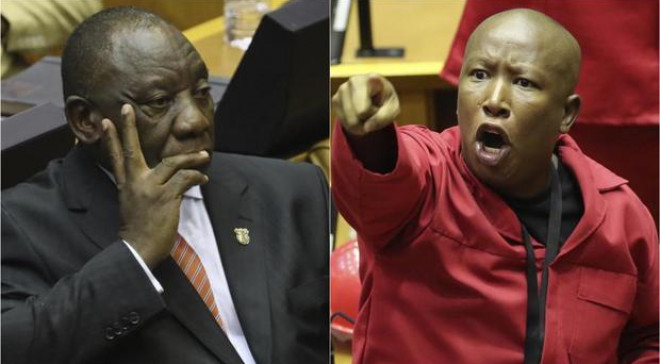
National Assembly Speaker Thoko Didiza faced fresh criticism from members of Parliament’s impeachment committee on Wednesday after EFF leader Julius Malema accused her of failing to defend Parliament against President Cyril Ramaphosa’s court challenge to the Section 89 Phala Phala report.
The disagreement emerged during a committee meeting on Wednesday, where MPs revisited Didiza’s decision to abide by the outcome of the court case instead of opposing Ramaphosa’s application.
At issue is the president’s attempt to have the findings of the independent panel chaired by former chief justice Sandile Ngcobo reviewed and set aside. The panel previously found prima facie evidence that Ramaphosa may have committed serious misconduct and violated provisions of the Constitution in relation to the theft of foreign currency from his Phala Phala farm.
Speaker’s responsibility to protect Parliament
For Malema, the matter boils down to a question of Parliament defending its own processes.
“The speaker acted wrongfully by not opposing,” he told the committee.
He argued that Ramaphosa was not simply challenging the findings of the panel but was taking aim at a parliamentary process, making it the speaker’s responsibility to protect the institution.
Malema also rejected suggestions that Didiza’s own legal advice supported her decision to stay out of the litigation.
According to him, the legal opinion obtained by the speaker recommended that she oppose the president’s application.
“The speaker’s legal advice was only one option: oppose. There were no two options,” he said.
Opposing legal advices
He accused Didiza of relying on legal advice commissioned by the committee after her own advisers allegedly recommended that she challenge Ramaphosa’s application.
“The speaker can’t rely on the legal advice of our committee. She went to get her own legal advice. It said oppose. Then the legal advice told her what she didn’t want to hear.”
Malema further accused Didiza of giving an inaccurate account of the legal advice in public interviews.
“She says when she does interviews, which is dishonest, the legal advice said I also have an option to abide. Her advice doesn’t have that option. It’s our advice and she has no right to use our advice.”
DA concurs with Malema
DA leader in Parliament George Michalakis, who first raised the issue during the meeting, shared similar concerns.
He argued that while the Speaker was expected to remain impartial when it came to the impeachment process itself, that neutrality should not extend to defending Parliament against legal action brought by the president.
“The speaker must always protect Parliament against anyone else who wants to stop Parliament from doing its job,” said Michalakis.
“The argument that the Speaker says that she needs to stand neutral in a conflict between Parliament and the president does not hold water. She cannot be neutral. She must defend Parliament. The Speaker should have backed Parliament and ourselves in this matter,” he said.
ANC MPs defend Didiza
ANC MPs on the committee disagreed.
Cameron Dugmore rejected suggestions that Didiza had aligned herself with Ramaphosa’s position, saying her decision to abide by the court’s ruling should not be interpreted as support for the president’s case.
“The notice to abide is not indicating agreement with the president’s case,” Dugmore said.
He told the committee that Didiza had consistently maintained that the impeachment committee was the body responsible for dealing with the matter and had communicated that position to both the president and the court.
According to Dugmore, correspondence before the committee showed that the Speaker had referred the matter to the committee and later filed an affidavit explaining her position.
ANC MP Mothapo Direko also defended Didiza, arguing that critics were overlooking the fact that the committee had previously received differing legal opinions on how Parliament should respond to Ramaphosa’s application.
She further argued that the committee had never formally adopted a majority position directing the speaker to litigate against the president.
“It cannot be correct that when the speaker has then legally acted on the matter where she has used her independence and ensured that she protected both the interests of the committee and her office, we then deem that action to be wrong,” Direko said.
“The speaker cannot be crucified on that decision.”
‘Impeachment committee must deal with matter’
Documents recently filed in the Western Cape High Court provide further insight into Didiza’s reasoning.
In an affidavit, the speaker argues that once the impeachment committee was established, responsibility for matters connected to the inquiry rested primarily with the committee rather than her office.
“Given that the impeachment committee is seized with the matter, and given further that the committee will ultimately report to the National Assembly on the outcome of its process, it is necessary that at this stage of the proceedings I allow the committee the latitude to deal with the matter in accordance with its mandate,” Didiza stated.
Although cited as a respondent in the proceedings, Didiza elected not to oppose Ramaphosa’s application, leaving the impeachment committee to defend the Section 89 process.
She told the court that the committee had already considered the matter and reached its own conclusions on how to respond to the litigation.
- EFF leader Julius Malema criticized National Assembly Speaker Thoko Didiza for not opposing President Cyril Ramaphosa's court challenge to the Section 89 Phala Phala report, accusing her of failing to protect Parliament's processes.
- The controversy centers on Ramaphosa's attempt to have findings from an independent panel, which found prima facie evidence of serious misconduct, reviewed and set aside.
- Malema and DA MP George Michalakis argued Didiza had a duty to defend Parliament and suggested her legal advice only supported opposing the president's application; they accused her of misrepresenting this advice.
- ANC MPs, including Cameron Dugmore and Mothapo Direko, defended Didiza, stating her decision to abide by the court ruling was not an endorsement of Ramaphosa’s case, and emphasized the impeachment committee’s primary role in the process.
- Didiza stated in court filings that the impeachment committee, not her office, is responsible for dealing with the matter and therefore allowed the committee to handle the legal defense, choosing not to oppose Ramaphosa’s application personally.


