


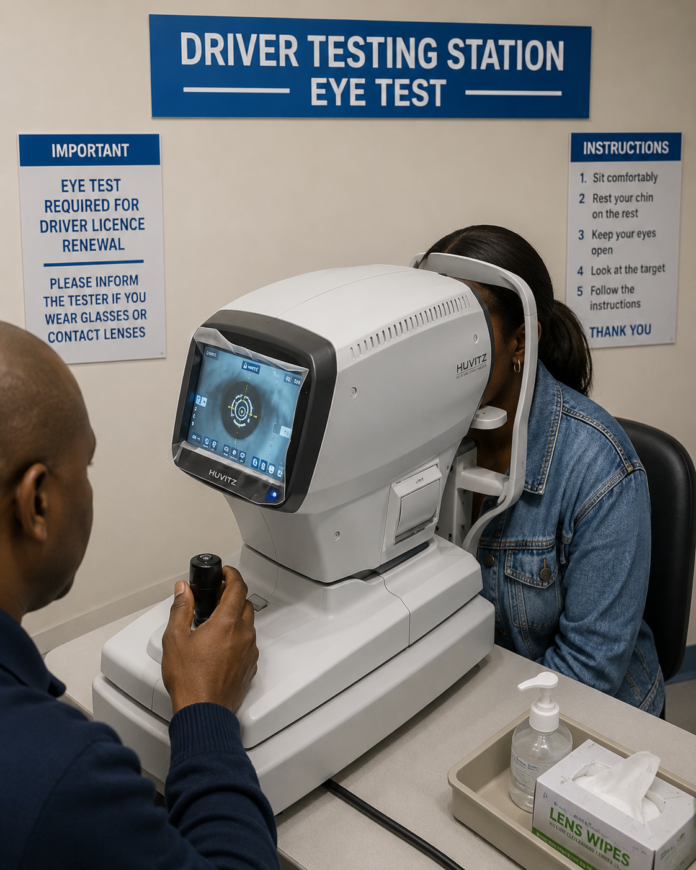
The Motor Industry Staff Association (Misa) has welcomed government’s proposal to extend the validity period of ordinary driving licence cards from five to 10 years, but says motorists should still be required to undergo compulsory eye tests every five years.
The union argues that while the planned changes will reduce administrative burdens, renewal costs and pressure on driving licence testing centres, they should not result in drivers going a full decade without mandatory eyesight screening.
Government recently published draft amendments to the National Road Traffic Regulations after Cabinet approved extending the validity period of ordinary driving licence cards from five to 10 years.
Concern over undetected vision problems
Misa national director of operations Martlé Keyter said the organisation supports the move to longer licence validity periods but believes regular eye testing remains a critical road-safety measure.
“Misa believes that eye testing should remain mandatory after five years,” said Keyter.
“Extending the licence validity to ten years without maintaining regular eye testing risks missing progressive conditions such as glaucoma, cataracts and diabetic retinopathy, all of which can severely impair driving ability.”
The union’s proposal would separate the eyesight assessment from the administrative process of replacing the physical driving licence card.
Under such a system, motorists could retain their licence cards for 10 years while still being required to undergo a vision examination midway through the validity period.
International examples support separate requirements
According to Misa, several countries already distinguish between licence validity and medical fitness assessments.
Keyter pointed to countries such as New Zealand and the UK, where licences may remain valid for extended periods while drivers are still subject to certain medical or vision requirements, particularly as they age.
“Regular eye testing is a non-negotiable safeguard that protects lives, jobs and communities,” said Keyter.
“Efficiency must go hand in hand with responsibility.”
Public invited to comment on draft regulations
The proposed amendments apply to categories A1 and A motorcycles, as well as ordinary B and EB driving licences. Heavy vehicle licence categories would continue to have five-year validity periods.
The changes have not yet come into force, and motorists must continue to comply with existing renewal requirements until the regulations are formally adopted.
Misa also believes that the introduction of longer licence validity periods, alongside the implementation of the Administrative Adjudication of Road Traffic Offences (AARTO) Act and its demerit system, should strengthen rather than weaken road-safety oversight.
The union is urging motorists and industry workers to participate in the public consultation process and support continued five-year eyesight screening requirements.
South Africans have until September 16 2026 to submit comments on the proposed regulatory amendments.
For Misa, the principle is clear: extending the life of a driving licence card should not mean allowing a driver’s eyesight to go unchecked for 10 years.
- The Motor Industry Staff Association (Misa) supports extending ordinary driving licence validity from five to 10 years but insists on compulsory eye tests every five years.
- Misa warns that skipping regular eye tests risks missing progressive vision conditions like glaucoma, cataracts, and diabetic retinopathy.
- The proposed regulations, approved by Cabinet, would apply to motorcycle categories A1 and A and ordinary B and EB licences, while heavy vehicle licences remain valid for five years.
- Misa cites examples from New Zealand and the UK where licence validity periods are extended but medical or vision tests remain mandatory.
- South Africans can submit comments on the draft amendments until September 16, 2026, as the public consultation process is open.


