


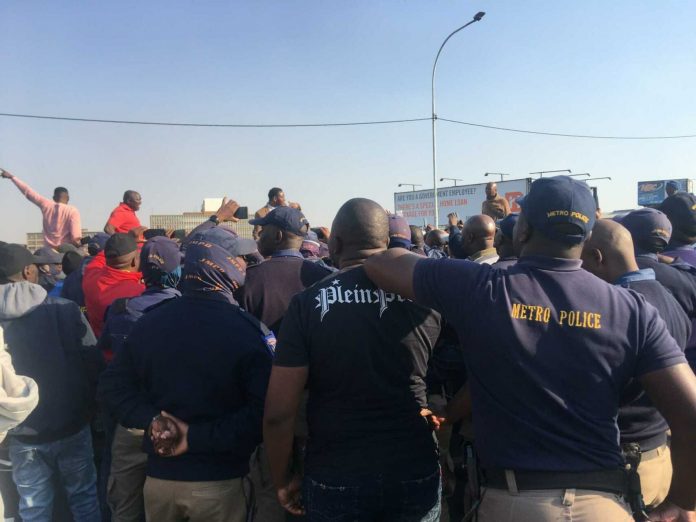
The Madlanga commission of inquiry has confirmed that the Johannesburg Metro Police Department (JMPD), the force policing the bloodstream of Africa’s biggest urban economy, is firmly within the inquiry’s legal sights as investigators widen scrutiny beyond national law enforcement agencies.
The disclosure follows social media speculation that the commission’s investigators have descended on South Africa’s richest city, demanding documents akin to how it ran probes into the Ekurhuleni Metro Police Department and testimony invitations and/or summonses.
On Wednesday, the commission spokesperson Jeremy Michaels told the Sunday World that metro police structures fall squarely inside the commission’s mandate.
“The commission’s inquiry is being conducted within clear terms of reference, which, in addition to the South African Police Service and other national law enforcement agencies, includes municipal police structures,” said Michaels.
“The Ekurhuleni Metropolitan Police Department, Johannesburg Metropolitan Police Department, and Tshwane Metropolitan Police Department are within the sights of the commission, as per its legal mandate.”
His remarks come after growing reports that records linked to specific city departments may already be under request as the commission maps its next terrain.
Sprawling economic magnet
If investigators proceed into JMPD, scrutiny could extend to procurement contracts, fleet management, overtime claims, towing and impound operations, firearm controls, disciplinary systems, deployment decisions, licensing-related corruption, bribery allegations at roadblocks, revenue leakages from fines, procurement violations, and any possible links between officials and organised criminal networks.
Such a move would carry weight because the JMPD is not a minor unit. It polices a sprawling economic magnet where migrants from across South Africa and the continent arrive daily, chasing jobs, trade, and survival.
When enforcement credibility is questioned in Johannesburg, the tremor is felt in traffic queues, business confidence, commuter trust, and public safety.
Michaels would not discuss operational details of any active inquiries. “The commission does not publicly discuss its investigations,” he said.
He added that the public would ultimately see evidence during open proceedings.
“Of course, the public is able to follow the commission’s proceedings via the hearings, where evidence collected during investigations is displayed while witnesses are testifying.”
The confirmation is likely to send a chill through the metro corridors in Johannesburg, Tshwane, and Ekurhuleni, where police departments control budgets, badges, and powers that shape daily urban life.
For now, the message from the commission is clear: Gauteng’s metro police agencies are not beyond reach.
- The Madlanga commission of inquiry has confirmed that the Johannesburg Metro Police Department (JMPD) is now under investigation, expanding scrutiny to include municipal police agencies alongside national law enforcement.
- The commission’s legal mandate covers metro police departments in Johannesburg, Tshwane, and Ekurhuleni, with demands for documents and testimonies already reportedly underway.
- Potential areas of investigation into JMPD include procurement contracts, fleet management, overtime claims, corruption, bribery at roadblocks, revenue leakages, and links to organized crime.
- JMPD’s role is critical given Johannesburg’s status as a major economic hub, where police credibility affects traffic, business confidence, commuter trust, and public safety.
- While operational details remain undisclosed, the commission will present evidence during open hearings, signalling strict oversight of Gauteng’s metro police forces.


