
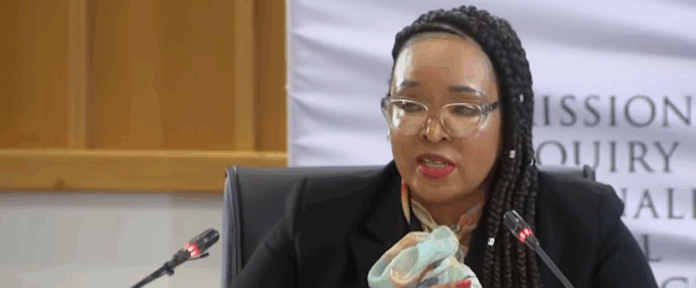
Acting national police deputy commissioner Lt-Gen Khosi Senthumule says there would have never been the Madlanga commission and parliament’s ad hoc committee probing shenanigans in the criminal justice system if the KZN police chief had been consulted before the taking away of the dockets under the political killings task team (PKTT).
Senthumule was presenting her evidence before the ad hoc committee convened at the Goodhope Chambers in Cape Town.
She testified that Mkhwanazi had no clue, even when the dockets had been taken away from KZN, about such a process, which she admits was totally flawed.
As the head of detectives at SAPS, Senthumule was involved in the controversial PKTT disbandment implementation at least from February 4, 2025.
Since this day, when she received communication from her superior, Lt-Gen Shadrack Sibiya, Senthumule had subsequently attended two meetings in March where police minister Senzo Mchunu, who is on special leave, was addressing them.
At a meeting on March 6 2025, Mchunu had given an instruction that the implementation of his December 31, 2024 directive to shut down the PKTT be expedited by April 17.
When this did not happen, Mchunu convened another meeting for March 27, where Mchunu expressed dissatisfaction with how Senthumule and crime intelligence boss, Lt-Gen Dumisani Khumalo, who is project manager for the PKTT, were dragging their feet on the matter.
‘Sidelining riled Mkhwanazi’
This apparently excited Sibiya, who was itching for the implementation of Mchunu’s directive to close the PKTT. When Senthumule and Khumalo started moving with speed in April, to not disappoint Mchunu, it was then that Senthumule realised the most important person in the whole saga – Mkhwanazi – had been excluded all along.
She believes this is ultimately what pushed Mkhwanazi over the cliff to call his famous July 6 press conference blowing the lid open on the extent of the rot besieging the criminal justice system in the country.
“On April 25, I called the PC (Mkhwanazi). He was confused by the dockets being in Pretoria and having to return to KZN. He said he could not accept those dockets. As the custodian of the PKTT dockets (which were opened in his jurisdiction of KZN), he did not know that the dockets were moved to Pretoria,” said Senthumule.
“He refused to take the dockets and said, ‘Even if you bring the dockets to KZN, I will not be responsible.’ I was concerned, and one of the things I did was to apologise and that is when it dawned on me that the process had been flawed.
“If the PC (Mkhwnazi) was not involved and informed, for me the whole process was suspicious. The deliberate exclusion of the PC, if that did not happen, these committees would not be sitting. We blundered. All of us were not supposed to work outside the provincial commissioner (Mkhwanazi).”
Dockets hot potato
When Senthumule went to inform national commissioner Gen Fannie Masemola about her discovery that Mkhwanazi had been kept in the dark, Masemola also distanced himself from the removal of the dockets from KZN.
He kicked the can down the road to Sibiya’s direction, saying he must decide what to do with the dockets, which at that point had become a political hot potato no one wanted to touch, and that is the point at which Senthumule too left the whole saga, she testified.
‘Mchunu overreached’
Asked whether she believed that Mchunu’s unilateral decision to disband the PKTT smacked of political interference, she responded with an emphatic “yes” before explaining her answer.
“The minister (Mchunu) could not have involved any operation person but had an obligation to call a meeting with IMC (Inter-Ministerial Committee), but he could not sit alone and make those decisions. He overreached; the intentions might have been good, but the process was flawed,” she charged.
“The exclusion of the PC (Mkhwanazi) led us to where we are today. Had he been involved, the outcome would have been different. It’s not about the person but the process.”
Senthumule is now getting a grilling from members of the committee.