


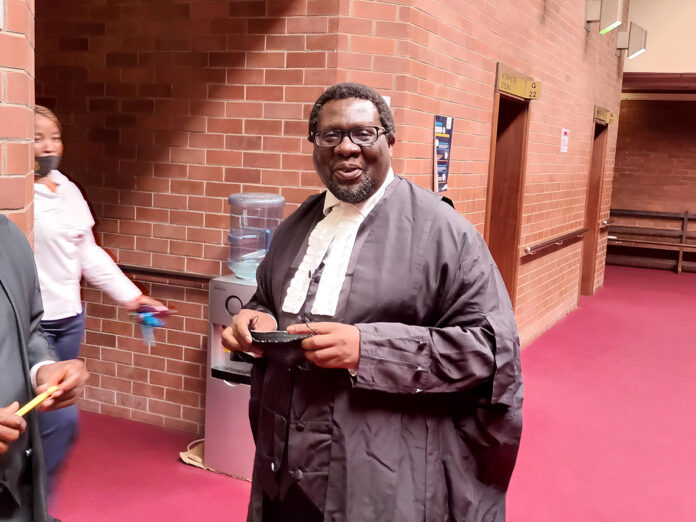
Senior advocate Thandazani Griffiths Madonsela has hit back at President Cyril Ramaphosa’s suggestion that he could harbour a grudge against him after being replaced as the president’s nominee to the Judicial Service Commission (JSC).
Madonsela says the president’s argument is not supported by the facts and is contradicted by his own response when Ramaphosa replaced him in 2022.
In a strongly-worded response to Ramaphosa’s submissions opposing his appointment as chief evidence leader in the Section 89 impeachment inquiry, Madonsela said the president had failed to point to anything he had said or done that suggested he bore a grievance against him.
Ramaphosa has argued that Madonsela’s replacement as his JSC designee shortly after the 2022 interviews for the appointment of the Chief Justice created a “reasonable apprehension” that he could harbour a sense of grievance towards the president and act on it.
Record reflects differently
But Madonsela says the record tells a different story.
READ: Mbalula reveals Madonsela’s prior work for ANC on Phala Phala impeachment inquiry
He said he had no dealings with Ramaphosa during his two years on the JSC because a presidential designee served as a commissioner bound by the Constitution, rather than as the president’s representative.
Madonsela said his tenure ended through the ordinary constitutional mechanism, which allows those who designated JSC members to replace them without giving reasons.
He also pointed to his response to Ramaphosa after being informed of his replacement.
According to Madonsela, he thanked the President for the courtesy of advance notice, expressed gratitude to Ramaphosa and then Justice Minister, Ronald Lamola for the privilege of serving for two years, said it was an honour to have been “considered worthy of the designation” and wished Ramaphosa “every success in your service to the Nation”.
“More than four years have passed. I have had no dealings with the President since,” Madonsela said.
“The alleged apprehension the President advances is therefore not factually grounded. It is also contradicted by the contemporaneous record.”
Madonsela said Ramaphosa had not alleged that he had ever said or done anything suggesting a grievance.
“Reduced to its core, the submission is that replacement alone suffices,” he said.
“That is obviously untenable.”
Dangerous precedent
Madonsela argued that accepting such reasoning would mean that people appointed, replaced or dismissed by Ramaphosa could automatically be presumed to harbour a disqualifying grievance against him.
His response forms part of a broader rejection of Ramaphosa’s objections to his appointment as evidence leader for Parliament’s Section 89 inquiry into the president.
Madonsela said the facts relied upon by Ramaphosa had already been disclosed to Parliament before the committee voted on his nomination.
READ: Ramaphosa moves to block Madonsela as impeachment evidence leader
He disclosed on July 27 that Ramaphosa had designated him to the JSC in March 2020 and that the designation ended in March 2022. He also mentioned that he had briefly advised on two legal opinions relating to the impeachment process.
Madonsela said the opinions dealt with Parliament’s procedural options in Ramaphosa’s application for an interdict and whether National Assembly rules should require members to be fit and proper persons.
He stressed that he had not advised on the merits of the allegations against Ramaphosa, was not privy to the underlying facts and had been released from the brief on July 5.
The African National Congress (ANC)’s position has also featured prominently in the dispute.
Madonsela said the party had disclosed that he had been briefed to advise it on matters relating to the Section 89 rules and processes, but had expressly stated that its disclosure did not constitute an objection to the committee’s decision and did not question his integrity or independence.
He further pointed out that ANC members on the committee abstained when his nomination was put to a vote rather than voting against him. The committee ultimately recommended Madonsela by nine votes to seven, with the ANC members abstaining.
Evidence leader’s powers not similar to judge’s
Madonsela rejected the premise that an evidence leader should be subjected to the same recusal test as a judge or other decision-maker. He said the chief evidence leader does not vote, make findings or decide whether Ramaphosa should be removed from office.
Instead, he points out that the evidence leader assists the committee in identifying and placing relevant evidence before it, while Ramaphosa and his legal representatives retain the opportunity to test that evidence.
For Madonsela, the issue is therefore not whether he has previously had professional dealings with Ramaphosa or the ANC, but whether there is actual evidence that those dealings would prevent him from performing his role fairly.
“The law does not permit pre-emptive disqualification based on speculation about how he might act,” he said.
Madonsela said the President’s objections ultimately amounted to speculation about what he “may” know or how he “may” behave rather than evidence of an actual conflict. He has asked that his response be placed before the impeachment committee and circulated in the same manner as Ramaphosa’s submissions.
On Wednesday the impeachment committee met and discussed Ramaphosa’s view that Madonsela is conflicted and should not lead evidence in the inquiry.
After much debate the committee concluded that they should seek a legal opinion on the president’s view.
Only the EFF and MK Party were against this move, as they were outvoted by the ANC, DA, Build One SA, ActionSA, IFP, ACDP and the Freedom Front Plus.
- Senior advocate Thandazani Griffiths Madonsela refuted President Cyril Ramaphosa's claim that Madonsela harbours a grudge after being replaced as the president's Judicial Service Commission nominee in 2022.
- Madonsela stated that his replacement followed constitutional procedures allowing designees to be replaced without reasons, and he expressed gratitude and respect to Ramaphosa upon being replaced.
- Ramaphosa argued that Madonsela’s replacement created a reasonable apprehension of bias, but Madonsela countered this with no evidence of grievance or conflict.
- The parliamentary committee recommended Madonsela as the chief evidence leader in the Section 89 impeachment inquiry by nine votes to seven, with ANC members abstaining.
- The impeachment committee agreed to seek a legal opinion on Ramaphosa’s conflict of interest claim against Madonsela, with only the EFF and MK Party opposing this decision.


