


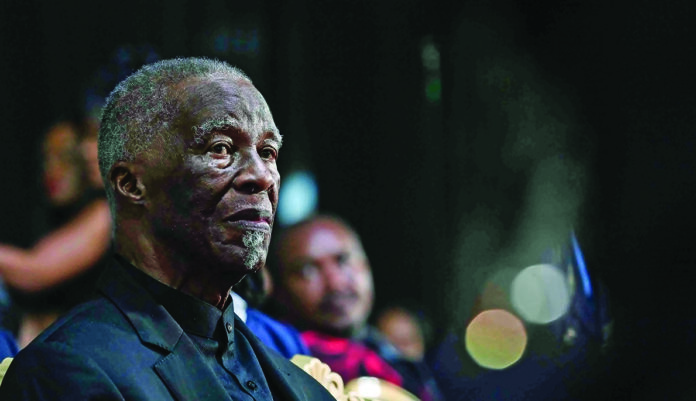
What’s Thabo Mbeki on about? The counter-revolution, it seems, is upon us all, according to our former president. But is this myth, reality or perhaps what some say amounts to excuses for ANC failures over the past three decades? Let’s take a closer look and ask some uncomfortable questions.
The term “counter-revolution” emerged during the French Revolution. The earliest known use of the English word dates from 1791, referring to movements in France that opposed the Revolution and sought to reverse its outcomes. Some sources credit French philosopher Joseph de Maistre (1753–1821) with forming the German equivalent, Konterrevolution.
The definition states that “a counter-revolution is a revolution or political movement that opposes a preceding revolution and seeks to reverse its results”. It can also refer to a movement that resists revolutionary tendencies. The term describes the overthrowing of a revolutionary government and the ideology of restoring a previous regime or social order.
The happenings post-1990, after FW de Klerk’s speech unbanning all political formations and releasing all political prisoners, including Nelson Mandela, are numerous. Negotiations started in earnest, to the chagrin of many in his party. So-called “black on black” violence erupted. The assassination of Chris Hani took place in Boksburg. Right-wing elements set off bombs just days before the historic 1994 elections. The IFP marched on the ANC headquarters in Johannesburg and got massacred. De Klerk had to fire three of the SADF generals who were hell-bent on causing havoc because they were not in agreement with the sweeping changes in their beloved racist country.
What happened to all the racist apartheid defenders?
On the one hand were civil society racist types such as the AWB, Broederbond, Jeugkrag and Witwolwe. On the other were government structures, such as the SADF, SAP, SB, NIS, BOSS and a plethora of covert collections. All these together had one strategic goal: to defend this crime against humanity called apartheid.
Another important element is the collaborators from the progressive black forces. Those among us liberation fighters who decided to betray the revolution and the cause, collaborate, work in service of and spy for their apartheid masters. Impimpis, askaris and spies among liberation organisations in total service to the apartheid system.
Where are all these people today and for the past 32 years? Many whites and the black chattering classes would like us to believe these people accepted their fate in the new non-racial, democratic South Africa. They want us to believe that “state capture” from 2008 to 2018 was the fault of the corrupt ANC only. Not of their collaborators in the ANC deliberately facilitating such.
The decline of the South African Revenue Service (Sars) under Tom Moyane, appointed by then-president Jacob Zuma. The decline of Eskom that led to loadshedding. The almost takeover of the National Treasury through the appointment of Desmond van Rooyen. And the July 2021 protests and looting suggest the ineptitude of our SAPS and intelligence agencies.
Before I hear you say “cadre deployment is the reason”, it is the same ANC that deployed cadres who brought the institutions back from the abyss. Edward Kieswetter had to undo Moyane’s mess at Sars. It is Cyril Ramaphosa’s appointment that saw Eskom end loadshedding. Enoch Godongwana’s appointment took care of business instead of Desmond “The Weekend Wonder” at the Treasury. And Shamila Batohi’s appointment took care of Shaun Abraham’s penguin’s mess. To mention but a few.
Mbeki recently also spoke about why he thinks the MK Party came about and got overwhelming support mainly from KZN. He says it too is a result of the National Security Management System that continues to operate since its establishment under apartheid. By implication, he is saying some MK Party members are collaborators of their apartheid masters. We all know the then-IFP was a third force funded and supported by the apartheid security establishment . Hence its role and participation in the black-on-black violence that led to the deaths of thousands in the early 1990s.
If we take all of this together, is it far-fetched to suggest that the counter-revolutionists are in full swing to this day? Is it really an excuse on the part of the ANC to say: “Yes, we have our fair share to answer for these last few years,” but I reckon Mbeki is on to something here.
• Dr Van Heerden is a senior research fellow at the Centre for African Diplomacy and Leadership at UJ
- The term “counter-revolution” originates from the French Revolution and describes movements opposing or seeking to reverse a preceding revolution.
- Post-1990 South Africa saw right-wing violence, political assassinations, and interference from apartheid supporters aiming to protect the racist regime.
- Collaborators from progressive black forces worked as spies and agents for the apartheid system, undermining the liberation cause.
- The period of state capture from 2008 to 2018 involved both corrupt ANC officials and their collaborators, contributing to institutional decline.
- Thabo Mbeki suggests that ongoing influences from apartheid-era security structures contribute to continued counter-revolutionary activities in South Africa.


