


Political parties in Mpumalanga are increasingly tailoring their campaigns around the issues dominating community conversations as the race towards the November 4 local government elections begins to intensify.
From free driver’s licences and sports tournaments to anti-illegal immigration campaigns and border security rhetoric, parties appear to be betting that voters will respond more readily to bread-and-butter concerns than traditional political promises.
The shift comes as municipalities across the province grapple with unemployment, crime, service delivery failures and growing public frustration over undocumented immigration.
Quest for resonance
Rather than relying solely on manifestos and policy documents, parties are increasingly taking their campaigns directly into communities, aligning themselves with issues already resonating in villages, townships and informal settlements.
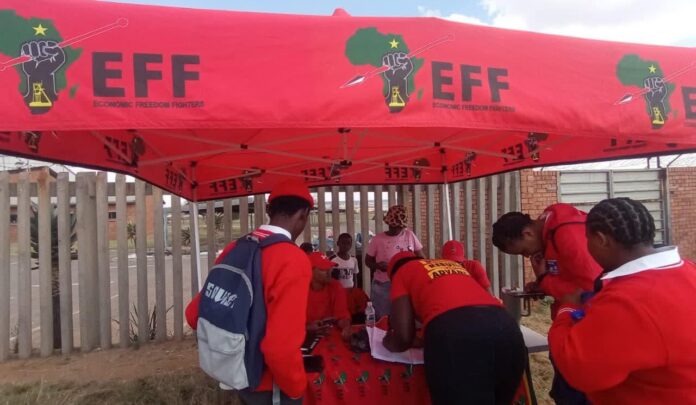
The EFF has chosen to focus heavily on youth mobilisation, offering free driver’s licence training and testing opportunities while using soccer and netball tournaments to attract young voters.
EFF Mpumalanga leader Collen Sedibe said the party’s immediate priority was registering young people who have not yet signed up to vote.
“The EFF is in a process of massive voter registration. Its focus is mainly on the youth who are eligible to vote but not registered with the IEC to vote on the 4th of November going forward,” said Sedibe.
He said branches and municipalities had been assigned registration targets ahead of the end of June.
“Each ward or branch of the EFF and the sub-regions (municipalities) has its own targets that they must reach before the end of June.”
Drawing young people into politics
Sedibe said the party was deploying a range of initiatives aimed at drawing young people into politics.
“The EFF is engaged in various programmes to lure young people to register and vote EFF in the upcoming local government elections through door-to-door campaigns, soccer and netball tournaments, free driver’s licences for matriculants who are still at high school, matriculated youth who are languishing in villages and townships without employment, as well as students in tertiary institutions.”
The party has even turned to churches as part of its voter registration drive.
“We also have a programme of church visits to request pastors to allow the EFF to register unregistered youth after church services,” Sedibe said.
Confident about the strategy, he predicted strong electoral gains for the party.
“With this plan and strategy, we are cock sure that if it is implemented fully without fail by all the branches and sub-regions, the EFF will emerge victorious in all the seventeen local municipalities and three district municipalities of Mpumalanga.”
Undocumented immigration
Meanwhile, the DA has thrown its weight behind one of the country’s most divisive and politically charged issues — undocumented immigration.
During Thursday’s budget debate for the Department of Community Safety, Security and Liaison in the Mpumalanga Legislature, DA spokesperson on community safety Teboho Sekaledi accused government of ignoring public anger over porous borders and organised crime.
“We cannot dare shy away from mentioning that the influx of undocumented immigrants is exacerbating the situation and making our people revolt,” he said.
The intervention comes amid growing anti-illegal immigration protests in several parts of South Africa and follows President Cyril Ramaphosa’s recent defence of government’s handling of migration and border security ahead of the 30 June deadline for undocumented foreign nationals to regularise their status or leave the country.
Sekaledi questioned whether government was allocating sufficient resources to tackle crimes often associated in public discourse with undocumented immigration.
“Has any portion of this budget set aside to deal with the current burning issue in the country: the fight against undocumented immigrants, drug dealers, human traffickers, kidnappers, hijackers and cyber scammers?” he asked.
‘Politicians out of touch’
The DA MPL argued that many political leaders were insulated from the realities facing ordinary South Africans.
“Most politicians here live in gated communities and mansions, with security details and medical aids. They are probably not in touch with the reality of our people on the ground.”
He said communities were increasingly frustrated by crime, unemployment and lawlessness.
“Our people are fed up with crime, unemployment, illegal mining, corruption, GBVF and undocumented immigrants who often bring illegal guns and drugs into the country.”
Sekaledi also accused government of turning against citizens who raised concerns about border security.
“If safety is a shared societal obligation, then why is the South African Government and SAPS threatening South Africans who rose up and pointed out government’s failures on porous borders that bring undocumented immigrants, drug dealers, human traffickers, kidnappers, hijackers and cyber scammers into our country?” he asked.
ActionSA steadfast on immigration issues
ActionSA, whose national political identity has long centred on immigration enforcement and law-and-order issues, is pursuing a similar strategy in Mpumalanga.
The party this week rallied behind Nkangala regional secretary Sibonezo “Sotobe” Nkolanyane after he allegedly faced intimidation following his participation in a March and March protest in Delmas.
In a statement issued on Thursday, ActionSA linked the incident directly to community concerns over illegal immigration and law enforcement.
“The march formed part of ongoing community concerns regarding illegal immigration, law enforcement and compliance with South African laws,” the party said.
ActionSA said all individuals residing and conducting business in South Africa should do so legally and in accordance with the country’s laws.
#Spaza4Locals campaign
The party further used the incident to reinforce its #Spaza4Locals campaign, which advocates stricter enforcement against unlawful business operations while promoting economic opportunities for South Africans.
“This incident further highlights the importance of ActionSA’s #Spaza4Locals campaign, which advocates for lawful business practices, proper enforcement of regulations and economic opportunities for South Africans, while ensuring that the rule of law is applied fairly and consistently,” the party said.
With less than five months before voters head to the polls, political parties appear increasingly focused on meeting voters where their frustrations already lie.
For the EFF, that means licences, sport and youth unemployment. For the DA and ActionSA, it means tapping into growing concerns over crime, border security and undocumented immigration.
As campaigning gathers momentum, the battle for Mpumalanga’s municipalities is shaping up to be less about ideology and more about who can best convince communities that they understand the problems unfolding on their doorstep.
Visit SW YouTube Channel for our video content
- Political parties in Mpumalanga are focusing their local election campaigns on immediate community concerns like youth unemployment, crime, service delivery, and undocumented immigration rather than traditional political promises.
- The EFF targets youth mobilization through initiatives such as free driver's licenses, sports tournaments, door-to-door voter registration, and church visits, aiming to secure votes across all municipalities.
- The DA centers its campaign on anti-illegal immigration rhetoric, criticizing government border security and linking undocumented immigration to increased crime and social unrest in communities.
- ActionSA emphasizes law enforcement and immigration control, supporting protests against illegal immigration and promoting the #Spaza4Locals campaign to ensure lawful business operations benefiting South Africans.
- Election strategies in Mpumalanga reveal a shift from ideology to pragmatic outreach, with parties seeking to resonate with voters by addressing pressing, everyday issues in towns and informal settlements ahead of the November 4 polls.


