


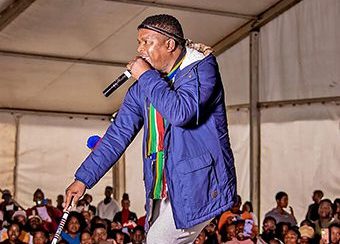
Social media and Zulu nationalism populist Ngizwe Mchunu has completely broken ranks with the anti-illegal immigration movement organised under the March and March organisation.
This incident has brought the divisions of the movement that came into the public glare on the eve of the June 30 deadline for undocumented illegal foreigners to leave South Africa after Mchunu and Insizwa Nobunsizwa Foundation boss Nkosiikhona Ndabandaba met President Cyril Ramaphosa without March and March leader Jacinta MaNgobese Zuma.
Since then, rumours of Mchunu selling out and taking “imali engcolile” started to swell, and this week, March and March officially divorced itself from him.
All hell broke loose, with Mchunu’s most favourite phrase now being “we cannot march forever”, a direct assault on March and March’s slogan of marching perpetually “until we win”.
Ngizwe goes it alone
Mchunu has since positioned himself as the number one opponent of March and March and is running an alternative movement which he claims is solution-based.
Fresh from his divorce with March and March, Mchunu met on Wednesday with the station commander of the Hillbrow Police Station to receive feedback on the memorandum of demands delivered on June 30.
Mchunu came out of the police station bouncing like a tennis ball, now running his operation away from March and March.
‘Gear of actions’
With his audience cheering him on with “Zulu” war cries, Mchunu announced that he was done marching and had agreed with the police to start an action operation to raid several buildings in Hillbrow as of August 5.
“The meeting was very successful such that the Hillbrow Police Station commander has committed to work with us fully to hunt down Nigerians selling drugs when we do unannounced raids all over Hillbrow,” said Mchunu.
“We cannot march forever without results. Some of us have now hit a gear of actions and we shall be having no more perpetual marches and endless meetings. If government and police do not act urgently, we will end up hurting each other. We are winning.”
‘We saw it coming,’ Mbalula gloats
Meanwhile, ANC secretary-general Fikile Mbalula on Tuesday mocked the divisions that have rocked the anti-illegal foreigners movement, saying it was inevitable because the movement itself has always been political.
Mbalula patted himself on the back for predicting the cracks, saying he had long seen it coming when Ndabandaba commented that the IFP must be given a chance in Joburg during the upcoming local government elections.
Ndabandaba, affectionately known as “Phakel’umthakathi”, is a former fully-fledged IFP politician in his hometown of KwaNongoma, north of KwaZulu-Natal.
Mbalula fell short of saying Ndabandaba might well be announced as the IFP mayoral candidate for his hometown.
According to Mbalula, the hidden political motives of March and March movement leaders were always bound to clash.
This was because when Ndabandaba, for instance, was heaping praises for IFP, March and March face Ngobebe-Zuma had thrown her weight behind the MKP.
Mchunu was, meanwhile, a notorious political gambler who appears to go with the highest bidder, having backed the ANC multiple times in recent history.
They began to espouse politics
“They were accused among other things that they are fermenting this thing (the anti-illegal immigration wave) because of political interest to undermine the democratic state by vested interests, both domestic and international, and that they are being given money – something that we cannot prove,” said Mbalula.
“But over and above that, they began to espouse politics. It is a well-documented fact that we were called by name repeatedly by some leaders of this March and March movement, saying that the ANC must be isolated and that certain political parties must be recognised.
“You want to tell me there is no political element there? And I did say that you will see…it has got a hand behind it that is political and that they will end up fighting among themselves,” he went on.
- Ngizwe Mchunu has split from the March and March anti-illegal immigration movement after meeting President Ramaphosa without the group's leader.
- Mchunu now leads a separate, action-focused campaign, collaborating with Hillbrow police for raids against drug-related activities by Nigerians.
- He rejects the perpetual marching strategy of March and March, emphasizing direct action instead.
- ANC Secretary-General Fikile Mbalula predicted the movement's internal divisions, highlighting underlying political motives among its leaders.
- Mbalula criticized the movement's politicization and accused leaders of using the cause for political gain, causing inevitable clashes.


