


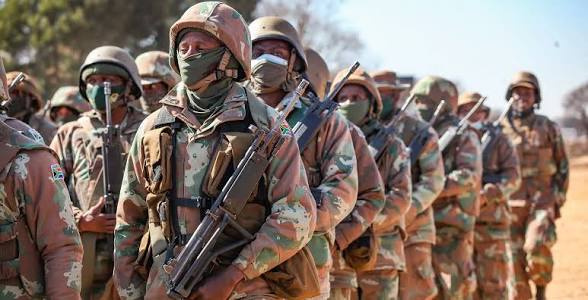
South Africa’s battered military could finally be marching towards redemption after years of public ridicule, deadly foreign deployments, shrinking budgets and extraordinary scenes of generals speaking out against the slow decay of the country’s armed forces.
The cabinet on Thursday approved a sweeping long-term rescue blueprint aimed at rebuilding the South African National Defence Force (SANDF) into what the government describes as a modern, resilient and future-ready force capable of defending the country both at home and beyond its borders.
The announcement was made by Minister in the Presidency Khumbudzo Ntshavheni during a post-cabinet media briefing in Pretoria.
SANDF’s battered image
For years, South Africans have watched the SANDF transform from a feared continental force into an institution increasingly mocked on social media and pitied by citizens as soldiers battled ageing equipment, grounded aircraft, deteriorating infrastructure and shrinking operational budgets.
The military’s public image sank so low that the derogatory nickname “Mabena” became shorthand for incompetence after a viral training video showed a struggling soldier battling to operate a cannon.
National security crisis
Behind the mockery, however, lay a much deeper national security crisis. Now government says that decline must end.
“After decades of constrained funding, ageing platforms and under-resourced capability development, the SANDF has developed a force evaluation strategy that is structured according to the milestones outlined in their journey to greatness plan,” Ntshavheni said.
She said the strategy links defence modernisation, regional stability and economic growth “to create a resilient and future-ready defence force”.
According to Ntshavheni, the approved long-term force evaluation strategy and planning concept will ensure the military is capable of responding both to domestic threats and long-term external missions.
Bid to restore army’s dignity
The plan also signals an attempt to restore dignity to a military institution that many South Africans still believe remains strategically important despite years of decline.
Successive deployments in conflict zones such as the Democratic Republic of the Congo and Mozambique exposed serious concerns about equipment shortages, troop readiness and the long-term sustainability of South Africa’s military ambitions.
Retired generals increasingly broke ranks publicly, warning that the SANDF was being expected to defend a modern state with declining resources.
In one of the most controversial episodes in recent years, Navy Chief Admiral Monde Lobese reportedly accused National Treasury of effectively sabotaging the military through severe budget cuts, dragging frustrations inside military circles into the national political arena.
Border security failures
Lt-Gen Ntshavheni Maphaha also caused waves after publicly criticising failures around border security and warning that soldiers were being expected to secure the country with inadequate resources.
The public frustration reflected a deeper institutional wound. Soldiers who once represented continental military prestige increasingly found themselves at the centre of memes, criticism and national anxiety over whether South Africa still possessed a credible defence force.
The SANDF occupies a symbolic place in the democratic era. Formed after 1994 from liberation armies, homeland forces and the former apartheid military, it was meant to embody unity, sovereignty and continental leadership.
Call for real action
But analysts have repeatedly warned that budget reductions and operational overstretch were slowly hollowing out that vision.
The new strategy now places enormous pressure on government to prove that the turnaround will involve more than policy documents and political promises.
For many South Africans, the real test will not come during media briefings or cabinet statements.
It will come the next time the nation’s soldiers are called upon to defend the republic, patrol dangerous borders or enter foreign conflict zones wearing the South African flag on their shoulders.
- South Africa's cabinet approved a long-term rescue plan aimed at transforming the battered South African National Defence Force (SANDF) into a modern, resilient, and future-ready military capable of domestic and foreign defense.
- The SANDF's reputation has suffered due to ageing equipment, underfunding, operational failures, and public ridicule, highlighted by viral videos and social media mockery.
- Government acknowledges a deep national security crisis stemming from decades of budget constraints, equipment shortages, and under-resourced capabilities.
- The new strategy aims to restore the SANDF's dignity and operational readiness, addressing concerns raised by retired generals and current military leaders about inadequate resources and border security failures.
- Analysts warn the success of this plan hinges on effective implementation beyond promises, with the true test being the SANDF's performance in future domestic and international missions.


