


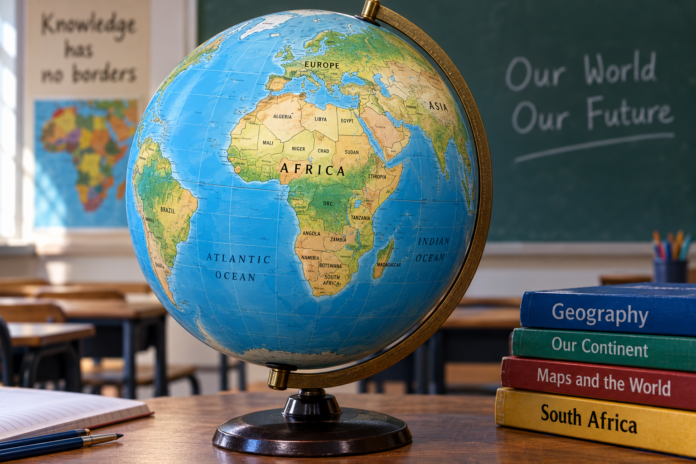
South Africa could review the maps used in school textbooks and classrooms after a landmark United Nations vote challenged centuries-old representations that make Africa appear disproportionately smaller.
Portfolio Committee on Basic Education chairperson Joy Maimela cautiously welcomed the global development but stressed that Parliament had made no decision to replace existing maps. She wants the Department of Basic Education to first establish what projections schools currently use, what changes are scientifically justified and how much implementation could cost.
The intervention follows the UN General Assembly’s adoption of the African-led “Correct the Map” resolution on September 4 by 164 votes to one, with six abstentions.
READ: UN backs African push to redraw world map
The resolution encourages the use of equal-area projections, including Equal Earth, when comparing the relative surface areas of countries and continents. It neither bans the familiar Mercator projection nor prescribes one map for every purpose.
Maimela told Sunday World that the committee welcomed the resolution and supported its educational objectives in principle.
However, she said Parliament needed evidence before contemplating changes to curricula, textbooks or procurement.
“Before taking a formal position on changes to curriculum, textbooks or procurement, the Committee needs a factual and costed assessment from the Department of Basic Education,” Maimela said.
She believes the starting point should be an audit rather than an expensive rush to replace books.
“A targeted national review would be appropriate,” she said.
“This should establish which projections are currently used in approved textbooks, atlases, classroom maps, examination materials and digital resources; whether projection-related distortion is adequately explained; and whether the maps being used are appropriate for their educational purpose.”
Africa map debate reaches schools
The global controversy centres on the Mercator projection, developed by Flemish cartographer Gerardus Mercator in 1569 primarily for navigation – when the spherical Earth is transferred onto its familiar rectangular map, territories closer to the poles become increasingly enlarged.
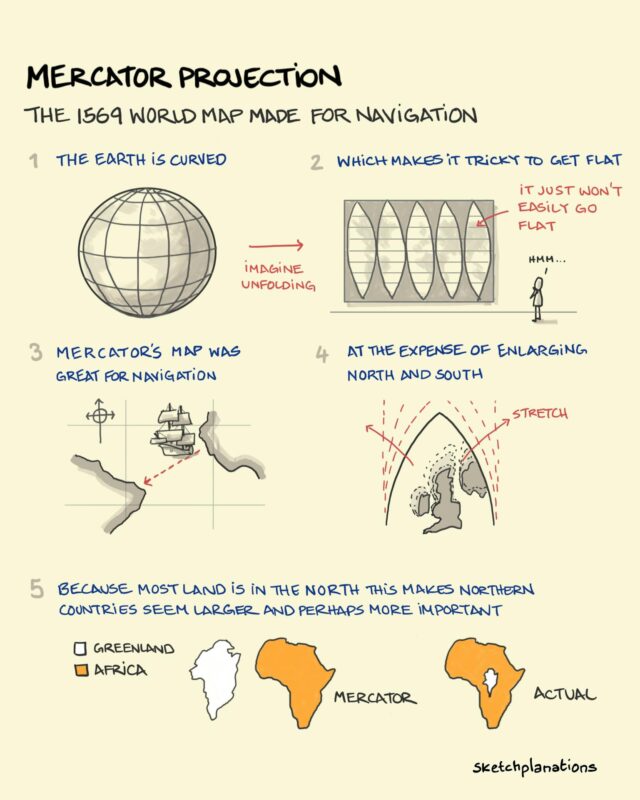
Greenland can consequently appear roughly comparable with Africa despite Africa being about 14 times larger.
Maimela cautioned against portraying Mercator itself as inherently wrong.
“We should be cautious about saying that every use of Mercator is inappropriate. The issue is whether a particular projection is suitable for the purpose for which it is being used.”
She said Mercator remained valuable when preserving direction and local angles was important. However, where pupils are comparing the relative sizes of continents and countries, an equal-area projection should preferably be used or displayed alongside other projections.
Maimela said she was willing to propose that the matter be considered through the committee’s normal programming process, stressing that programming decisions are taken collectively.
The department could then be asked to brief Members of Parliament (MPs) on existing learning materials, possible changes, costs and a realistic implementation timetable.
No rush to dump textbooks
Maimela also poured cold water on expectations that millions of textbooks could simply be discarded and replaced before the 2027 academic year.
“It would be premature to promise wholesale replacement of printed materials for 2027 before the Department has completed an audit and consulted provinces, publishers and subject specialists,” she said.
“Textbook revision, screening, procurement and distribution require lead time and public funds.”
She nevertheless warned that practical considerations should not become a reason to do nothing.
Lower-cost interventions during 2027 could include departmental guidance, digital resources, teacher support material and equal-area maps when schools acquire new displays or digital content.
Permanent changes could then coincide with scheduled textbook and curriculum revision cycles, reducing unnecessary expenditure and wastage.
READ: Mushonga to head decolonised studies
For Maimela, the argument ultimately concerns education rather than making Africa artificially larger.
“The objective is not to make Africa appear ‘bigger’; Africa does not need to be enlarged, it needs to be represented accurately.”
That may prove the most consequential lesson emerging from the UN vote: before South Africa changes the map on the classroom wall, Parliament wants to establish what children are looking at, what it teaches them and what correcting it will cost.
- South Africa may review the maps used in school textbooks following the UN General Assembly's adoption of the "Correct the Map" resolution encouraging equal-area map projections.
- The UN resolution was adopted on September 4 by a vote of 164 to 1, with six abstentions, aiming to address distortions in traditional maps like the Mercator projection.
- Joy Maimela, chairperson of the Portfolio Committee on Basic Education, said Parliament has not decided to replace existing maps and requires an audit of current map use and cost assessments first.
- The Mercator projection is still considered useful for navigation and preserving local angles, but equal-area projections are preferred for accurately comparing the sizes of continents and countries.
- Any changes to textbooks or curricula would be phased in gradually with departmental guidance, digital resources, and coincide with regular textbook revision cycles to avoid unnecessary expenditure.


