


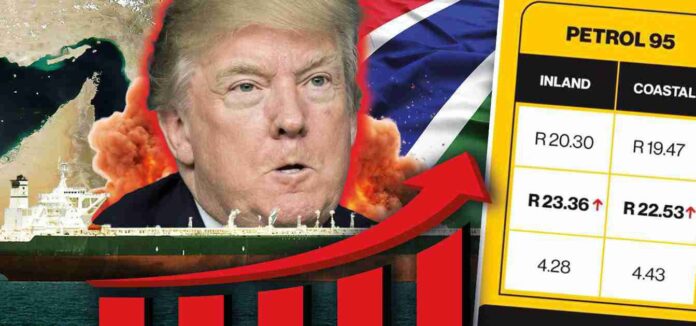
United States President Donald Trump has escalated tensions in the Middle East and South Africa is already feeling the fallout.
On Sunday, April 12, Trump ordered the US Navy to begin blockading the Strait of Hormuz, one of the world’s most critical oil routes. The move followed the collapse of high-stakes talks between Washington and Tehran, led by US Vice President JD Vance and Iranian Parliament Speaker Mohammed Bagher Ghalibaf.
The talks broke down over Iran’s nuclear programme, putting a fragile ceasefire in place since a US-Israel military campaign against Iran in February, on the brink of collapse.
Trump wasted no time making his stance clear. In a fiery social media post, he declared that US forces would stop any ships entering or leaving the strait, accusing Iran of “world extortion” and warning that any resistance would be met with overwhelming force.
Iran has rejected the blockade outright. The Islamic Revolutionary Guard Corps warned that any military presence near the waterway would face a strong response, raising fears of a direct confrontation.
The Strait of Hormuz carries about 20% of the world’s oil and gas. Any disruption sends shockwaves through global markets and that’s already happening.
Oil prices jumped to over $100 a barrel on Monday, with analysts warning they could climb far higher if tensions escalate.
For South Africa, that translates into immediate pain.
The rand weakened to R16.53 against the dollar, and economists are warning of another spike in fuel prices in May. With inflation already under pressure, the blockade could push living costs even higher for ordinary South Africans.
But the oil crisis is only half the story.
Trump’s latest move comes amid growing signs that his administration is tightening the screws on South Africa across multiple fronts.
Finance Minister Enoch Godongwana confirmed that neither he nor Reserve Bank Governor Lesetja Kganyago will attend the upcoming G20 finance meeting in Washington after the US failed to accredit them.
That effectively sidelines South Africa from key global economic discussions.
It’s part of a broader pattern:
• The US has imposed steep tariffs on South African goods
• A formal trade investigation into SA is underway
• Washington is backing efforts to remove SA from AGOA
• South Africa has been excluded from major global forums
Trump has also repeatedly pushed discredited claims about a white genocide in South Africa, further straining relations.
Analysts warn that the blockade could spiral into a wider conflict, potentially removing millions of barrels of oil from global supply.
At the same time, diplomatic efforts to cool tensions are underway. Oman’s Foreign Minister has called for restraint, while US lawmakers, including Senator Mark Warner have questioned the logic behind the blockade.
But for South Africa, the reality is already clear.
Trump’s aggressive foreign policy is creating a double crisis: rising global oil prices and increasing political and economic pressure on Pretoria.
And as both storms gather, it’s ordinary South Africans who are likely to feel the squeeze the most.
- President Trump ordered a US Navy blockade of the Strait of Hormuz after failed talks with Iran over its nuclear program, escalating Middle East tensions.
- The blockade threatens a critical oil route carrying 20% of global oil, causing oil prices to spike over $100 a barrel and economic ripple effects worldwide.
- South Africa faces immediate impacts: the rand weakened sharply, fuel prices are expected to rise in May, and inflation pressures may worsen living costs.
- Diplomatic tensions between the US and South Africa are growing, with South African officials excluded from key global economic forums and US trade actions targeting South Africa.
- Analysts warn the blockade risks escalating into broader conflict; meanwhile, diplomatic calls for restraint continue, but South Africa already confronts a dual crisis of economic pressure and rising oil costs.


