


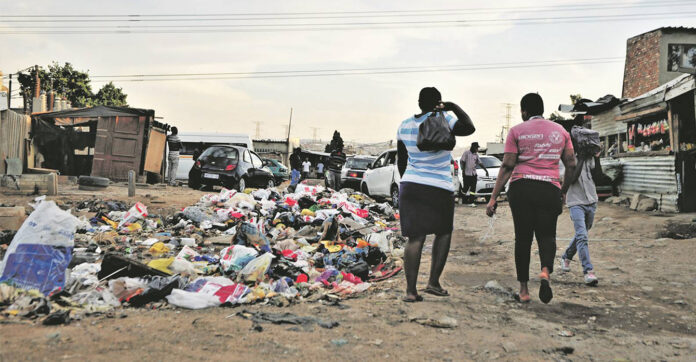
South Africa stands at a profound historical crossroads, facing imminent state failure. The collapse of basic municipal services and rise of a predatory, kleptocratic political elite have shattered the post-1994 constitutional promise of Batho Pele, People First.
From everyday services, such as accessing a driving licence or death certificate, to massive infrastructure procurement in state entities, a culture of bureaucratic privatisation of public funds has taken deep root with terrifying impunity.
Every public infrastructure project meant to uplift our communities, from water and sewer networks to roads, streetlights and waste collection, is ripped apart daily by a heartless pack of bribery vampires.
The state has conceded to extortion mafias and cartels whose networks include public representatives, municipal bureaucrats and gang lords. This proves a painful truth: our problem is not a lack of resources but the deliberate treatment of public funds as a means of parasitic personal enrichment.
At the same time, rampant political party entrepreneurship has fractured the unity of our communities. There are more political parties today in African communities than there were tribes or ethnic groups in 1912.
Contrary to what many mainstream pundits say, this is not the flourishing of a vibrant democracy. It is commercialised political party entrepreneurship that has little to do with genuinely representing the aspirations of our people.
Therefore, it is unsurprising that widespread voter apathy is not political laziness. It is often a dignified, conscious rejection of a broken and parasitic political strata. Voting is a noble and historic right but many people stay away because choosing between different versions of failure is no choice at all. It has become irresponsible to knowingly vote for political elites embedded in criminal cartels, fundamentally incompetent and without a sound plan for the future.
We cannot resist the label that we have become “beggar-voters”, perpetually petitioning a broken state run by visibly clueless elements. This has reproduced us as a waiting people, who wait as a permanent form of being. We can no longer wait for a political saviour to capture Parliament or councils while our communities crumble. We must cease to be passive clients of this failed bureaucracy and become active architects of our survival. This historical necessity has driven the birth of the Batho Pele Convention.
The BPC is not a traditional political party, corporate think-tank or toothless civic advocacy group. It is an active, rule-bound machinery engineered to construct a parallel system of service delivery, infrastructure maintenance and economic development directly at neighbourhood level. Our mission is rooted in the worldview of Ubuntu (I am because we are) and the practice of Siyazenzela (Do It Ourselves).
The point is not to romanticise abandonment by the state or excuse elected leaders from their duties. It is to refuse the politics of helplessness: communities must organise their capacity while continuing to confront, expose and replace those who have failed them.
The definitive battleground for this parallel governance revolution begins in our education system. Drawn directly from the directives of Thesis 7, the BPC introduces the Alumni League of Public Schools, ALPS.
Our public schools, once proud, militant incubators of black excellence and community resistance, are decaying structurally and academically under a paralysed bureaucracy. Broken windows, collapsed toilets and poor security are treated as minor line items by a detached state. We reject this structural violence against our children.
The ALPS bypasses bureaucratic state budgets by mobilising former pupils, working-class parents, artisans and professionals to take direct, permanent ownership of public schools.
Engineers, accountants and educators in alumni networks will pool their skills, tools and resources to handle infrastructure maintenance, structural upgrades, security and mentorship. By crowdsourcing our professional excellence, we remove public schools from the desert of state dependency and help guarantee safe, dignified learning environments.
Soweto holds the historic blueprint of student militancy and educational defiance. It is therefore fitting that the parallel machine of educational survival launches its foundational activation here.
We issue an urgent, non-partisan call to every professional, worker and citizen produced by Soweto’s public schools — your school needs your mind, skills and agency. Come and claim your place as an architect of our survival. The BPC invites you to the historic first Soweto Alumni League activation assembly on Saturday, October 10, 2026, at Regina Mundi Catholic Church in Moroka, starting strictly at noon.
Let us stop begging, South Africa. Let us start building. We are doing it ourselves. Siyazenzela!
• Ndlozi is the founder of the Batho Pele Convention
- South Africa is experiencing imminent state failure due to collapsing municipal services and widespread corruption by a kleptocratic political elite.
- Public funds meant for infrastructure projects are being extorted by mafias and cartels involving public representatives and gang lords.
- The Batho Pele Convention (BPC) aims to create a parallel system of service delivery and economic development at the neighborhood level based on Ubuntu and Siyazenzela principles.
- The BPC is launching the Alumni League of Public Schools (ALPS) to mobilize former pupils and professionals to directly maintain and improve public schools, bypassing dysfunctional state bureaucracy.
- The first Soweto Alumni League activation assembly will take place on October 10, 2026, at Regina Mundi Catholic Church to engage alumni in rebuilding schools and communities.


