


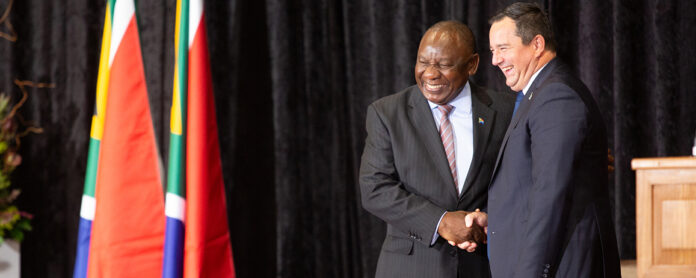
To understand what happened last Wednesday when the Democratic Alliance leader issued a statement that effectively reshuffled the Cabinet, it helps to begin not in Pretoria but in April, when Geordin Hill-Lewis defeated John Steenhuisen in the DA’s federal leadership contest, ending the Steenhuisen’s tenure as party leader.
What happened this week was the logical conclusion of the internal party result: through the unauthorised pen of Hill-Lewis, Steenhuisen was removed from the agriculture portfolio he had occupied as part of the government of national unity (GNU) arrangement
and demoted to deputy minister of trade, industry and competition, making way for Willie Aucamp as the new agriculture minister and David Maynier as minister of forestry, fisheries and the environment.
Three further deputy ministerial positions are set to change hands. Hill-Lewis framed all this as a careful assessment of performance and a demonstration of “Democratic Alliance values in action”.
What it demonstrates is something rather more familiar to South African political life: a new party leader settling internal scores and reorganising factional loyalties, then presenting the bill to the president of the Republic for signature.
The Cabinet is being used to finalise the party leadership contest and the president has been cast in the role of the human resources department for the DA’s internal transition.
One of the DA values in action, it also turns out, is replacing women with men. Alexandra Abrahams loses her position as deputy minister of trade, industry and competition to make way for the demoted Steenhuisen, Mimi Gondwe is removed as deputy minister of higher education and training to be replaced by Yusuf Cassim. He and Jack Bloom, both men, take up new deputy ministerial appointments.
The result of the exercise in DA accountability is a Cabinet that is whiter and more male than it was before Hill-Lewis picked up his pen.
If that is the DA’s difference in action, South Africans are entitled to ask exactly what is being demonstrated here.
What the DA’s statement also did not acknowledge was that the power to make the appointments belongs exclusively to the president of the Republic, that the president had not yet made a decision and that announcing a Cabinet reshuffle to the public before the head of state has applied his mind to anything is not accountability in action. It is the usurpation of a constitutional prerogative dressed in the language of good governance.
What makes this episode particularly remarkable is that even the GNU’s own Statement of Intent, signed by all parties to this arrangement, including the DA, explicitly recognises in clause 17 that while the president’s prerogative to appoint members of the executive is acknowledged, such appointments should be made in consultation with the leaders of the respective parties of the members considered for appointment. Consultation is a process of engagement that informs a decision.
It is not a process by which a party leader makes the decision, announces it publicly and then notifies the president by a letter. What occurred this week is notification to be followed by ratification. The distinction between the two sequences is the difference between a functioning constitutional presidency and a ceremonial one. The president, it seems, now reads about his own Cabinet in the same place the rest of us do.
Section 91(2) of the Constitution is clear: the president appoints the deputy president and ministers, assigns their powers and functions and may dismiss them. This is not a courtesy extended to coalition partners under a negotiated pact. It is an exclusive head-of-state competence vested by the supreme law of the Republic in a single office, and no political arrangement, however carefully worded in a statement of intent or a framework agreement, can lawfully transfer that competence to a party leader who has not taken the Oath of Office as Head of State. The Constitution does not provide for co-presidents. It does not recognise party headquarters as extensions of the executive authority. It knows only one appointing authority and that authority resides in the Union Buildings, not in the federal council of any political party.
What Section 91 contemplates is a Cabinet: a coherent instrument of executive government, composed by the president on the basis of rational deliberation, accountable collectively and individually to Parliament and oriented toward a shared national programme. What we have witnessed this week suggests that we now have a constituency-representative system or, at worst, a bring-and-share Cabinet, in which portfolios are dished out by party headquarters and the president is left to administer the seating arrangement.
You bring what you have, you share it around and nobody stops to ask whether the combination makes nutritional sense for the country.
The DA’s GNU pact does entitle the party to nominate which of its members occupy the portfolios allocated to it. That entitlement is not in dispute. What is constitutionally incongruous is the manner in which this week’s changes were announced: publicly, as a directive, before the president had applied his mind to anything. The proper sequence is clear and admits of no ambiguity. A party submits a request. The president exercises his constitutional discretion, weighing variables including demographic balance, the substantive value each individual brings to a portfolio and the impact of any change on the government’s programme of action and on institutional continuity.
That discretion is not ceremonial but the very mechanism by which the Constitution ensures rational, accountable executive governance. Reducing it to a rubber-stamping exercise is not a procedural quibble but a constitutional deformation.
When a party leader can announce a Cabinet reshuffle, he has effectively assumed the function of a co-president. Whether one calls this a forced reshuffle, in the manner of a vis major (act of God) that the president is simply made to execute, the practical effect is the same: the president’s authority over the composition of his own executive is eroded each time it happens, regardless of whatever courteous language accompanies the letter. There is something almost inelegant in the constitutional impropriety of it all. A party leader can deploy the national executive to settle a leadership contest, reduce women’s representation in Cabinet without a word of explanation, claim the political credit for accountability and high standards and then walk away from any responsibility for the institutional disruption that follows, since it is the president, not the party leader, who answers to Parliament and to the country for the coherence and performance of Cabinet. That is power exercised without the accountability the Constitution insists must accompany it.
I need to add that a study I recently completed, drawing on 25 years of South African data and corroborated through interviews with 24 senior officials and advisers, found that leadership instability in the executive produces two distinct and statistically significant categories of harm: an immediate negative shock to institutional performance at the point of disruption and a persistent deterioration in the trajectory of outcomes thereafter.
The damage does not resolve when a new minister settles into a portfolio. It compounds because ministerial churn triggers cascading changes within departmental technical leadership, eroding the institutional memory and cumulative knowledge that effective governance requires. A Cabinet change to resolve a party leadership transition, rather than to serve a national governance objective, becomes a measurable drag on the state’s capacity to deliver, and the empirical record on this point is unambiguous.
- Ngcaweni is director of the Centre for Public Policy and African Studies at the University of Johannesburg.
- To understand what happened last Wednesday when the Democratic Alliance leader issued a statement that effectively reshuffled the Cabinet, it helps to begin not in Pretoria but in April, when Geordin Hill-Lewis defeated John Steenhuisen in the DA’s federal leadership contest, ending the Steenhuisen’s tenure as party leader.
- What happened this week was the logical conclusion of the internal party result: through the unauthorised pen of Hill-Lewis, Steenhuisen was removed from the agriculture portfolio he had occupied as part of the government of national unity (GNU) arrangement and demoted to deputy minister of trade, industry and competition, making way for Willie Aucamp as the new agriculture minister and David Maynier as minister of forestry, fisheries and the environment.
- Three further deputy ministerial positions are set to change hands.
- Hill-Lewis framed all this as a careful assessment of performance and a demonstration of “Democratic Alliance values in action”.
- What it demonstrates is something rather more familiar to South African political life: a new party leader settling internal scores and reorganising factional loyalties, then presenting the bill to the president of the Republic for signature.


