


South Africa’s debate about migration, informality and criminality is often reduced to a question of who must stay and who must leave. That is too narrow. The deeper issue is that systems of control have fallen away faster than systems of accountability have been built.
To understand the present moment, we must remember the journey South Africa has travelled: from a country that managed African labour through coercion, to a constitutional democracy that carries a duty to promote dignity, lawful mobility and continental cooperation.
The old migrant labour system that fed South Africa’s mines was tightly organised. Recruitment, movement and settlement were controlled through institutions such as Wenela to serve a narrow economic purpose.
It was unjust and coercive. Yet it was also institutionally coherent. Democracy rightly dismantled the architecture.
In its place, South Africa embraced rights, openness and the promise of human dignity. It also became a regional economic anchor and a continental symbol of opportunity.
But while the old system was dismantled quickly, the new framework of accountability has grown too slowly.
The gap is visible in several places:
• Migration systems remain uneven and slow.
• Labour laws are not enforced consistently.
• Informal economies often operate beyond clear rules and protection.
The result is pressure without enough capacity to
manage it well. When governance is uneven, the public begins to join together matters that should remain distinct.
Migration is labour mobility and human movement. Informality is often an economic response to exclusion. Criminality is a matter for lawful enforcement. Confusing the three weakens public trust, exposes migrants to danger and makes enforcement less credible.
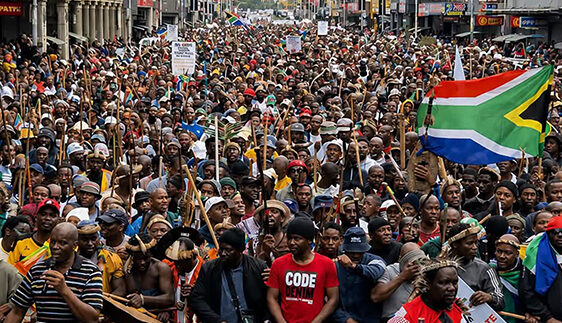
The confusion appears in public language and political slogans such as Abahambe (they must leave), which should not be dismissed as mere noise. They are warnings that communities feel unheard and that the state is not seen to be acting with sufficient speed or clarity.
Citizens compete for work, housing and services. Migrants experience vulnerability and fear. The state is judged by both and too often it is found wanting. In moments of weak governance, such sentiments can become contested political and social spaces. Legitimate grievances can be appropriated by actors with nefarious interests.
South Africa is therefore operating in a difficult narrative environment.
The dynamics do not stop at the border. South Africa must manage domestic pressures in a way that protects regional trust and keeps faith with its African commitments.
The starting point is to recognise that the country is part of a wider African system of movement.
Migration into South Africa is regional and continental, and South Africa is one of Africa’s convergence points. Yet many responses remain national in design, fragmented in the region and weakly aligned with the continental vision of integration.
The answer is not to return to past systems of control. It is to build stronger systems of accountability, which means a state that knows who enters, works, employs, exploits and breaks the law. It also means enforcement that is firm, lawful and clearly separated from prejudice.
The priorities are practical, and include modern migration systems, clean administration, fair labour enforcement and stronger regional cooperation.
South Africa’s domestic response must therefore be consistent with its foreign policy duty to advance the African Agenda, deepen regional cooperation and support lawful and humane integration.
• Ambassador Mashaba, director for Southern Africa at Dirco, writes in her personal capacity.
- South Africa’s migration debate is overly simplified as a matter of who should stay or leave, overlooking deeper issues of weakened control systems and slow accountability development.
- The country transitioned from a coercive migrant labor system to a constitutional democracy promoting dignity, lawful mobility, and regional cooperation, but new accountability frameworks lag behind.
- Challenges include uneven migration systems, inconsistent labor law enforcement, and informal economies operating outside clear regulation, causing public confusion between migration, informality, and criminality.
- Public frustration and political rhetoric reflect perceptions of government inaction, creating social tension where legitimate concerns risk exploitation by harmful actors.
- South Africa must strengthen modern migration management, fair labor enforcement, and regional cooperation aligned with its African commitments, rather than reverting to past coercive systems.


