


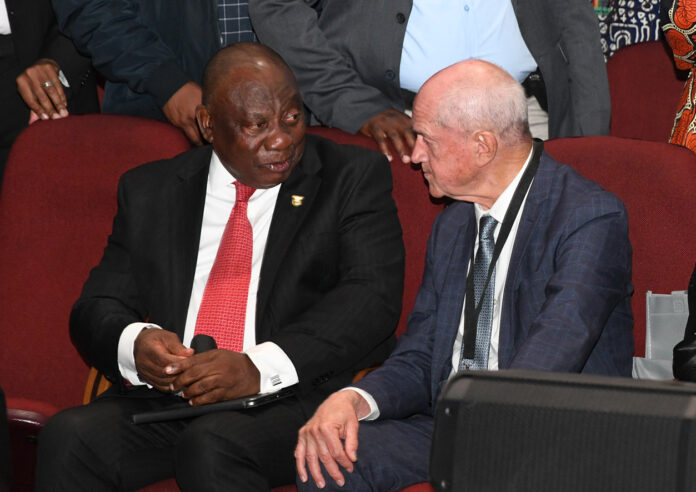
Yet again, South Africa and the US are engaged in that old friend or foe game of international relations chess.
The appointment of Roelf Meyer as our ambassador to the US has expectedly raised eyebrows in Mzansi. Is this a safe bet? Why are we capitulating to Donald Trump and Marco Rubio? Seriously, an apartheid-era politician?
These were just some of the sentiments expressed by many throughout the country as the announcement came. These are genuine concerns since our relationship with the US remains in tatters. But who is Roelf Meyer, and why did the president choose him for this daunting task?
Meyer served in the cabinet of FW de Klerk as defence minister in the early 1990s. He was one of the strategic thinkers that was foisted by the National Party to the forefront to take the lead in negotiating our transition to democracy.
He did this side by side with President Cyril Ramaphosa, who represented the anti-apartheid forces in that equation.
The two became good friends and have remained such to this day. It is therefore no wonder that Ramaphosa decided to call in his trusted friend, take him into confidence and ask him to please accept this daunting task.
As Sipho Ngwema stated on Facebook: “First and foremost, let’s not pretend the current posture of the Trump administration towards South Africa is warm or predictable. It’s anything but. It’s layered, transactional, and at times openly hostile.” So what do you do then?
Some sentiment says you don’t send someone noisy. You don’t jump onto your ideological bandwagon. You send someone who knows how to sit across the table from a hard-line position and still find a deal. Some will argue, and I am one of them, that Meyer is that person.
In chess, you don’t move pieces based on sentiment. You move them based on the board in front of you. And for months the board shows that our diplomatic relations have been on the rocks. We supposedly sold arms to Russia, according to the Americans, which was proven to be false.
The majority party’s policies are very far left, bordering on socialist. We play footsie with Iran, Russia, and China through naval exercises. We are in an alliance called Brics, which threatens de-dollarisation, and we recently took the US’s closest ally, Israel, to the International Court of Justice on the charge of genocide against the Palestinians.
Now, we tried on two occasions to supply worthy candidates for the position of ambassador, but alas, the US just wasn’t biting. And because this is the largest economy in the world and in no small measure still the hegemonic power, we simply must have diplomatic relations.
So, you start thinking out of the box. This one? Feels like a calculated play.
Meyer is a big boy, and he understands why the president had to call on him for this task. One last time to yet again make a profound contribution and take our country forward. Just like the good old days of dismantling apartheid.
Needless to say, the first hurdle will be acceptance by Rubio, the secretary of state and then Trump. If that happens, then our ambassador can begin to tackle the complex matters of trade and industry and bat down that elusive bilateral trade agreement. Making sure we remain in the Agoa agreement going forward and then the softer issues of cultural exchanges and tourism.
I fear that if Trump rejects Meyer because of the issues above and demands that South Africa first and foremost demonstrate goodwill and relent on some of the concerns raised by the Trump administration, it will be the clearest sign that Washington is not interested in having any diplomatic relations with Pretoria.
In this scenario, I fear we will be left with no option but to request that the US ambassador to South Africa, Leo Brent Bozell III must also leave and go back home. I fear a stand-off between us and the Trump administration.
Let us all hope we don’t get there.
- Dr Van Heerden is a senior research fellow at the Centre for African Diplomacy and Leadership at UJ.
Visit SW YouTube Channel for our video content
- South Africa has appointed Roelf Meyer, a former apartheid-era politician and strategic negotiator during the transition to democracy, as ambassador to the US, sparking controversy and concern domestically.
- President Cyril Ramaphosa chose Meyer due to their longstanding friendship and Meyer's ability to engage pragmatically with difficult counterparts, especially given the current strained US-South Africa relations.
- The relationship with the US is tense, impacted by South Africa's alleged arms sales to Russia (denied), left-leaning policies, ties with Iran, Russia, China, and BRICS participation, as well as legal actions against Israel.
- Previous South African ambassador candidates were rejected by the US, making Meyer a calculated diplomatic choice to potentially salvage relations and address trade, bilateral agreements, and cultural exchange issues.
- Acceptance of Meyer by US officials like Marco Rubio and Donald Trump remains uncertain; rejection could lead to a diplomatic standoff including expulsion of the US ambassador from South Africa.


