


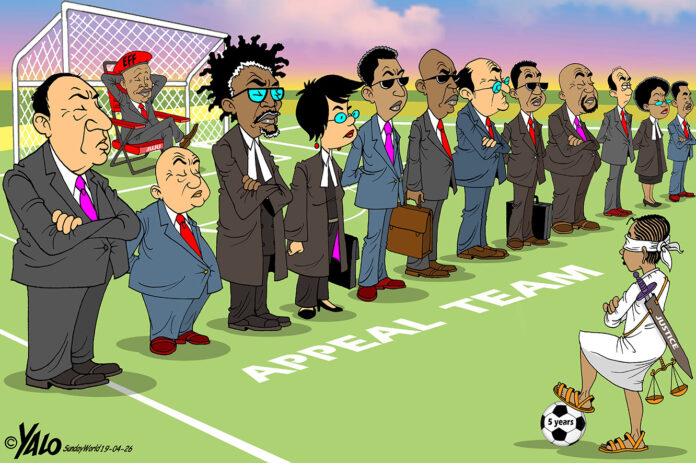
In the theatre of South African politics, Julius Malema has fashioned himself the revolutionary, the voice of the poverty-stricken masses against a governance and economic system he deems irredeemably unjust.
His sentencing to five years in prison for firing an assault rifle at an EFF rally in 2018 could derail his revolutionary advance towards the socialist utopia he has spent almost two decades constructing. But while the conviction and sentence initially appear to wound the EFF leader; the legal logic suggests the latter is unlikely to survive appellate scrutiny.
On its surface, the ruling by the KuGompo (East London) Regional Court should be celebrated as a stern defence of the rule of law. The state argued for the maximum 15-year term, underscoring that firing a semi-automatic weapon into a crowd – even in “celebration” – constitutes reckless endangerment.
Magistrate Twanet Olivier agreed. By finding Malema guilty and condemning him to a custodial sentence, she reinforced the sacred principle that no one is above the law. However, to view this solely as a matter of public safety is to ignore the glaring inconsistencies the case and the unique profile of the accused.
The magistrate may have inadvertently re-energised the EFF’s support base. Malema has already framed the judgment as a conspiracy of “white supremacy” and a plot to silence a revolutionary voice. He is shifting the narrative from criminality to persecution.
Malema’s political frenemy, Jacob Zuma, successfully exploited the political persecution argument to engineer a spectacular rise to ANC presidency in 2007, and the Union Buildings two years later; beating rape charges in the process and deferring corruption charges while at it. They were only reinstated in March 2018, a month after his resignation from office.
But does Malema stand a good chance of having this sentence overturned or reduced to a fine? Legal precedence and sentencing guidelines offer a roadmap towards a lesser penalty. He was convicted of five offences, including unlawful possession of a firearm and ammunition, and for discharging the weapon in public. On the charge of unlawful possession of a firearm, the Firearms Control Act of 2000 stipulates a maximum penalty of 15 years behind bars. The latter charge of discharging a firearm in public carries a maximum five-year sentence. However, the act does not prescribe the maximum sentence for both offences, placing this discretion at the hands of the court.
South African courts have in the past shown a marked preference for fines or suspended sentences over incarceration in cases where unlawful possession of a firearm, and even discharge, did not lead to harm as is the case with Malema.
The sentence seems too harsh and will likely be overturned on appeal. This process could take months, if not years, especially if the matter subsequently ends up before the Supreme Court of Appeal.
Lobby group AfriForum, which laid the original charges, may believe the sentence to be the death warrant for Malema’s political career. They are wrong.
By sentencing him to five years in jail, the court may have handed the EFF leader one generous campaign slogan.
Visit SW YouTube Channel for our video content
- Julius Malema was sentenced to five years in prison for firing an assault rifle at an EFF rally in 2018, a ruling seen as a defense of the rule of law by the magistrate.
- The sentence may not stand on appeal due to legal precedents favoring fines or suspended sentences for similar firearm offenses without harm.
- Malema portrays the conviction as politically motivated persecution and a conspiracy of "white supremacy," potentially rallying his support base.
- His political rival Jacob Zuma’s past experience shows that claims of political persecution can be effective in sustaining a political career despite legal challenges.
- The five-year prison sentence could backfire on prosecutors by providing Malema with a powerful campaign narrative, prolonging legal battles possibly up to the Supreme Court of Appeal.


