


Let us state from the onset that as a paper we hold no brief for President Cyril Ramaphosa.
He first took office in February 2018, hoisted upon the nation as this great reformer who would undo almost a decade of the capture of state institutions and the erosion of governance, and reverse loss of the country’s international stature under his predecessor Jacob Zuma.
Ramaphosa himself described the rot under Zuma as “nine wasted years”. Never mind that he served as deputy for five of those “wasted” years.
We were told that because he made a fortune in business after leaving politics in the mid-to-late 90s, he would be incorruptible and lead a clean administration.
Ramaphosa, the enigma, was a path to the deliverance we had prayed for after a dark period of selfish and kleptocratic rule; we were told.
The country drank the Kool-Aid, the markets reacted favourably, the international community believed; the ratings agencies stabilised our credit score; and the economy seemed poised for growth.
The new leader gave resounding speeches and said the right things. “Thuma Mina” (send me), he implored even the incredulous amongst us at his first State of the Nation Address.
Eskom would be fixed and loadshedding ended. The rail network would be revitalised, and rail and ports entity, Transnet – almost crippled under state capture – brought back to life. The government would invest trillions of rands in infrastructure and reduce the red tape strangling SMEs so they could be drivers of job creation. The public service would be reformed and staffed by capable people.
Success on implementation has been mixed, but the prevailing view is that Ramaphosa has largely failed to drive his own reforms, which in turn has led to economic growth stagnation. He has also been slow to act against poorly performing or misbehaving political allies.
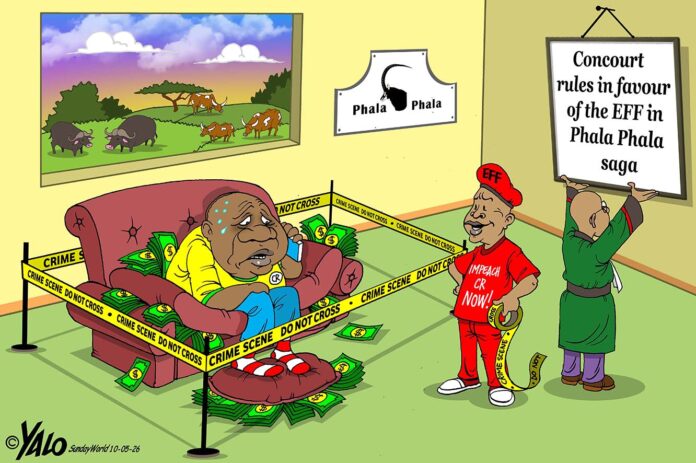
However, it’s not his dismal performance in government that has left him on the brink, but a scandal involving the theft of US dollars from his private farm, Phala Phala. The circumstances under which he came into this money, attempts to cover up the theft, and the involvement of senior officials in investigating this messy saga has now seen him become the first president post-democracy to face an impeachment inquiry by Parliament.
Mr Clean has been muddied.
The Constitutional Court on Friday threw out a National Assembly vote in 2022 which rejected a Section 89 Panel report that found the president had a case to answer. When that report first surfaced, Ramaphosa’s initial inclination was to resign, but his political protectors closed ranks and used the ANC’s majority to shield him from accountability. That majority is now gone. Whatever his next move, it must be stated that the Concourt has not found the president guilty of a criminal act. That will be left to the impeachment committee to establish; and a final verdict could take months, if not years, to be delivered.
However way this sorry affair ends; the mask is now off. Ramaphosa had long lost the invincibility that first brought him to power; but now he’s fast turning into a liability. He stands at the precipice, and the Phala Phala nightmare could ultimately define his legacy.
- President Cyril Ramaphosa was initially hailed as a reformer set to reverse the damage done during Jacob Zuma's presidency but has largely failed to drive significant reforms.
- Key promises included fixing Eskom, revitalizing rail and port infrastructure, boosting the economy through SME support, and reforming public services, but success has been mixed and economic growth has stagnated.
- His reputation has been severely damaged by a scandal involving the theft of US dollars from his private farm, Phala Phala, and alleged cover-up attempts, leading to South Africa's first post-democracy presidential impeachment inquiry.
- The Constitutional Court overturned a National Assembly vote that previously blocked investigation into the allegations, removing parliamentary protection and putting Ramaphosa in a precarious political position.
- Despite not being found guilty criminally yet, the scandal threatens to define Ramaphosa’s legacy and has transformed him from a symbol of hope to a political liability.


