


On a warm October morning of 2021, four brothers, the youngest six years old, were on their way to school in Polokwane when armed men shattered the windows of their BMW with R5 rifles, forced them into a getaway vehicle and abducted them. The Moti family endured three weeks of nail-biting, sleep-depriving, weight-loss-accelerating negotiations before their sons came home. The country recoiled. Then we moved on.
But the Moti brothers were not an outlier. They were a preview.
What happened in June 2024? A hard-working, law-abiding small business owner stepped outside his trading premises in Florida, Johannesburg, and vanished! Like a politician after the voting is done. Poof. Gone. He was taken.
For days, his family lived the same suffocating terror the Moti family had. When the police finally breached a house in Snake Park to rescue him, they found a dark reality. Locals were working with undocumented foreign nationals to perpetrate these kidnappings.
The South African Police Service logged over 17 000 kidnappings in 2024. That’s fifty-one people taken every day in South Africa. That’s a 264% rise in a decade. Most cases trace back to syndicates whose foot soldiers slip in and out through borders we do not police documents we cannot verify.
This is not a column about kidnappings. It’s a column about a country that has allowed this level of crime to go on. When criminals fear the law, they steal money. Easy to move. Easy to spend. When criminals don’t fear the law, they steal buildings. Immovable, but they can bribe law enforcement. Whether it’s money or a building, it’s stealing from a person.
When criminals run the system, they steal the actual people.
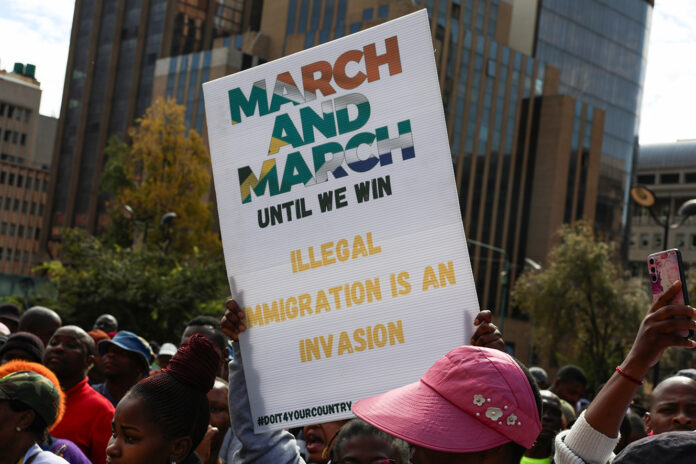
Long before the so-called xenophobic attacks of recent weeks, before the marches at Helen Joseph, before the spaza shop unrest from Soweto to KwaMashu, this country had a fever. South Africans had been asking why the state did not know who was here, how they had entered the country, and why the consequences kept landing at citizens’ doorsteps. Overrun public infrastructure is felt most by the poor, who rely on it. So let me say the unpopular thing. The problem in South Africa is not xenophobia. The problem is immigration management.
Ask the spaza owner whose till is no longer his. Ask the truck driver whose route now requires a brown envelope. Ask the township family who paid protection to a syndicate the police could not name. They are not xenophobes. They are citizens reaching for their government to protect them. And we see the Madlanga commission daily broadcast the police’s failure to police.
Three institutions have failed. The first is the Border Management Authority. If you do not have borders, you do not have a country. It does not matter that you have a flag, a head of state, a Constitutional Court, and a currency. A country whose perimeter leaks is a hotel without a front desk.
Second, the Department of Home Affairs. Remember Samantha Lewthwaite? The infamous “White Widow”. A British national and terrorist who exploited our system and got her hands on fraudulent South African papers. She was found to have paid R20 000 to a Durban fixer for a South African passport in another woman’s name.
She lived in Johannesburg, worked in Lenasia, and crossed our borders for years. She didn’t just hide in Johannesburg; she used a South African passport to evade global intelligence and facilitate terror operations.
When I first started travelling to the UK on business, South Africans didn’t need visas. Today, we do. Why? Because the global community saw our immigration system for what it is: compromised. Our passports became cheap commodities for syndicates and terrorists. Today, intelligence reports confirm that home affairs is an open marketplace. Documentation is bought and sold to the highest bidder. This destroys our national security and betrays our people.
Politicians may disagree about how a country should be run. But they surely must agree that the nation should be protected. When ordinary people stand up and say, “South Africans first”, they are not saying “South Africans only”. It is not a xenophobic slur. It’s a statement of basic fact: The primary duty of any nation-state is to care for its own citizens first.
Chaos thrives where leadership is absent. It would be easy to label what we are seeing in the streets as a simple crisis of xenophobia. But the truth is more complex than that. It is the violent consequence of an absent state.
If you erected a billboard above the political headquarters of South Africa today and it bore the seal of the Republic, it would read, quite simply: House to Let.
- Thembekwayo is a businessman and motivational speaker
- In June 2024, South Africa experienced a surge in kidnappings, with over 17,000 cases logged, reflecting a 264% increase over a decade and involving local and undocumented foreign nationals in criminal syndicates.
- The article argues that South Africa’s core problem is not xenophobia but poor immigration management and ineffective policing of borders and documentation.
- Three key institutions have failed: the Border Management Authority, Department of Home Affairs, and the South African Police Service, allowing criminals to exploit porous borders and corrupt the system.
- The compromised immigration system has allowed serious security threats, including terrorists obtaining fraudulent South African documents, damaging national security and international trust.
- The author emphasizes the need for the state to prioritize protecting its citizens, stating that the current lawlessness and chaos stem from a lack of leadership and a dysfunctional immigration and security framework.


